


AT A GLANCE
- Postoperative retinal displacement is a common and unwanted outcome following RRD repair.
- The authors’ study found that assessment of retinal displacement using a novel homography-based overlay method was superior to fundus autofluorescence imaging.
- Treatment modifications and varied surgical techniques can influence and reduce postoperative retinal displacement, leading to better anatomical and functional outcomes.
There has been recent interest in improving the integrity of anatomic outcomes following rhegmatogenous retinal detachment (RRD) repair to optimize postoperative functional outcomes. This is of critical importance because a substantial proportion of patients with an RRD complain of postoperative aniseikonia and metamorphopsia with current surgical repair techniques.1-4
Postoperative retinal displacement, also known as a low-integrity retinal attachment (LIRA), is a common and unwanted outcome following RRD repair. One post-hoc study found that 75% of patients had subjective distortion 2 months following macula-off RRD repair.4 There is increasing evidence that modifications to our treatment paradigms and variations in surgical technique can influence both the incidence and the extent of postoperative retinal displacement, leading to better anatomical and functional outcomes.5-9 For example, research suggests that pars plana vitrectomy (PPV) is associated with a higher risk of LIRA compared with pneumatic retinopexy.5,10 Studies have found that LIRA is associated with greater risk of postoperative metamorphopsia and aniseikonia.4,5,10 Moreover, an association was found between the amplitude of retinal displacement and some of these outcomes.4
Finding ways to minimize LIRA may lower the incidence and severity of postoperative visual distortion.
DISPLACEMENT ORIGINS
Retinal displacement was first detected and described by Shiragami et al in 2010 using fundus autofluorescence (FAF) imaging.11 The researchers identified hyperautofluorescent lines that were adjacent to and followed the contour of retinal vessels. They hypothesized that these retinal vessel printings (RVPs) were hyperautofluorecent because retinal displacement had uncovered retinal pigment epithelium (RPE) cells that were previously naive to light.12 This likely results in a different composition of fluorophores or differences in metabolic activity that lead to increased autofluorescence on FAF.11-13
IMAGING UPDATES
Currently, FAF imaging is the only method to detect postoperative retinal displacement, although grading FAF images for LIRA can be challenging. For example, in some patients, the displacement is less than a full vessel width or there are other abnormal RPE cells in the same vicinity. In other situations, there may be RPE atrophy, high myopia, or generally reduced image quality preventing the detection of RVPs. In addition, RVPs on FAF imaging are almost exclusively detected along major arcades and are often not visible adjacent to smaller retinal blood vessels, such as those in the macular region, where displacement is most relevant.
To assess the true extent of retinal displacement, clinicians must evaluate the location of retinal blood vessels before the occurrence of the RRD and compare this to the location of the retinal vessels postoperatively. Such a study is only possible if pre-RRD imaging is available.
Our group encountered one patient with available ultra-widefield imaging before the occurrence of an RRD. Using a novel overlay technique with ultra-widefield FAF, we found that the RVPs corresponded to the location of retinal vessels before the RRD (Figure 1)—proving Shirigami’s hypothesis.14 What was most surprising was that the retinal displacement was much more extensive than what was seen when only assessing the RVPs on FAF.
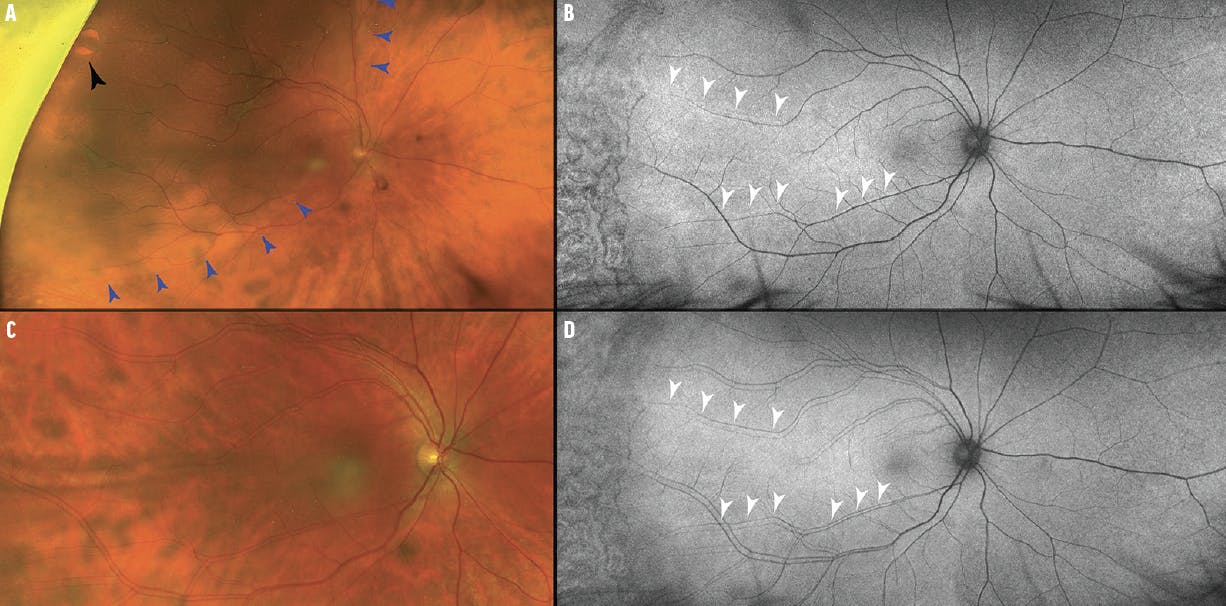
Figure 1. This patient presented with a superotemporal macula-off RRD and was treated with vitrectomy (A). Postoperative FAF demonstrated fine RVPs adjacent to both the superior and inferior arcades (B, arrows). Overlay of ultra-widefield retina images (C) and FAF (D) show that the RVPs correspond to the location of pre-RRD blood vessels.
Therefore, we retrospectively reviewed RRD patients to find cases where we had imaging before an RRD. We used the infrared en face spectral-domain (SD) OCT imaging of the macula before the occurrence of RRD to assess postoperative LIRA using the overlay technique.
To perform the overlay, at least four corresponding landmarks of the optic nerve head (ONH)/RPE/choroid were manually selected on both pre- and post-RRD infrared SD-OCT imaging (Video). An ONH marking was mandatory and combined with, ideally, one mark in each quadrant on RPE or choroidal landmarks. A computer code for homography was used to perform the overlay based on the provided markings. Red and green color channels were used to allow for better visualization of the retinal vessels pre- and post-RRD repair, respectively (Figure 2).
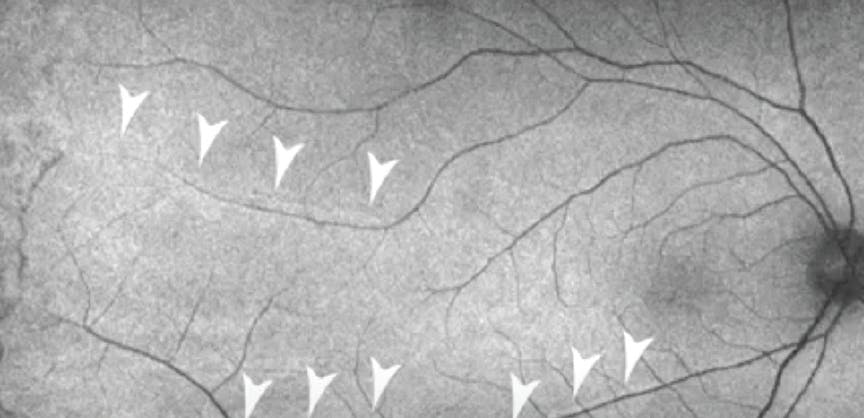
Video. Retinal Displacement on FAF Imaging: The Tip of the Iceberg
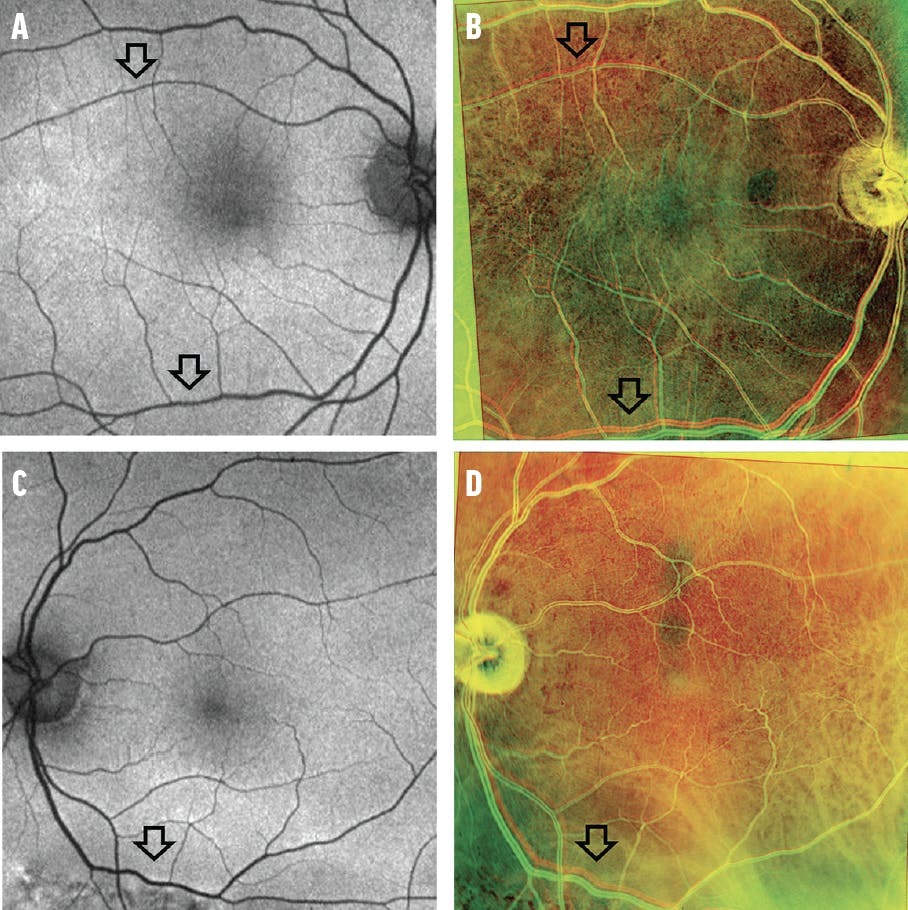
Figure 2. Two eyes where FAF imaging following vitrectomy for RRD repair showed no evidence of retinal displacement (A, C; arrows). However, OCT overlays demonstrated obvious inferior displacement (B, D; arrows).
To validate this novel approach, we performed the technique in eight contralateral normal eyes and another 12 healthy eyes with no displacement. We also confirmed stationary ONH, RPE, and choroidal vessel landmarks using the “flipping mode,” which consisted of rapid visualization between aligned pre- and post-RRD repair infrared SD-OCT images to confirm that the landmarks were fixed.
We found 16 eyes of 15 patients that were eligible for the study. All patients underwent PPV for RRD repair except one, who had pneumatic retinopexy. Two independent and masked graders assessed both the overlays and FAFs for retinal displacement; 46.6% of FAFs were found to be positive for retinal displacement compared with 100% of the overlays after PPV.
The mean number of displaced macular vessels detected by FAF and overlay techniques were 1.0 ± 0.8 and 2.6 ± 0.9, respectively (P = .001). In 93.3% (14/15) of cases, the infrared overlay images revealed a greater number of major arcade vessels displaced than the FAF images. Additionally, the infrared overlay demonstrated more definitive displacement, graded as obvious in 53.3% (8/15) of images, whereas RVPs on FAF were never graded as obvious (0/7).
Our results demonstrated that FAF underestimates the presence and extent of LIRA, which may explain the variability in displacement rates among previous studies.5,13,15-18 Our data suggest that FAF images should be very carefully assessed for the presence of retinal displacement, as there is a high risk of false negatives.
A major limitation of the overlay technique is that pre-RRD imaging is needed to produce the homography. The small number of patients in our cohort, and the fact that this was a novel technique with the possibility of small errors in the manual markings, are also limitations.
KEY TAKEAWAYS
RRD repair has undergone a significant shift in the last few decades toward PPV. However, research suggests that functional and structural outcomes may be better with alternative techniques. It is important that we continuously evaluate our RRD repair techniques to maximize the integrity of retinal attachment and functional outcomes.
Our findings demonstrate that assessment of retinal displacement using a novel homography-based overlay method was superior to FAF imaging, which can miss or underestimate the true extent of LIRA. FAF has limited sensitivity and is likely showing only the tip of the iceberg when it comes to retinal displacement. Further research is needed to reveal what lies beneath the water and detect the true extent of retinal displacement after RRD repair.
1. Okuda T, Higashide T, Sugiyama K. Metamorphopsia and outer retinal morphologic changes after successful vitrectomy surgery for macula-off rhegmatogenous retinal detachment. Retina. 2018;38(1):148-154.
2. Okamoto F, Sugiura Y, Okamoto Y, Hiraoka T, Oshika T. Metamorphopsia and optical coherence tomography findings after rhegmatogenous retinal detachment surgery. Am J Ophthalmol. 2014;157(1):214-220.
3. Lina G, Xuemin Q, Qinmei W, Lijun S. Vision-related quality of life, metamorphopsia, and stereopsis after successful surgery for rhegmatogenous retinal detachment. Eye. 2016;30(1):40-45.
4. Casswell EJ, Yorston D, Lee E, Charteris DG. Distortion resolution after vitrectomy for macula-involving retinal detachment repair: post hoc analysis of the PostRD trial. Retina. 2022;42(12):2315-2320.
5. Brosh K, Francisconi CLM, Qian J, et al. Retinal displacement following pneumatic retinopexy vs pars plana vitrectomy for rhegmatogenous retinal detachment. JAMA Ophthalmol. 2020;138(6):652.
6. Hillier RJ, Felfeli T, Berger AR, et al. The pneumatic retinopexy versus vitrectomy for the management of primary rhegmatogenous retinal detachment outcomes randomized trial (PIVOT). Ophthalmology. 2019;126(4):531-539.
7. Muni RH, Felfeli T, Figueiredo N, Marafon SB, Escaf LC, Juncal VR. Minimal gas vitrectomy technique for reducing risk of retinal displacement following rhegmatogenous retinal detachment repair. Retin Cases Brief Rep. 2022;16(6):681-684.
8. Muni RH, Felfeli T, Sadda SR, et al. Postoperative photoreceptor integrity following pneumatic retinopexy vs pars plana vitrectomy for retinal detachment repair. JAMA Ophthalmol. 2021;139(6):620-627.
9. Bhambra N, Francisconi CLM, Marafon SB, et al. A novel method of quantifying retinal displacement using ultra-widefield fundus autofluorescence imaging. Am J Ophthalmol. 2022;244:1-10.
10. Francisconi CLM, Marafon SB, Figueiredo NA, et al. Retinal displacement after pneumatic retinopexy versus vitrectomy for rhegmatogenous retinal detachment (ALIGN). Ophthalmology. 2022;129(4):458-461.
11. Shiragami C, Shiraga F, Yamaji H, et al. Unintentional displacement of the retina after standard vitrectomy for rhegmatogenous retinal detachment. Ophthalmology. 2010;117(1):86-92.e1.
12. Dell’Omo R, Mura M, Lesnik Oberstein SY, Bijl H, Tan HS. Early simultaneous fundus autofluorescence and optical coherence tomography features after pars plana vitrectomy for primary rhegmatogenous retinal detachment. Retina. 2012;32(4):719-728.
13. Lee E, Williamson TH, Hysi P, et al. Macular displacement following rhegmatogenous retinal detachment repair. Br J Ophthalmol. 2013;97(10):1297-1302.
14. Brosh K, Roditi E, Muni RH. Retinal vessel printings on fundus autofluorescence imaging represent retinal displacement: proof of prior hypothesis. Am J Ophthalmol. 2022;238:e3-e4.
15. Casswell EJ, Yorston D, Lee E, et al. Effect of face-down positioning vs support-the-break positioning after macula-involving retinal detachment repair: The PostRD randomized clinical trial. JAMA Ophthalmol. 2020;138(6):634-642.
16. Casswell EJ, Heeren TFC, Lee E, Khabra K, Yorston D, Charteris DG. Postretinal detachment retinal displacement: how best to detect it? Ophthalmologica. 2020;243(4):280-287.
17. Shiragami C, Fukuda K, Yamaji H, Morita M, Shiraga F. A method to decrease the frequency of unintentional slippage after vitrectomy for rhegmatogenous retinal detachment. Retina. 2015;35(4):758-763.
18. dell’Omo R, Scupola A, Viggiano D, et al. Incidence and factors influencing retinal displacement in eyes treated for rhegmatogenous retinal detachment with vitrectomy and gas or silicone oil. Invest Ophthalmol Vis Sci. 2017;58(6):BIO191-BIO199.


_1784132761.jpg?auto=compress,format&w=75)





