

External Drainage for Stage 4 Coats Disease
By Nimesh A. Patel, MD
A 2-year-old patient presented with stage 4 Coats disease, eye pain, and a total exudative retinal detachment that worsened with time. I elected to use a 25-gauge limbal approach, employing iris hooks to break synechiae. Given that the retina had migrated directly posterior to the lens, a lensectomy was performed.
After removing the lens, it was clear that the detachment was very bullous. I performed a scleral cutdown using a #64 blade. A bent 30-gauge needle was employed for the external drainage of fluid containing the subretinal exudative material (Figure 1). The retina was attached, and visualization improved significantly following drainage (Figure 2).
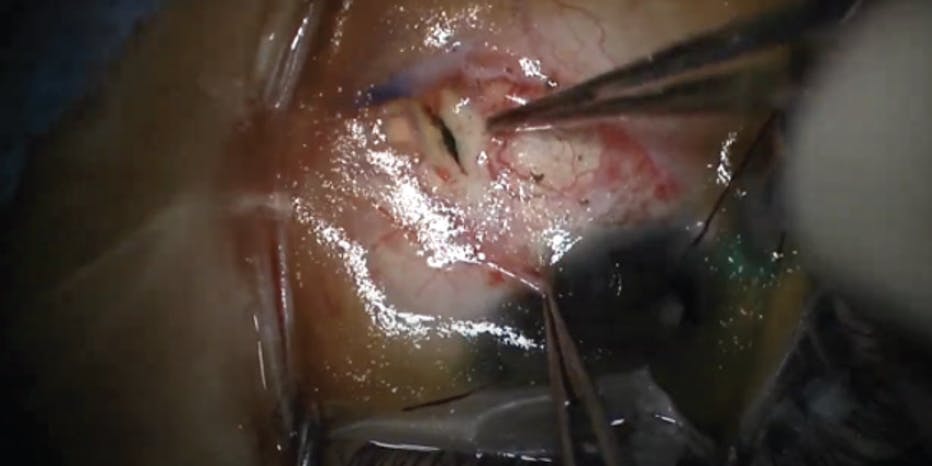
Figure 1. External drainage revealed fluid with cholesterol crystals typical of advanced Coats disease.
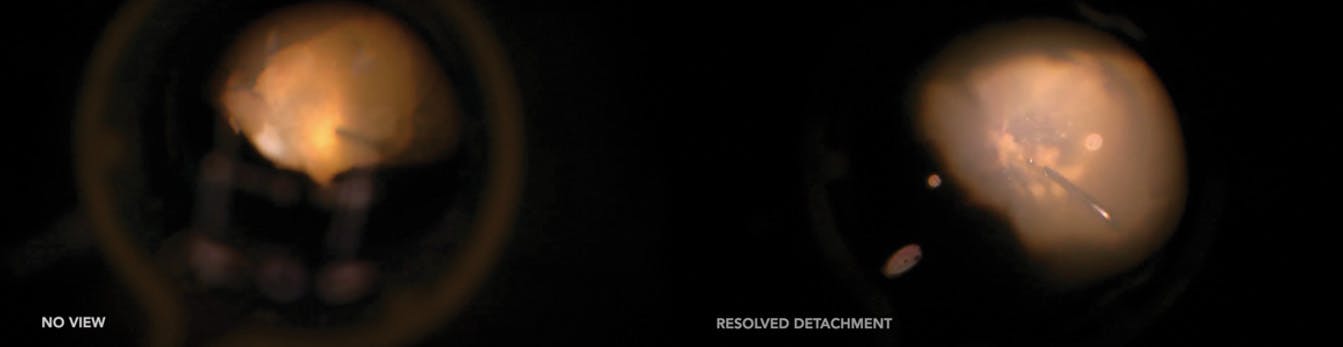
Figure 2. Prior to drainage, visualization of the posterior segment was poor (left). After fluid egress, a clear view was obtained (right).
This allowed membrane peeling to relieve traction, erring on the side of caution so as not to induce iatrogenic damage. Importantly, application of laser aimed at telangiectatic vessels was facilitated, thereby decreasing the likelihood of a future redetachment. I finished the case with an oil fill and triamcinolone injection.
After 1.5 years of follow-up, the patient has maintained the status of his eye and pain has resolved. Notably, the need for enucleation was obviated by this surgery.

1. Imai H, Tetsumoto A, Yamada H, et al. Intraoperative three-dimensional fluorescein angiography-guided pars plana vitrectomy for branch retinal vein occlusion. Retin Cases Brief Rep. 2022;16(6):802-805.
MIVS IMPORTANT PRODUCT INFORMATION
Caution: Federal law restricts this device to sale by, or on the order of, a physician.
Indications for Use: The CONSTELLATION® Vision System is an ophthalmic microsurgical system that is indicated for both anterior segment (i.e., phacoemulsification and removal of cataracts) and posterior segment (i.e., vitreoretinal) ophthalmic surgery.
The ULTRAVIT® Vitrectomy Probe is indicated for vitreous cutting and aspiration, membrane cutting and aspiration, dissection of tissue and lens removal. The valved entry system is indicated for scleral incision, canulae for posterior instrument access and venting of valved cannulae. The infusion cannula is indicated for posterior segment infusion of liquid or gas.
Warnings and Precautions:
The infusion cannula is contraindicated for use of oil infusion.
Attach only Alcon supplied products to console and cassette luer fittings. Improper usage or assembly could result in a potentially hazardous condition for the patient. Mismatch of surgical components and use of settings not specifically adjusted for a particular combination of surgical components may affect system performance and create a patient hazard. Do not connect surgical components to the patient’s intravenous connections.
Each surgical equipment/component combination may require specific surgical setting adjustments. Ensure that appropriate system settings are used with each product combination. Prior to initial use, contact your Alcon sales representative for in-service information.
Care should be taken when inserting sharp instruments through the valve of the Valved Trocar Cannula. Cutting instrument such as vitreous cutters should not be actuated during insertion or removal to avoid cutting the valve membrane. Use the Valved Cannula Vent to vent fluids or gases as needed during injection of viscous oils or heavy liquids.
• Visually confirm that adequate air and liquid infusion flow occurs prior to attachment of infusion cannula to the eye.
• Ensure proper placement of trocar cannulas to prevent sub-retinal infusion.
• Leaking sclerotomies may lead to post operative hypotony.
• Vitreous traction has been known to create retinal tears and retinal detachments.
• Minimize light intensity and duration of exposure to the retina to reduce the risk of retinal photic injury.
ATTENTION: Please refer to the CONSTELLATION® Vision System Operators Manual for a complete listing of indications, warnings and precautions.
LenSx® Laser - Important PATIENT Product Information
Caution: The LenSx® Laser is restricted by law to the sale and use by, or on the order of, a physician.
Description: The LenSx® Laser is for use in patients undergoing cataract surgery. The laser is used as a tool to break up a cataract and to create incisions in the cornea. The LenSx® Laser may also be used for the creation of corneal flaps in LASIK surgery. The LenSx® Laser may also be used for the creation of corneal pockets or tunnels for the placement of corneal devices. The LenSx® Laser uses accessories called Patient Interfaces to hold the eye steady during a procedure.
Warnings and Precautions: The LenSx® Laser Patient Interface and the LenSx® Laser SoftFit® Patient Interface hold an eye by applying light suction. Some bleeding and foreign body sensation may occur. As with any cataract surgery, there are risks involved. These risks may include but are not limited to infection, pain, corneal abrasion and capsular tear.
Surgery with the LenSx® Laser is not for everyone. Conditions such as corneal opacity, glaucoma, a poorly dilating pupil and previous corneal surgery may preclude use of the
LenSx® Laser. Your doctor can determine if the LenSx® Laser is right for you.
© 2023 Alcon Inc. 2/23 US-VIT-2300025
