

A 30-year-old woman who was involved in a motor vehicle accident was taken by ambulance to a trauma center. She had been ejected from a vehicle through the windshield as an unrestrained driver. At presentation, she had bilateral globe ruptures, as well as Le Fort fractures I, II, and III on her left side and a Le Fort fracture I on her right side. She underwent immediate bilateral globe repair at that time.
Several days later, the left eye (ie, the side with all three types of Le Fort fractures) was phthisic without light perception or ability to maintain IOP. Light perception vision was present in the right eye. Following a bedside ultrasound, it was determined that surgery for a secondary repair in the right eye was necessary.
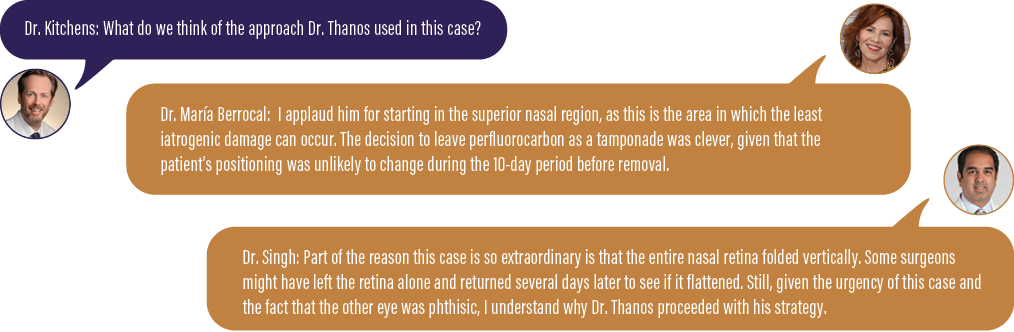
I first needed to establish landmarks for surgery. I began the case with an anterior chamber infusion and a limbal lensectomy. I placed my light pipe through the cornea in order to identify the location of the retina and ensure that it was not drawn anteriorly (Figure 1). No identifiable anatomical structures were evident. Next, I transitioned to pars plana vitrectomy using a 6-mm infusion line. I began working in the supero-nasal region and soon found that the entire nasal retina had folded vertically (Figure 2). I proceeded to clear the dense vitreous hemorrhage, noting the presence of widespread uveal pigment, choroidal rupture, and subretinal hemorrhage. Still, the patient’s posterior pole was fairly intact, and I was hopeful that she could regain some vision.
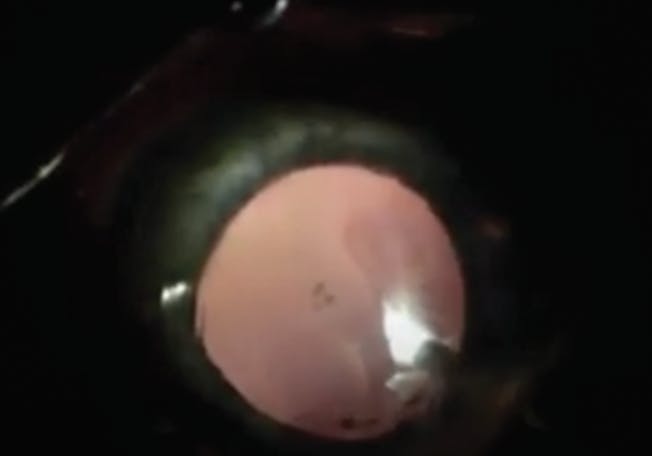
Figure 1. Because understanding the position of the retina was a key early step in surgery, the light pipe was inserted through the cornea to maximize visualization of the posterior segment.
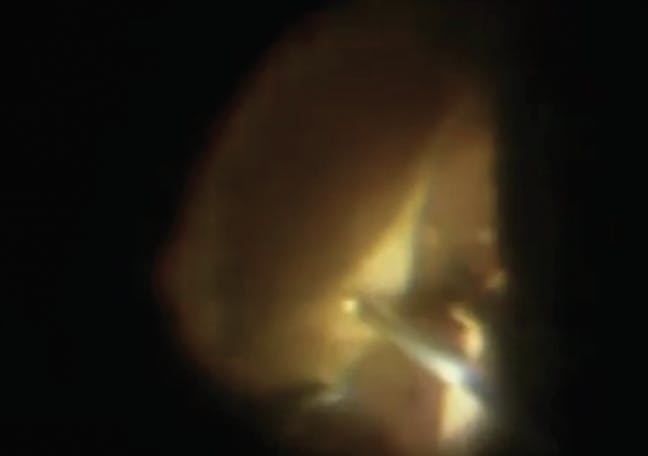
To address the vertical retinal fold, I created a small retinotomy at the pars plana to allow balanced salt solution from the infusion line to enter the subretinal space, thereby detaching the entire nasal retina. While that occurred, I used the FINESSE Flex Loop (Alcon) to scrape any remaining uveal pigment from the retinal surface (Figure 3), which could lead to formation of preretinal membranes and proliferative vitreoretinopathy. I observed an area of retinal incarceration in the supero-temporal region which was the original rupture site. I performed a retinectomy to release the retina and relieve tension. The whole nasal retina had detached at this point, and the fold had relaxed. Application of perfluorocarbon liquid led to the flattening of the patient’s retina. Laser photocoagulation was applied along the side of the temporal retinectomy and supero-nasal retinotomy. At postoperative month 3, the patients BCVA was 20/100 (Figure 4).
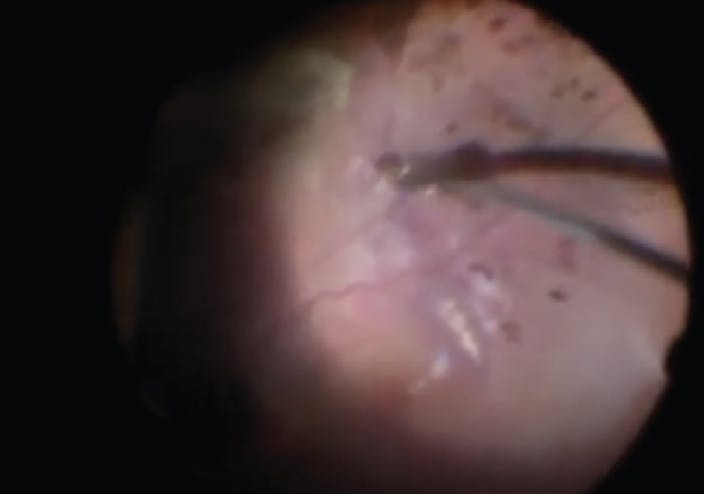
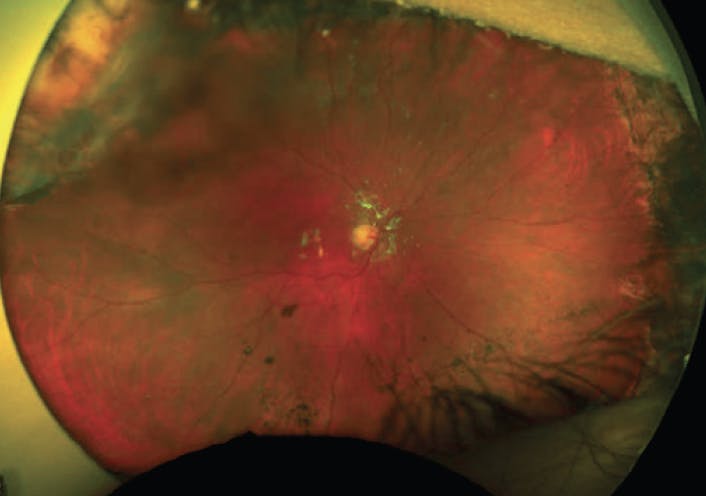
Figure 4. Three months after the second surgery in the patient’s right eye, BCVA was 20/100 and significant anatomic resolution was observed.
© 2023 Alcon Inc. 2/23 US-VIT-2300025
