Background
Biosimilars are studied in a phase 3 clinical trial compared to a reference biologic in a “sensitive patient population.”1 The goal of the study is confirmatory and to demonstrate equivalence, and not superiority or non-inferiority compared to the originator.2 For biosimilars to on-label ranibizumab, primary endpoints in these trials are established in consultation with regulatory bodies and based on the originator’s already established clinical profile. In the phase 3 clinical trial comparing ByoovizTM (ranibizumab-nuna, Biogen) with Lucentis (ranibizumab, RBZ; Genentech), the following endpoints were used:3
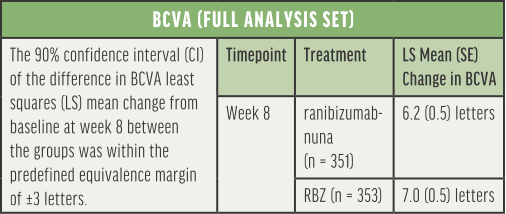
- Change from baseline in BCVA at week 8 for US FDA.
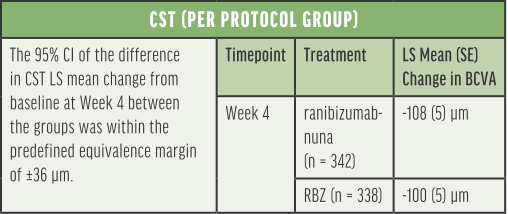
- Change from baseline in central subfield thickness (CST) at week 4 for EMA or other regulatory agencies who were in favor of CST as the primary endpoint.
About the Study
The phase 3 clinical trial was a double-masked, parallel-group, multicenter study. Patients were randomized 1 to 1 to 0.5 mg ranibizumab-nuna ITV injection every 4 weeks (n=351) or RBZ 0.5 mg ITV injection every 4 weeks (n = 354). Baseline demographic and disease characteristics were comparable between the two groups. Of note, mean BCVA was approximately 20/63 in each group, which is a greater starting acuity than in the ANCHOR and MARINA pivotal trials.4 At 24 weeks, 95.2% in each of the ranibizumab-nuna (n = 334/351) and RBZ (n = 337/354) groups completed the study.
Study Results
Safety
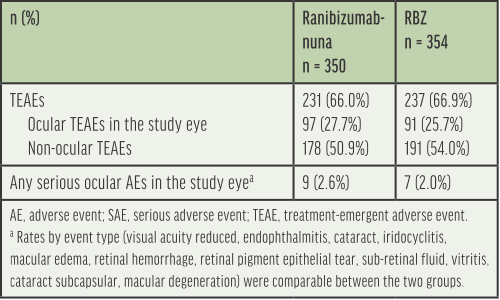
- Rates of treatment-emergent adverse events (TEAEs) and serious adverse events (SAE) were comparable between the two groups.
- Immunogenicity: The cumulative incidence of positive anti-drug antibody up to week 24 was low and appeared similar between groups (3.0% for ranibizumab-nuna and 3.1% for RBZ).
52-Week Data
Outcomes at 52 weeks have been published separately.5 A total of 307 in the ranibizumab-nuna group and 327 in the RBZ group completed the week 52 visit.
- Final study results for change from baseline in BCVA and CST showed that the improvements in the primary efficacy outcomes remained stable and were comparable between the two groups at all time points up to week 52.
- The finding of comparable safety was confirmed at 52 weeks.
Conclusion: Final 52-week study results provided additional long-term evidence supporting biosimilarity of ranibizumab-nuna to RBZ.5
1. European Commission. Consensus Information Paper 2013. What you need to know about Biosimilar Medicinal Products. https://www.medicinesforeurope.com/wp-content/uploads/2016/03/biosimilars_report_en.pdf. Accessed February 2022.
2. Vulto AG, Jaquez OA. The process defines the product: what really matters in biosimilar design and production? Rheumatology (Oxford). 2017 Aug 1;56(suppl_4):iv14-iv29.
3. Woo SJ, Veith M, Hamouz J, et al. Efficacy and safety of a proposed ranibizumab biosimilar product vs a reference ranibizumab product for patients with neovascular age-related macular degeneration: a randomized clinical trial. JAMA Ophthalmol. 2021;139(1):68-76.
4. Rofagha S, Bhisitkul RB, Boyer DS, et al; SEVEN-UP Study Group. Seven-year outcomes in ranibizumab-treated patients in ANCHOR, MARINA, and HORIZON: a multicenter cohort study (SEVEN-UP). Ophthalmology. 2013;120(11):2292-2299.
5. Bressler NM, Veith M, Hamouz J, et al. Biosimilar SB11 versus reference ranibizumab in neovascular age-related macular degeneration: 1-year phase III randomised clinical trial outcomes. Br J Ophthalmol. Published Online October 16, 2021.
