



SYFOVRE® (pegcetacoplan injection) is indicated for the treatment of geographic atrophy (GA) secondary to age-related macular degeneration (AMD).
SELECT SAFETY INFORMATION
SYFOVRE is contraindicated in patients with ocular or periocular infections, and in patients with active intraocular inflammation
Please see additional important Safety Information at the bottom of the page.
CASE STUDIES
Case Study 1: Patient with GA and CNV in Fellow Eye Treated With Anti-VEGF
Dr. Goldberg: Please see Figure 8. An active, 74-year-old white male who works full time in an office setting was referred to me in 2021 for new-onset wet AMD in the right eye. At presentation, the right eye had a hemorrhagic pigment epithelial detachment, choroidal neovascularization, and subretinal hemorrhage, as well as intraretinal fluid. The left eye had drusen and a small area of atrophy just temporal to the fovea. The vision in the left eye was 20/30; the vision in the right eye was 20/150.
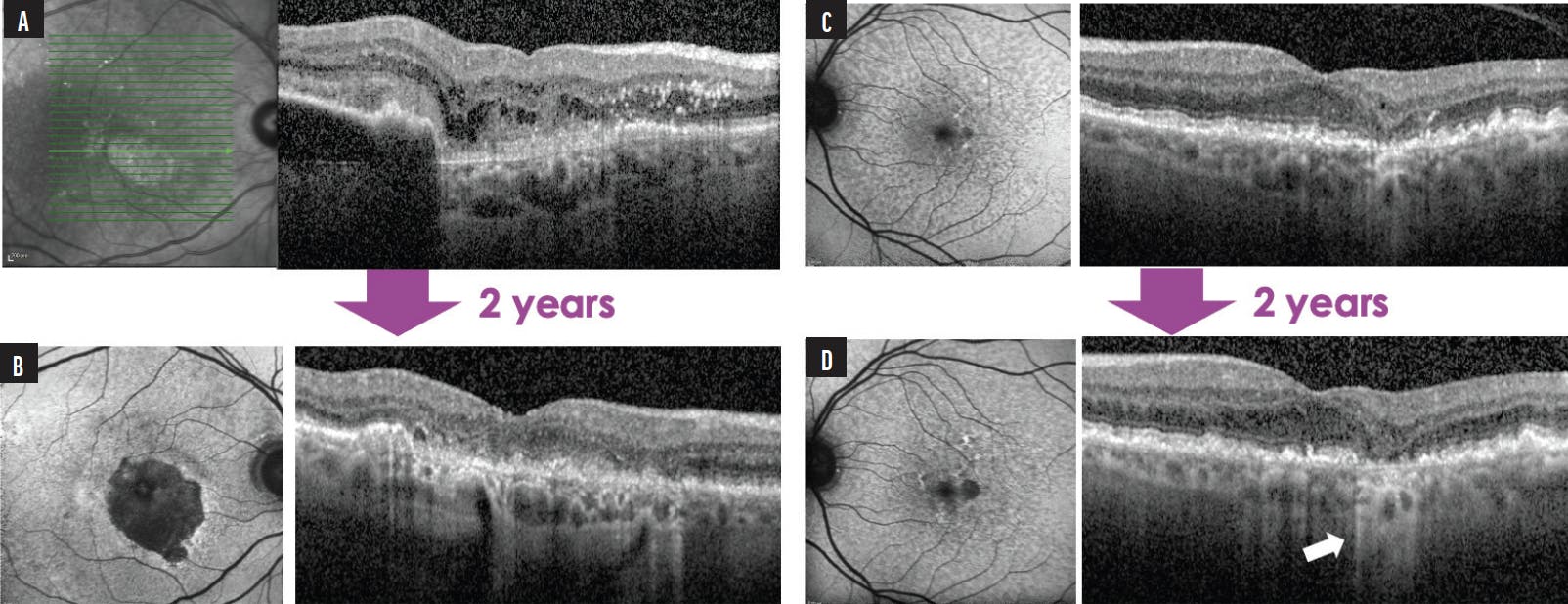
Figure 8. The right eye of a 74-year-old white male showed a hemorrhagic pigment epithelial detachment, choroidal neovascularization, and subretinal hemorrhage, as well as intraretinal fluid (A). After 2 years of anti-VEGF treatment for wet AMD, the right eye had developed extensive RPE scarring and atrophy (B). The patient’s left eye had drusen and a small area of atrophy just temporal to the fovea at presentation (C). After 2 years, the left eye showed GA growth temporal to the fovea (the white arrow points to a hypertransmission defect). (Case and images provided with permission by Roger A. Goldberg, MD, MBA).
After 2 years of treating the right eye with anti-VEGF for wet AMD, that eye developed extensive RPE scarring and atrophy secondary to wet AMD, and its vision declined to counting fingers. There was clearly GA growth just temporal to the fovea in the left eye, seen on both fundus autofluorescence and on OCT with an increased hypertransmission defect. Although the vision was still 20/30 in the left eye, the patient complained that the quality of the vision in that eye was declining. Thus, we elected to treat that left eye with SYFOVRE.
This case shows the difference in using OCT versus fundus autofluorescence to detect GA. I don’t think I would have appreciated how much atrophy was present in the left eye just by looking at its initial OCT, especially in light of its good vision.
Dr. Wykoff: This patient reminds us that GA encompasses a very broad spectrum of phenotypes. This patient would not have qualified for the phase 3 clinical trials, because the lesion size in the left eye is substantially smaller than a disc area. Yet, we see patients like this regularly in clinic, especially when they’ve lost vision in one eye. Many patients are very sensitive to visual decline, and they may be very interested in something that will slow the progression of disease.
View these cases as videos
_1689184581.png?auto=compress,format)
A Real-World GA Case: Patient with CNV in the Fellow Eye
_1689184592.png?auto=compress,format)
A Real-World GA Case: Patient with Bilateral GA
Case Study 2: Bilateral GA With Subfoveal Involvement
Dr. Goldberg: My second case is of a very healthy 90-year-old white female with bilateral foveal-involving GA. She had a PCIOL in both eyes. The GA in the right eye (Figure 9) was more advanced, with 20/150 vision. In the left eye, despite extensive GA that looked to be involving the foveal center, the BCVA was actually 20/60, and Figure 10 shows hyperautofluorescence around it. We agreed to treat the right eye (the worst-seeing eye) first with SYFOVRE, with a plan to see her in the clinic every month and treat each eye every other month.
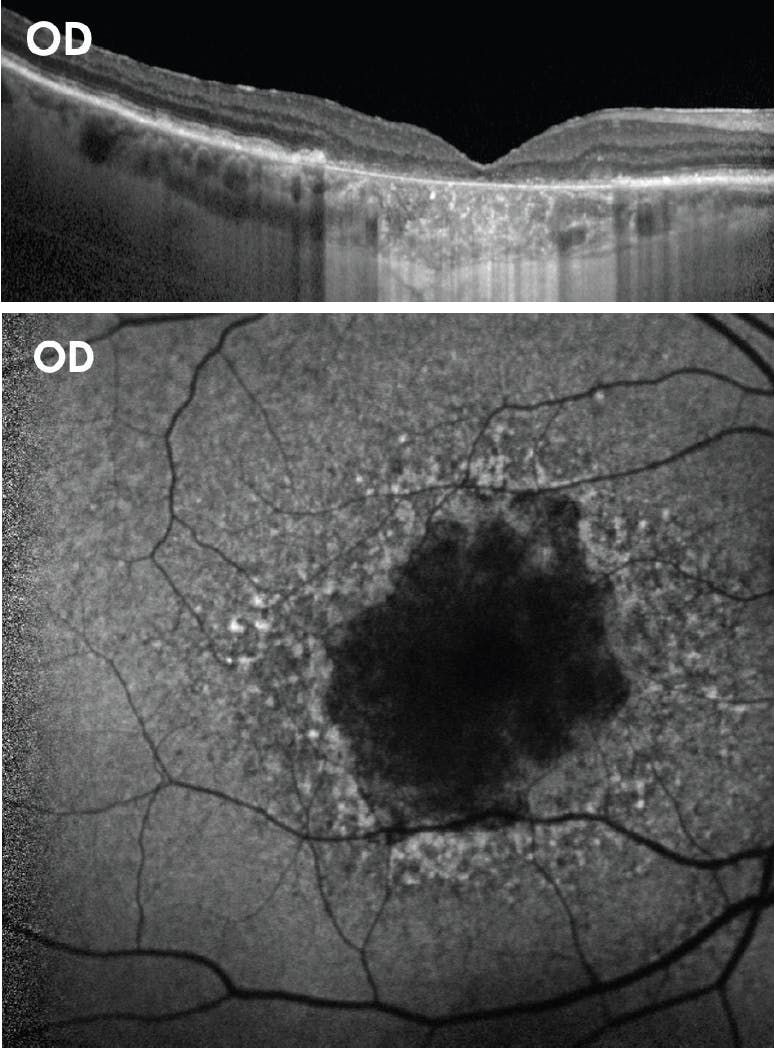
Figure 9. Foveal-involving GA in the right eye of a healthy 90-year-old white female. (Case and images provided with permission by Roger A. Goldberg, MD, MBA).
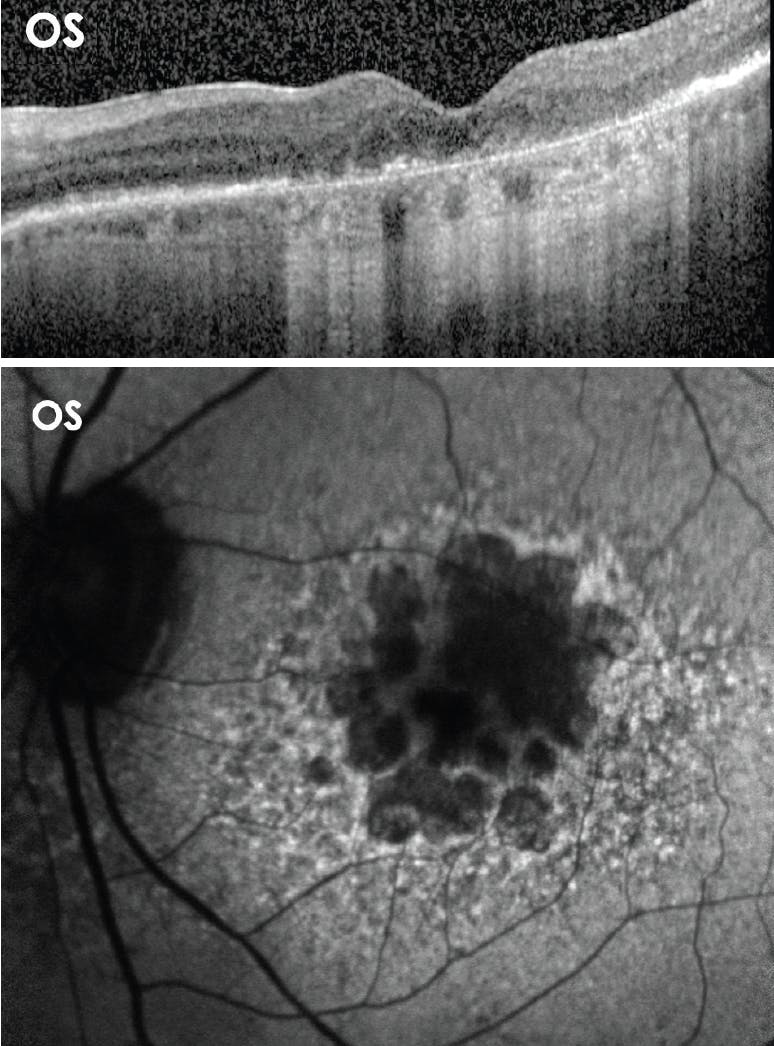
Figure 10. Hyperautofluorescence seen around the foveal GA in the left of the same patient. (Case and images provided with permission by Roger A. Goldberg, MD, MBA).
This case demonstrates two important features of progressing disease. First is lesion size: we know larger lesions progress faster. Second is the hyperautofluorescent rim around GA lesion in each eye, which suggests a higher risk of progression.
Dr. Wykoff: Generally, I will not need to see documented growth of GA in the natural history of a given eye before I initiate therapy with SYFOVRE, although my decision tree will be patient-specific. There are certain lesion types—for example, a regressed area of macular neovascularization (MNV)—that may have an atrophic footprint that may not progress over time; in cases like this, SYFOVRE would not be appropriate, as the underlying pathophysiology appears to be distinct from that of GA. Autofluorescence can also be helpful in determining who is appropriate to treat by ensuring there is hyperautofluorescence adjacent to GA as was required in the phase 3 trials. In the context of this case of Dr. Goldberg’s where there is clear hyperautofluorescence around the area, consistent with a diagnosis of GA secondary to AMD, I’ll discuss the safety and efficacy results of the trials with the patient and initiate therapy if the patient would like to be treated.
1. SYFOVRE (pegcetacoplan injection) [package insert]. Waltham, MA: Apellis Pharmaceuticals, Inc; 2023.
2. Data on file. Apellis Pharmaceuticals, Inc.
3. Boyer DS, Schmidt-Erfurth U, van Lookeren M, et al. The pathophysiology of geographic atrophy secondary to age-related macular degeneration and the complement pathway as a therapeutic target. Retina. 2017;37(5):819-835.
4. Friedman DS, O’Colmain BJ, Muñoz B, et al. Prevalence of age-related macular degeneration in the United States. Arch Ophthalmol. 2004;122(4):564-572.
5. GBD 2019 Blindness and Vision Impairment Collaborators. Causes of blindness and vision impairment in 2020 and trends over 30 years, and prevalence of avoidable blindness in relation to VISION 2020: the Right to Sight: an analysis for the Global Burden of Disease Study. Lancet Glob Health. 2021;9(2):e144-e160.
6. Sunness JS, Gonzales-Baron J, Applegate CA, et al. Enlargement of atrophy and visual acuity loss in the geographic atrophy form of age-related macular degeneration. Ophthalmology. 1999;106(9):1768-1779.
7. van Lookeren Campagne M, LeCouter J, Yaspan JL, Ye W. Mechanisms of age-related macular degeneration and therapeutic opportunities. J Pathol. 2014;232(2):151-164.
8. Wong WL, Su X, Li X, et al. Global prevalence of age-related macular degeneration and disease burden projection for 2020 and 2040: a systematic review and meta-analysis. Lancet Glob Health. 2014;2(2):e106-e116.
9. Rudnicka AR, Jarrar Z, Wormald R, et al. Age and gender variations in age-related macular degeneration prevalence in populations of European ancestry: a meta-analysis. Ophthalmology. 2012;119(3):571-580.
10. Linblad AS, Lloyd PC, Clemons TE, et al; Age-Related Eye Disease Study Research Group. Change in area of geographic atrophy in the Age-Related Eye Disease Study: AREDS report number 26. Arch Ophthalmol. 2009;127(9):1168-1174
11. Seddon JM, Cote J, Page WF, et al. The US twin study of age-related macular degeneration: relative roles of genetic and environmental influences. Arch Ophthalmol. 2005;123(3):321-327.
12. Aldebert G, Faillie JL, Hillaire-Buys D, et al. Association of anticholinergic drug use with risk for late age-related macular degeneration. JAMA Ophthalmol. 2018;136(7):770-778.
13. Sobrin L, Seddon JM. Nature and nurture - genes and environment - predict onset and progression of macular degeneration. Prog Retin Eye Res. 2014;40:1-15.
14. Katschke KJ, Xi H, Cox C, et al. Classical and alternative complement activation on photoreceptor outer segments drives monocyte-dependent retinal atrophy. Sci Rep. 2018;8(1):7348.
15. Smailhodzic D, Klaver CCW, Klevering BJ, et al. Risk alleles in CFH and ARMS2 are independently associated with systemic complement activation in age-related macular degeneration. Ophthalmology. 2012;119(2):339-346.
16. Del Amo EM, Rimpelä EH, Heikkinen E, et al. Pharmacokinetic aspects of retinal drug delivery. Prog Retin. 2017;57:134-185.
17. Kaiser PK, Giani A, Fuchs H, Chong V, Heier JS. Factors that can prolong ocular treatment duration in age-related macular degeneration. Ophthalmic Res. 2023;66:653–663.
18. de Castro C, Grossi F, Weitz IC, et al. C3 inhibition with pegcetacoplan in subjects with paroxysmal nocturnal hemoglobinuria treated with eculizumab. Am J Hematol. 2020;95:1334–1343.
19. Holz FG, Strauss EC, Schmitz-Valckenberg S, van Lookeren Campagne M. Geographic atrophy: clinical features and potential therapeutic approaches. Ophthalmology. 2014;121(5):1079-91. doi: 10.1016/j.ophtha.2013.11.023.
20. Yates JRW, Sepp T, Matharu BK, et al. Complement C3 variant and the risk of age-related macular degeneration. N Engl J Med. 2007;357(6):553-61.doi: 10.1056/NEJMoa072618.
21. Mastellos DC, Reis ES, Ricklin D, Smith RJ, Lambris JD. Complement C3-targeted therapy: replacing long-held assertions with evidence-based discovery. Trends Immunol. 2017;38(6):383-394. doi: 10.1016/j.it.2017.03.003.
22. Merle NS, Church SE, Fremeaux-Bacchi V, Roumenina LT. Complement system part I - molecular mechanisms of activation and regulation. Front Immunol. 2015;6:262. doi: 10.3389/fimmu.2015.00262.
23. Seddon JM, Yu Y, Miller EC, et al. Rare variants in CFI, C3 and C9 are associated with a high risk of advanced age-related macular degeneration. Nat Genet. 2013;45(11):1366-1370. doi:10.1038/ng.2741.
24. An extension trial to evaluate the long-term safety and efficacy of pegcetacoplan (APL-2) in subjects with geographic atrophy secondary to AMD (GALE). Updated August 2022. January 20, 2023. https://clinicaltrials.gov/ct2/show/NCT04770545s
25. Keenan TD, Agrón E, Domalpally A, et al. Progression of geographic atrophy in age-related macular degeneration: AREDS2 report number 16. Ophthalmology. 018;125(12):1913-1928. doi:10.1016/j.ophtha.2018.05.028.
26. Fleckenstein M, Mitchell P, Freund KB, et al. The progression of geographic atrophy secondary to age-related macular degeneration. Ophthalmology. 2018;125(3):369-390.
IMPORTANT SAFETY INFORMATION
CONTRAINDICATIONS
- SYFOVRE is contraindicated in patients with ocular or periocular infections, and in patients with active intraocular inflammation
WARNINGS AND PRECAUTIONS
- Endophthalmitis and Retinal Detachments
- Intravitreal injections, including those with SYFOVRE, may be associated with endophthalmitis and retinal detachments. Proper aseptic injection technique must always be used when administering SYFOVRE to minimize the risk of endophthalmitis. Patients should be instructed to report any symptoms suggestive of endophthalmitis or retinal detachment without delay and should be managed appropriately.
- Retinal Vasculitis and/or Retinal Vascular Occlusion
- Retinal vasculitis and/or retinal vascular occlusion, typically in the presence of intraocular inflammation, have been reported with the use of SYFOVRE. Cases may occur with the first dose of SYFOVRE and may result in severe vision loss. Discontinue treatment with SYFOVRE in patients who develop these events. Patients should be instructed to report any change in vision without delay.
- Neovascular AMD
- In clinical trials, use of SYFOVRE was associated with increased rates of neovascular (wet) AMD or choroidal neovascularization (12% when administered monthly, 7% when administered every other month and 3% in the control group) by Month 24. Patients receiving SYFOVRE should be monitored for signs of neovascular AMD. In case anti-Vascular Endothelial Growth Factor (anti-VEGF) is required, it should be given separately from SYFOVRE administration.
- Intraocular Inflammation
- In clinical trials, use of SYFOVRE was associated with episodes of intraocular inflammation including: vitritis, vitreal cells, iridocyclitis, uveitis, anterior chamber cells, iritis, and anterior chamber flare. After inflammation resolves, patients may resume treatment with SYFOVRE.
- Increased Intraocular Pressure
- Acute increase in IOP may occur within minutes of any intravitreal injection, including with SYFOVRE. Perfusion of the optic nerve head should be monitored following the injection and managed as needed.
ADVERSE REACTIONS
- Most common adverse reactions (incidence ≥5%) are ocular discomfort, neovascular age-related macular degeneration, vitreous floaters, conjunctival hemorrhage.
Please see full Prescribing Information for more information.
This supplement was developed by Retina Today with support from Apellis Pharmaceuticals, Inc. Apellis is acknowledged for participating in the writing, review, and editing of this supplement.
APELLIS®, SYFOVRE®, and their respective logos are registered trademarks of Apellis Pharmaceuticals, Inc.
©2023 Apellis Pharmaceuticals, Inc.
All rights reserved. 12/23 US-PEGGA-2300370 v3.0
