


The one constant in health care is that the industry is always changing. Physicians must navigate the rapidly shifting health insurance industry and reimbursement models, ongoing government regulation, and increasing staffing concerns, not to mention clinical challenges such as complex cases and novel therapeutics.
Physicians want to get back to doing what they do best: making a profound difference in the health of their patients. It’s hard to focus on this when various business demands and financial concerns are weighing them down. This is where mergers and acquisitions (M&A) may be able to help, as it can provide a financially feasible business model that helps physicians and their practices.
AT A GLANCE
- Much of private equity (PE) health care services investing represents an effort to capitalize on demographic trends by consolidating specialties that provide advanced care to older adults.
- Because the PE model centralizes the business function, selling to PE may improve the quality of life for the physician selling the practice.
- Before selling to PE, ensure that you have a strong bookkeeper, office manager, controller, or chief financial officer who can handle the financial support and rigor of the due diligence process.
- When a PE company exits in the future, the physicians’ retained equity is liquidated and provides a second liquidity event, known in the industry as the second bite.
Health care services is the largest business sector within private health care investing, accounting for roughly 10% of buyout and growth deals overall in the United States in 2022.1 This sector includes traditional health care providers who offer medical treatment in hospitals, clinics, residential facilities, and homes.
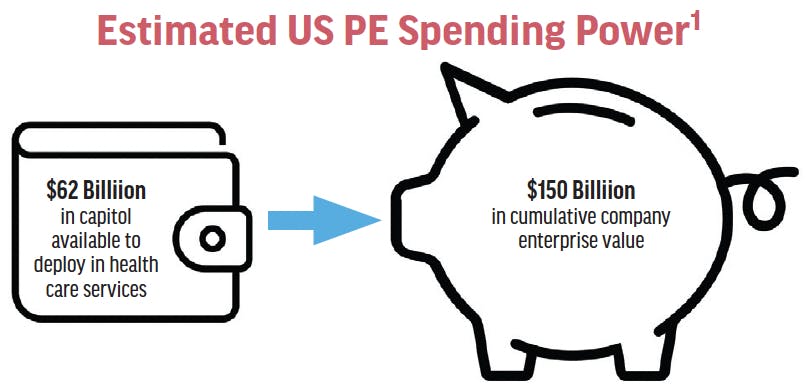
The largest buyers of services are private equity (PE) investors who seek to consolidate practices and achieve economies of scale. This is known as a buy-and-build strategy, and it is one of PE’s oldest investment strategies. The health care sector attracts PE investment due to the favorable market and demographic trends, resistance to recession, and high fragmentation. According to one industry report, US PE firms currently have $62.0 billion in capital available to deploy in health care services, which translates to roughly $150 billion in cumulative company enterprise value.1 Thus, there are immense opportunities for physicians to achieve maximum liquidity for their practices, all while allowing them to focus on patient care as clinicians.
INCREASING MARKET DEMAND
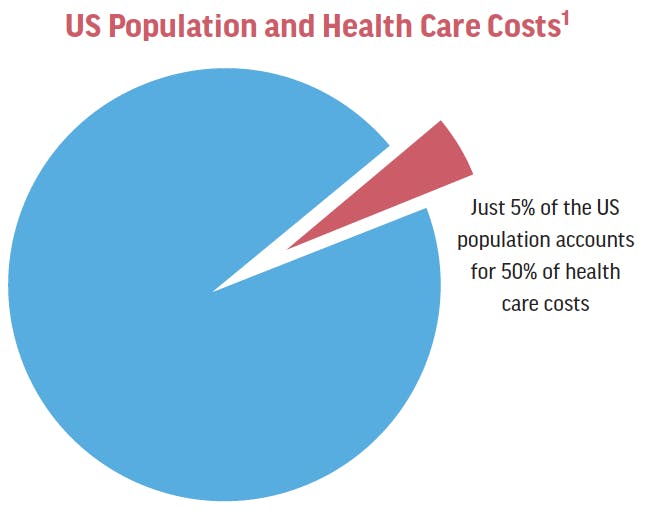
The aging population has been a significant driver of health care spending in the United States. Not only is a growing proportion of people in the United States over the age of 60, but as life expectancy increases, more people are living well past 80 years of age. This is when medical care often becomes the most expensive. In addition, more sophisticated and specialized care may lead to increased health care costs.
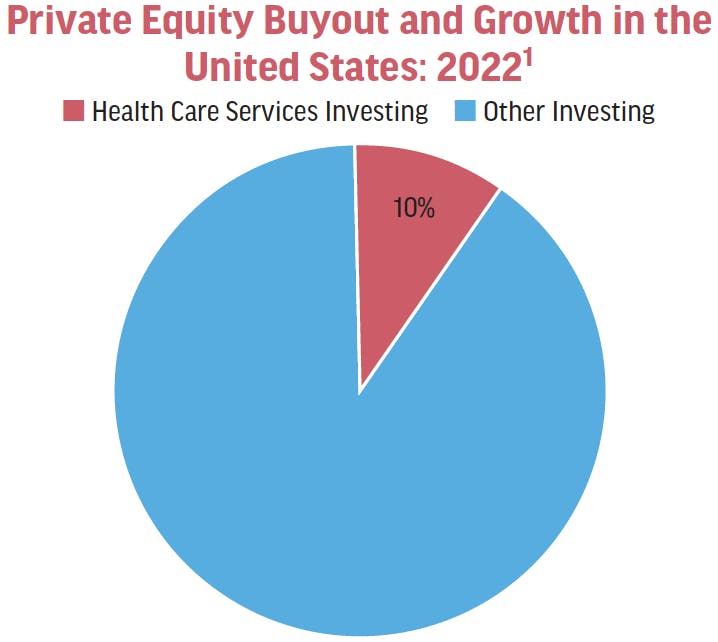
Much of PE health care services investing represents an effort to capitalize on demographic trends by consolidating specialties that provide advanced care to older adults—and, under value-based models, using preventative care to improve outcomes for the sickest individuals. Rising labor costs and inflationary pressures have put stress on practices’ profit margins, and PE investors are primed to help companies negotiate better payor rates, centralize administration, and achieve buying power through economies of scale.
CONSOLIDATING PRACTICE MANAGEMENT AND VISION CARE
Physician practice management (PPM) deals are at the heart of PE health care investment strategies. The term PPM refers to a structure employed by PE once a company is acquired, in which a centralized business office or management services organization supports the administrative and business functions of a physician-owned practice. This structure allows practitioners to go back to being clinicians, relegating the business of the practice to executive leaders to scale and optimize. PPM is short for a single-specialty PE-backed consolidator that is physician-owned and operated. Many platforms exist in specialties such as dermatology, ophthalmology, and dentistry.
Because the PE model centralizes the business function, acquisition also comes with the chance for an improved quality of life for the physician selling the practice. Gone are the days of worrying about insurance, bookkeeping, personnel, negotiating payor contracts, and compliance, to name only a few. Physicians can focus on patient care and the clinic, all while monetizing the business they have built to date. It also may improve the day-to-day for other clinical staff, as PE often brings additional tools and resources that smaller private practices cannot provide, such as more (or better) equipment, improved technology tools, and recruiting and marketing resources. PE essentially brings a “bag of money” to help improve and grow a practice, giving the staff an opportunity to do the things they have always wanted to do but could not.
Vision care has been a longstanding area of investment for PE. Typical PE-backed vision groups incorporate both ophthalmology and optometry, but some groups focus exclusively on retina care, such as Retina Consultants of America and US Retina. The vision PE deal count has been growing rapidly over the past 5 years, from approximately 40 transactions in 2017 to 120 in 2022.1
WHAT IT MEANS FOR ME AND MY PRACTICE
Many Baby-Boomer and Generation-X physicians started their own practices after medical school, driving the hyper-fragmentation seen today. PPM exits are an attractive retirement strategy for these physicians because it allows them to liquidate the wealth that they built up in their practice but also monetize the growth of the buying platform. In contrast, new research suggests that younger physicians graduating today are often seeking a more traditional employment model, which allows these platforms to manage the succession of older physicians who are nearing retirement.2
Competition for good assets is still fierce, and valuations remain strong for high-performing practices. While valuations have come down from the highs of 2020 and 2021, they remain at pre-pandemic levels, which were the highest ever on record.1
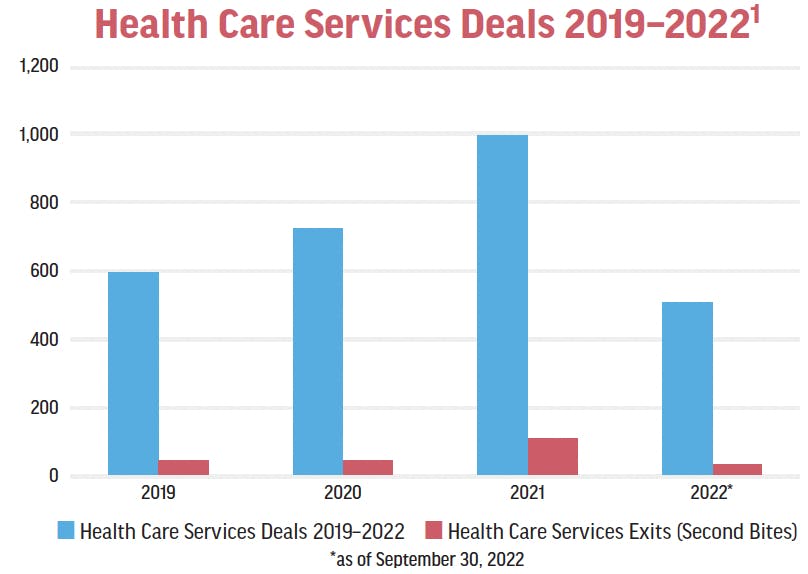
With volatile public markets and constrained (and expensive) traditional debt, PE exits in health care services are down. This means they will continue to grow their portfolio via add-on acquisitions, and there is plenty of demand for companies to acquire.
THE SECOND BITE
Many business owners think of an acquisition as a singular transaction, traditionally at the time of retirement. While that is one possible outcome, the structure most employed by PE allows for multiple liquidity events. Physician owners can: 1) be paid for the acquisition of the business, 2) receive a market-rate salary and benefits over the next 3 to 5 years, and 3) retain equity in the PE platform company. When that PE platform company (which that practice is now a part of) exits in the future, that retained equity is liquidated and provides a second liquidity event, known in the industry as the second bite. This is often quite lucrative, and the proceeds of that transaction could possibly exceed what was received in the initial transaction. PE loves this model, as it incentivizes physician owners to help grow the greater portfolio company and reap the reward of that growth in a subsequent transaction.
It is important to note that these equity opportunities are not reserved for practice owners. Key physician employees, nurses, practice administration, and office management also can benefit from a second bite. This is because PE acquirers almost always create a pool of equity to be granted to key employees to incentivize them to help with future growth. PE investors understand their future investment success relies on the performance of all employees—not just physician owners. There’s no better way to encourage top performance than by making employees owners alongside the physician owners and PE. If equity is not an option, often PE owners implement robust bonus and profit-sharing plans to provide cash incentives tied to growth.
Additionally, PE platforms provide greater job security and future professional growth opportunities, as the larger consolidated company has more stable cash flows than a private practice and more opportunities for advancement into leadership or other roles. This economy of scale also results in improved employee benefits, such as better health care coverage, retirement savings opportunities, and other fringe benefit programs.
THE POTENTIAL DOWNSIDES
There are plenty of upside opportunities available when partnering with PE. However, change is never easy, and there are some aspects of the process that practice owners and their teams should consider:
Track record. Does the PE partner have proven successes of growing and transacting a buy-and-build strategy? With the growing number of private investors, some are more experienced than others. Because one of the key benefits of a PE transaction is the second bite, practice owners should perform their due diligence and feel confident that the PE group can deliver the expected outcome.
Integration. It sounds simple to buy 20+ practices to create a larger entity, but truly integrating all those practices into one efficient enterprise is not an easy feat. It is important to understand the PE’s plan for integration; otherwise, your employees will bear the brunt of the inefficiency and dysfunction of poor integration. Disparate systems, inconsistent processes, and varying company cultures increase costs and constrain growth, which is the exact opposite of the investment’s intended outcome. It is ideal to include some of your key leaders in the due diligence process so that you can all assess and strategize how the companies will integrate.
Debt. PE uses a combination of their own capital and debt to acquire practices. If too much debt is placed on the business, it will not be able to grow because too much of the businesses’ cash flow will go to servicing the debt, rather than being reinvested in growth. In times of rising interest rates, the debt becomes even more expensive, further constraining growth. Physician owners must understand how much debt will be used as a percentage of overall profits and ensure it is a conservative amount.
Autonomy. Many physicians and clinical staff choose to work in private practices because they do not want to work in large, bureaucratic health care companies or systems. As PE-backed health care services companies grow, standardized processes and profit preservation are necessary to fuel financial growth for an exit. This could be viewed as a negative by practice staff, as they have enjoyed their autonomy and flexibility over the years. It is important for PE to ensure that any changes made improve both patient care and the daily work life of clinical staff. Physicians or other practice staff joining a PE-backed health care platform should vet this in their interview process when changing jobs, especially if coming from another private practice. Prospective employees can easily research practice ownership online, as PE publicly discloses its ownership in its portfolio companies.
The buy-and-build process is not an easy one, which is why it is lucrative—the reward for the risk is the incentive for PE, physician owners, and practice staff to execute this strategy. If the above considerations are vetted thoroughly, there is a much higher chance of success.
TAKE ADVANTAGE OF OPPORTUNITIES
While a transaction many not be front of mind for many physicians today, the market conditions are ripe with opportunity. It would be advantageous to see what the market could bear for your practice. That said, it takes dedication and preparation to ensure the best outcome.
First, find your team. It takes many people to help successfully transition a business: an M&A advisor, certified public accountant, M&A attorney, and wealth manager are just a few experts needed to help ensure you have thought through all your needs and wants in a potential acquisition. They will help you understand your business’ value, find the right partner, know what your personal profit needs are, maximize tax opportunities, and invest the large sum of proceeds post-sale. All these service providers work together to get you the most successful outcome possible. It isn’t something that can be done on your own.
Second, get your internal finance team together and ensure your records are accurate and transparent. You must have a strong bookkeeper, office manager, controller, or chief financial officer who can handle the financial support and rigor of the due diligence process. If you don’t have that person now, hire one as soon as possible. While certainly an expense, it pays dividends in a transaction. Almost all transactions are re-traded because of poor financial recordkeeping. So, get your books in order now to save yourself a significant amount of time and money in the future.
Third, mentally prepare for the transition ahead. It can be a very emotional process, and one of the biggest financial decisions of your lifetime. Your team will be there to help you navigate the complexity, so focus on the opportunity and the new, exciting chapter. Be committed to the process and see it through, and you will reap the rewards of that emotional investment.
Business Buzz
- Demetrios Vavvas, MD, PhD, the Solman and Libe Friedman professor of ophthalmology and director of the Retina Service at Harvard Medical School in Boston received the 2022 Kreissig Award for excellence in retinal surgery from the Association for Research in Vision and Ophthalmology (ARVO) Foundation.
- Miguel Flores-Bellver, PhD, a research instructor in the Department of Ophthalmology at the University of Colorado and a principal investigator at the CellSight-Ocular Stem Cell and Regeneration Program, received ARVO’s 2023 Bert M. Glaser, MD Award for innovative research in retina.
- Caroline Baumal, MD, joined Apellis as its chief medical officer.
- Jay S. Duker, MD, chief operating officer (COO) at EyePoint Pharmaceuticals, was promoted to President and COO.
- Thomas A. Ciulla, MD, MBA, is stepping down as Clearside Biomedical’s chief medical officer and chief development officer and is transitioning to the role of chief medical advisor-retina.
KEY TAKEAWAYS
Whether you are ready for retirement or are interested in getting back to patient care rather than worrying about running a business, M&A may be especially beneficial for you. The key is to have the right team in place to help you navigate the process.
1. Q3 2022 Healthcare Services Report. Pitchbook. November 14, 2022. Accessed January 16, 2023. pitchbook.com/news/reports/q3-2022-healthcare-services-report
2. Physicians Advocacy Institute. COVID-19’s impact on acquisitions of physician practices and physician employment 2019-2021. Avalere Health. April 2022. Accessed January 26, 2023. bit.ly/3HewS2u


