
WHERE IT ALL BEGAN
Daniel Su, MD, was born in Taiwan, and his family moved to New Zealand when he was young; they moved again during his high school years, this time to California.
He studied electrical engineering at the Univeristy of California Los Angeles and was preparing for a career in medical device engineering. However, he was insipired to pursue medicine while working on a project involving the da Vinci surgical robot (Intuitive Surgical).
HIS PATH TO RETINA
Dr. Su first became interested in ophthalmology while working as an undergraduate in a lab that studied rhodopsin. Although he kept an open mind and explored other subspecialities during residency, he gravitated toward retina specialists and senior residents who wanted to pursue retina. Dr. Su found this group of physicians to be down to earth, compassionate, and fun to be around. Ultimately, the breadth of pathology, intricate and challenging surgeries, and innovative environment led him to pursue a career in retina.
SUPPORT ALONG THE WAY
Dr. Su has been fortunate to have great mentors at every step of his training. In residency, Uday Devgan, MD; Pradeep Prasad, MD, MBA; and David Sarraf, MD, fostered his growth as an ophthalmologist and supported his goals of pursuing a career in retina.
During fellowship at Wills Eye Hopsital, Dr. Su had the opportunity to learn from many amazing mentors, including Arunan Sivalingam, MD; Michael A. Klufas, MD; Omesh P. Gupta, MD, MBA; Jason Hsu, MD; Allen C. Ho, MD; and Carl D. Regillo, MD.
After training, Dr. Su found mentors and colleagues within his own practice. Thomas G. Chu, MD; Firas M. Rahhal, MD; and David S. Boyer, MD, are a constant source of advice for everything retina and beyond.
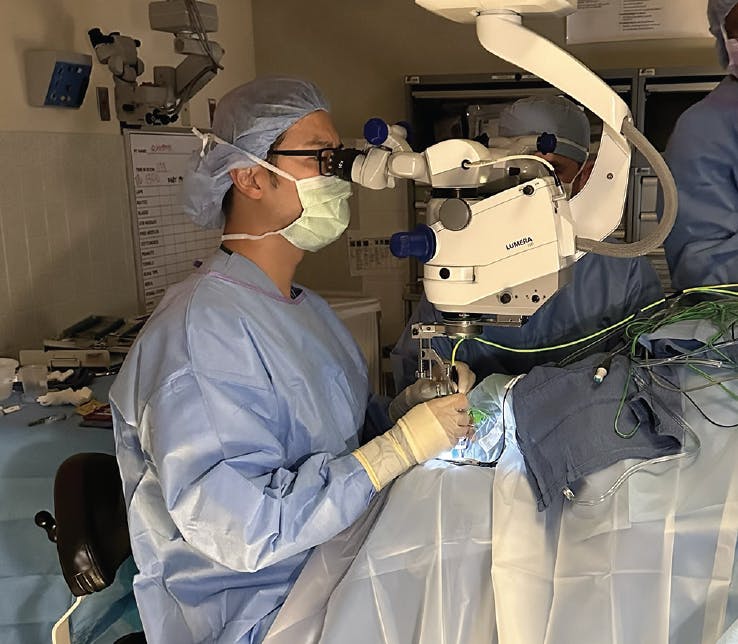
Dr. Su’s Advice: The relationships you develop with your mentors and peers during training do not end after residency and fellowship. Continue to invest in those relationships and seek advice whenever you need help. It’s not only the relationships we build with our patients, but also the ones we have with our peers and mentors that make the field of retina so rewarding.
AN EXPERIENCE TO REMEMBER
Dr. Su’s most memorable encounters to date have involved patients who were referred to him to rule out possible retinal pathologies, but none were found. Instead, Dr. Su had to rely on his comprehensive ophthalmology training to recognize visual field abnormalities that led to the diagnosis of stroke or brain tumor.
These “karate kid” moments make him appreciate his training from residency, even if at the time it might not have seemed relevant to an aspiring retina specialist.
