


AT A GLANCE
- Gene therapy may offer a one-time treatment regimen to provide sustained anti-VEGF protein expression after initial administration.
- Tyrosine kinase inhibitors bind to intracellular domains of tyrosine kinase receptors and target the downstream receptor signaling of VEGF receptors, platelet-derived growth factor signaling, and more.
- Several therapies incorporate dual targets, such as inhibition of VEGF-C and VEGF-D, VEGF and fibroblast growth factor, VEGF and Ang-2, VEGF and C3b/C4b, and VEGF with Tie2 promotion.
It’s been an exciting year for AMD with new therapeutic options in the clinic. The traditional set of anti-VEGF options has expanded to include biosimilars, high-dose variations, and dual-action combination therapies. With all this innovation, we may soon have a doubling of available choices to treat wet AMD.
Nonetheless, the path to market can be challenging, and several promising candidates have been discontinued or paused in the last year. Kodiak discontinued and then reinitiated its tarcocimab program with the release of positive phase 3 GLOW data.1 The FDA did not approve Outlook Therapeutic’s ONS-5010/Lytenava, and the company is pursuing an additional phase 3 trial (NCT05112861) set to complete in March 2024.2 The port delivery system with ranibizumab (Susvimo, Genentech/Roche) was voluntarily recalled due to issues with septum dislodgement, and the company hopes to introduce an updated version soon.3
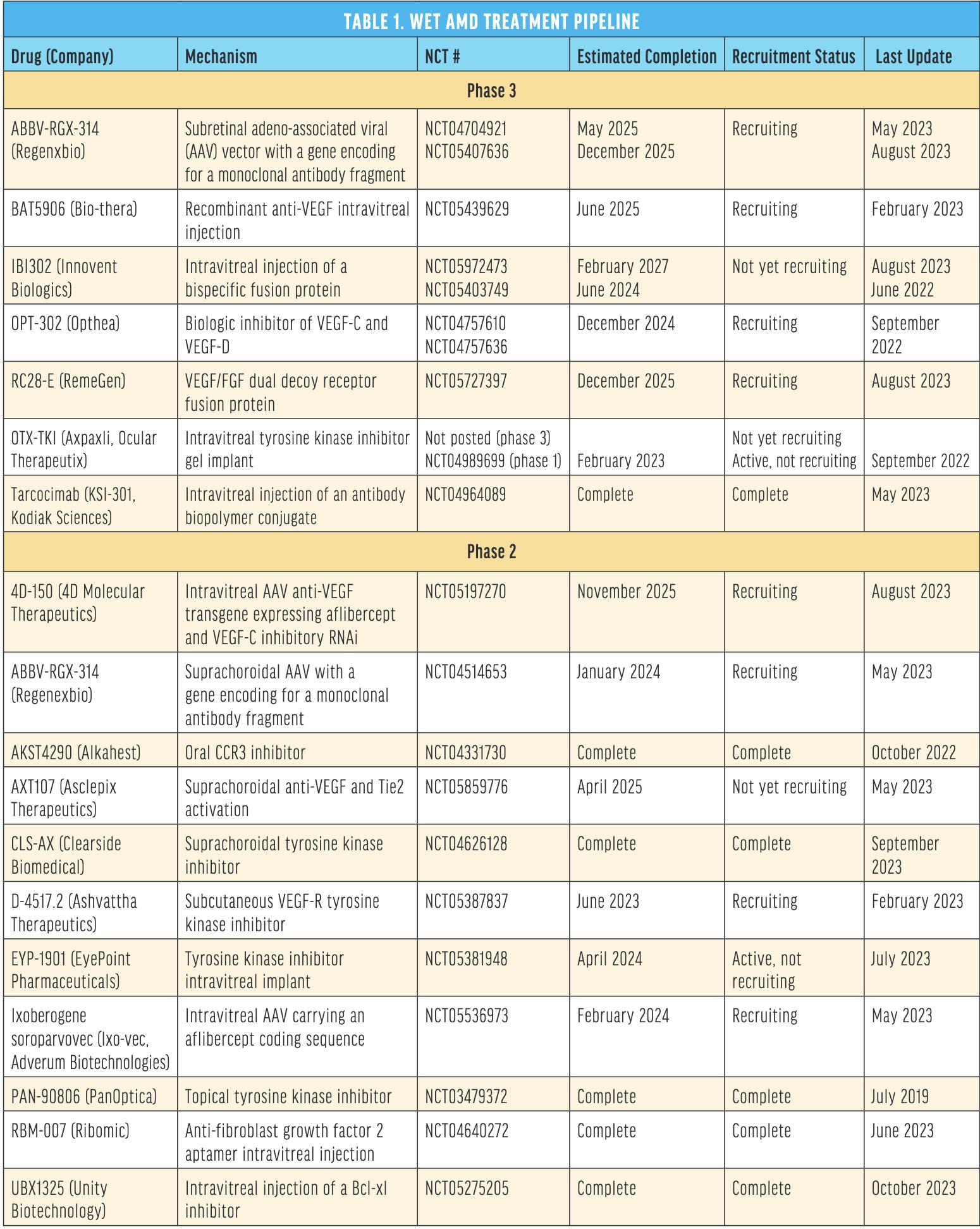
Research continues for other therapeutics, and trials are underway that strive to offer more effective, durable, and cost-effective options for patients—some are exploring gene therapy, tyrosine kinase inhibition, and alternative methods of drug delivery beyond intravitreal injection (Table 1).
GENE THERAPY
Gene therapy is an exciting alternative to ongoing intravitreal injections. By using viral vectors to deliver anti-VEGF transgenes, these therapies may offer a one-and-done treatment regimen to provide sustained anti-VEGF protein expression after initial administration.
ABBV-RGX-314 (Regenxbio) is being tested as a subretinal injection during vitrectomy in two phase 3 trials, ASCENT (NCT05407636) and ATMOSPHERE (NCT04704921). The studies are comparing the drug candidate with intravitreal aflibercept (Eylea, Regeneron) and ranibizumab (Lucentis, Genentech/Roche), respectively. This gene therapy produces sustained expression of ranibizumab-like proteins.
ABBV-RGX-314 is also under investigation with a one-time in-clinic suprachoroidal delivery method in the phase 2 AAVIATE trial (NCT04514653). The 6-month interim safety results showed that the suprachoroidal delivery was well-tolerated in 85 patients. Mild intraocular inflammation was reported with an increase in incidence with the third dose level (cohort 4, 1x10¹² GC/eye); all inflammation resolved with topical corticosteroids. There was an 85% reduction in the annualized injection rate, with 67% of patients (all previously treated with anti-VEGF therapy) remaining injection-free in the highest dose group.4 ABBV-RGX-314 at the third dose level was also evaluated with a short course of prophylactic ocular steroids, which meaningfully reduced the occurrence of mild to moderate intraocular inflammation.5
Ixoberogene soroparvovec (Ixo-vec [formerly ADVM-022], Adverum Biotechnologies) is in the phase 2 LUNA trial (NCT05536973) evaluating an intravitreal injection of one of two doses in conjunction with prophylactic steroids in patients with wet AMD. The 3-year data from the phase 1 OPTIC trial (NCT03748784) show that this aflibercept-encoding AAV.7m8 vector produced therapeutically active ranges of aflibercept protein; there was an 84% reduction in annualized anti-VEGF injections, with 53% of the participants at the 2E11 dose free of injections at 3 years.6
4D-150 (4D Molecular Therapeutics) is a dual anti-VEGF transgene that expresses aflibercept and VEGF-C inhibitory RNAi; the investigational therapy is dosed as a one-time intravitreal injection. The phase 1/2 trial (NCT05197270) consists of four cohorts: dose escalation (up to four dose levels), dose expansion (exploring two doses), steroid optimization, and population extension.
TYROSINE KINASE INHIBITORS
These small molecules bind to intracellular domains of tyrosine kinase receptors and target the downstream receptor signaling of VEGF receptors, platelet-derived growth factor signaling, and more.
Axitinib (CLS-AX, Clearside Biomedical) is in a phase 1/2a trial (NCT04626128) investigating one-time suprachoroidal delivery of the drug candidate. All four dose-escalating cohorts showed no serious safety signals, and cohorts three and four experienced a 73% reduction in treatment burden at 3 months.7 The phase 2b ODYSSEY trial completed recruitment (NCT05891548).
EYP-1901 (EyePoint Pharmaceuticals) is an intravitreal sustained-release implant that is under investigation in the phase 2 DAVIO trial for patients with wet AMD (NCT05381948). Initial safety data suggest the therapy is well tolerated with no drug-related severe ocular adverse events. The company is expecting topline data in December.8
PAN-90806 (PanOptica) phase 1/2 clinical trial (NCT03479372) topline results showed safety and a biological response with this once-daily topical eye drop for the treatment of AMD. More than half of the treated patients completed the 12-week study without requiring rescue with an anti-VEGF injection, with 88% experiencing clinical improvement or disease stability.9
D-4517.2 (Ashvattha Therapeutics) is a monthly subcutaneous therapy in a phase 2 trial (NCT05387837) investigating the safety, tolerability, and pharmacokinetics of four different doses. In a mouse model, treatment with D-4517.2 led to an approximate two-fold decrease in choroidal neovascular lesion area compared with controls.10
OTX-TKI (Axpaxli, Ocular Therapeutix) is an investigational bioresorbable implant with axitinib. The company is initiating a phase 3 trial after the 12-month phase 1 (NCT04989699) data showed an 89% reduction in treatment burden for patients treated with the implant compared with those treated with aflibercept.11 In the pivotal superiority trial, 300 patients will receive either a single OTX-TKI implant or one injection of aflibercept followed by as-needed anti-VEGF treatment.
DUAL TARGET THERAPY
OPT-302 (Opthea), is a Fc-fusion protein designed to inhibit VEGF-C and VEGF-D. The phase 3 trials (NCT04757610, NCT04757636) are investigating combination therapy with OPT-302 and either aflibercept or ranibizumab, with a primary endpoint of change in BCVA at week 52. In phase 2, the mean visual acuity gain in the 2.0 mg OPT-302 group was significantly superior to sham.12
RC28-E (RemeGen) is a dual decoy receptor fusion protein targeting VEGF and fibroblast growth factor undergoing phase 3 testing (NCT05727397). The trial is investigating intravitreal injection of the study drug every 12 weeks after a loading dose of three monthly injections compared with aflibercept every 8 weeks after a loading dose of three monthly injections.
Efdamrofusp alfa (IBI302, Innovent Biologics) is a recombinant human anti-VEGF and anticomplement (C3b and C4b) bispecific fusion protein. The company announced the first patient dosed in the phase 3 STAR trial (NCT05972473) evaluating intravitreal injections of 8 mg efdamrofusp alfa compared with aflibercept.13 The phase 2 trial (NCT05403749) is ongoing.
AXT107 (Asclepix Therapeutics) is a suprachoroidal injection of a suspension that self-assembles into a gel inside the eye and blocks VEGF and promotes Tie2 signaling. The phase 1/2 trial (NCT05859776) is investigating low, mid, and high doses of the study drug in 15 patients to assess safety up to 40 weeks.
AM712 (AffaMed) is a candidate fusion protein targeting VEGF and Ang-2, similar to faricimab-svoa (Vabysmo, Genentech/Roche). The phase 1 clinical trial (NCT05345769), set for completion in June 2024, is evaluating ascending doses of the study drug, followed by its safety, tolerability, pharmacokinetics, and efficacy.
ALTERNATIVE APPROACHES
UBX1325 (Unity Biotechnology) is a small molecule Bcl-xl inhibitor that increases apoptosis of diseased senescent cells in the retinal pigment epithelium, suppressing inflammation and neovascularization. At 48 weeks in the completed phase 2 ENVISION trial (NCT05275205), 40% of patients treated with the study drug did not require anti-VEGF treatment, and 64% achieved an anti-VEGF treatment-free interval of more than 24 weeks. However, the company indicated that it will be focusing on the diabetic macular edema program for UBX1325.14
RBM-007 (Ribomic) is an anti-fibroblast growth factor 2 aptamer that inhibits angiogenesis and scar formation. The company completed the phase 2 trial (NCT04895293), which suggested a clinical benefit in treatment-naïve patients.
Tarcocimab (KSI-301, Kodiak Sciences), an intravitreal antibody biopolymer conjugate, met its primary endpoint in the phase 3 DAYLIGHT study (NCT04964089) of noninferior visual acuity gains with monthly KSI-301 compared with aflibercept every 8 weeks. The company plans to pursue another phase 3 trial to support a single biologics licensing agreement submission for wet AMD, nonproliferative diabetic retinopathy, and retinal vein occlusion.1
Other unique approaches to wet AMD therapy include an oral CCR3 inhibitor (NCT04331730, AKST4290, Alkahest); episcleral brachytherapy (NCT02988895, Salutaris Medical Devices); OCT angiography-directed photodynamic therapy triple therapy with ranibizumab, photodynamic therapy with verteporfin (Visudyne, Bausch + Lomb), and triamcinolone acetonide (NCT04075136); and adjuvant doxycycline/MMP-9 inhibition (NCT04504123).
BIOSIMILARS
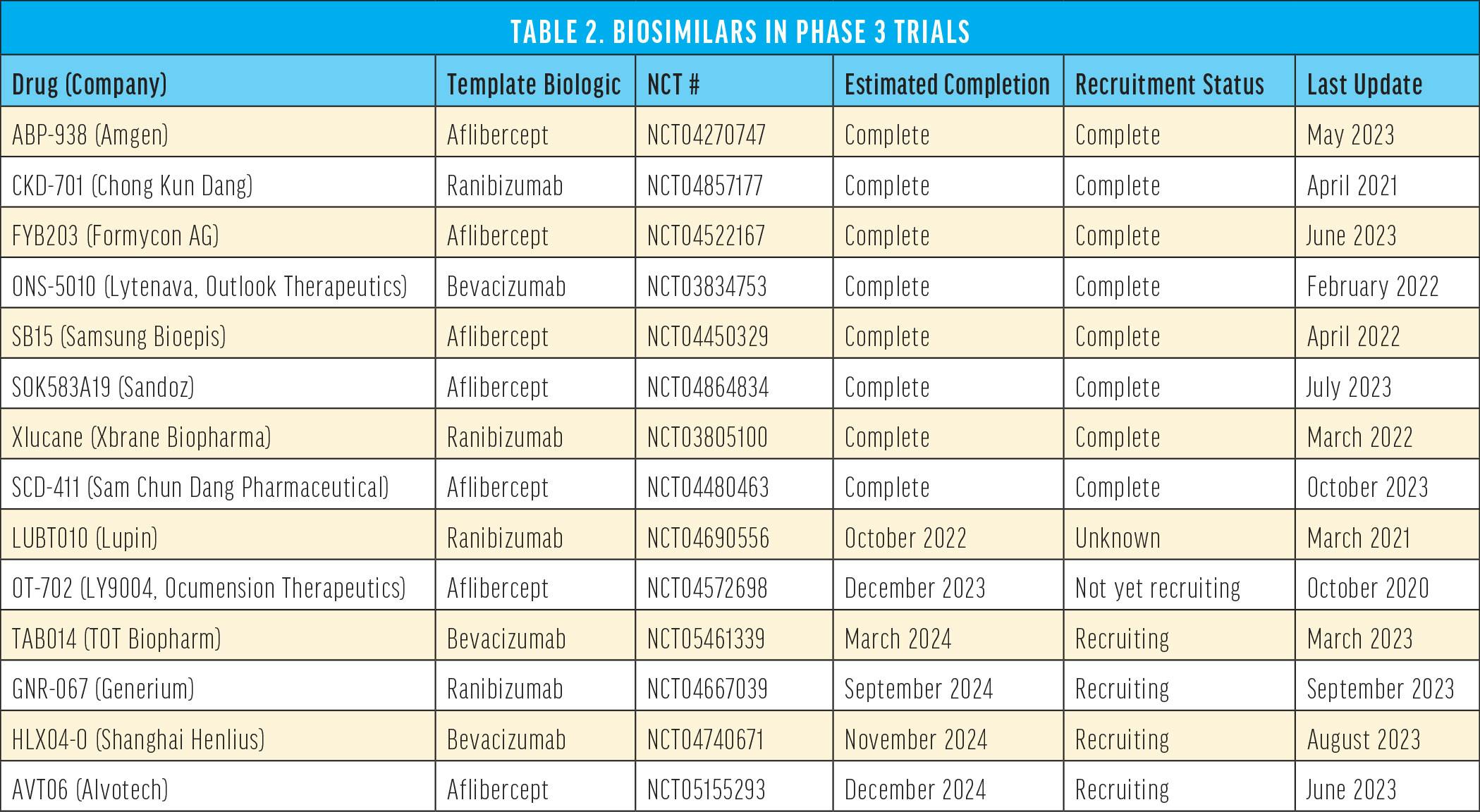
Many companies are rushing to introduce anti-VEGF biosimilars, and more than 10 drug candidates are in phase 3 clinical trials with biosimilars of bevacizumab (Avastin, Genentech/Roche), aflibercept, and ranibizumab (Table 2).
THE LANDSCAPE
Exciting therapies are on the horizon for wet AMD. We may soon be using gene therapy, tyrosine kinase inhibitors, or a variety of other approaches in the clinic; the future of wet AMD treatment, and the practice of retina, may look quite different in just a few years.
Editor’s Note: Data are cited as of November 13, 2023.
1. Kodiak Reboots Tarcocimab Tedromer Development Program Following Strong Positive Results in Phase 3 Diabetic Retinopathy GLOW Study and Following Dialogue with US Regulatory Authorities on a Regulatory Pathway for BLA Submission [press release]. Kodiak Sciences. November 6, 2023. Accessed November 13, 2023. bit.ly/3SuDMrP
2. Outlook Therapeutics provides regulatory update on FDA review of ONS-5010 / Lytenava (bevacizumab-vikg) for the treatment of wet AMD [press release]. Outlook Therapeutics. August 30, 2023. Accessed November 13, 2023. bit.ly/3Q9AGrM
3. Sharma A, Khanani AM, Parachuri N, Kumar N, Bandello F, Kuppermann BD. Port delivery system with ranibizumab (Susvimo) recall- What does it mean to the retina specialists. Int J Retina Vitreous. 2023;9(1):6.
4. Regenxbio announces additional positive interim data from trials of RGX-314 for the treatment of wet AMD [press release]. Regenxbio. October 3, 2022. Accessed November 13, 2023. bit.ly/3tw2OfW
5. Regenxbio highlights AAV pipeline with interim results from retinal and Duchenne programs at its virtual investor day on July 11, 2023 [press release]. Regenxbio. July 11, 2023. Accessed November 13, 2023. bit.ly/3PIogFC
6. Adverum Biotechnologies announces 3-year efficacy and safety results from the OPTIC extension study in patients with wet AMD at AAO 2023 [press release]. Adverum. November 4, 2023. Accessed November 13, 2023. bit.ly/3FJfpiC
7. Marcus DM, Hu A, Barakat M, et al. Safety and tolerability study of suprachoroidal injection CLS-AX in neovascular AMD patients with persistent activity following anti-VEGF therapy (OASIS, NCT04626128; Extension Study NCT NCT05131646). Invest Ophthalmol Vis Sci. 2023;64:728.
8. EyePoint Pharmaceuticals reports positive masked safety update for lead product candidate EYP-1901 in ongoing PAVIA and DAVIO 2 phase 2 clinical trials as of September 1, 2023 [press release]. EyePoint Pharmaceuticals. September 11, 2023. Accessed November 13, 2023. bit.ly/3Q6xZai
9. PanOptica anti-VEGF eye drop shows promise in treatment of neovascular (wet) AMD [press release]. October 10, 2029. Accessed November 13, 2023. bit.ly/3rDujUf
10. Ashvattha Therapeutics presents preclinical data on anti-VEGF nanomedicine D-4517.2 at the 2023 ARVO Annual Meeting [press release]. April 26, 2023. November 13, 2023. bit.ly/3ZWLIUr
11. Ocular Therapeutix announces initiation of its first pivotal clinical trial of OTX-TKI in wet AMD [press release]. Ocular Therapeutix. October 3, 2023. Accessed November 13, 2023. bit.ly/3MnqB84
12. Jackson TL, Slakter J, Buyse M, et al. A randomized controlled trial of OPT-302, a VEGF-C/D inhibitor for neovascular age-related macular degeneration. Ophthalmology. 2023;130(6):588-597.
13. Innovent announces first patient dosed in the phase 3 clinical study (STAR) of efdamrofusp alfa (IBI302), a first-in-class ophthalmic anti-VEGF and Anti-complement bispecific fusion protein for the treatment of neovascular age-related macular degeneration [press release]. October 9, 2023. Accessed November 13, 2023. bit.ly/46K3D2R
14. Unity Biotechnology announces 48-week results from phase 2 ENVISION study of UBX1325 in patients with wet age-related macular degeneration [press release]. September 27, 2023. Accessed November 13, 2023. bit.ly/46FZ61p


_1784132761.jpg?auto=compress,format&w=75)





