


AT A GLANCE
- Several gene and cell therapies are under investigation for the treatment of geographic atrophy (GA), including JNJ-1887 (Janssen), RG6501 (OpRegen, Lineage Cell Therapeutics), and ASP7317 (Astellas Pharma).
- Immunomodulation is the most prevalent mechanism for treating GA, with at least five clinical trials underway.
- Novel approaches to GA therapy include a retinal prothesis, antioxidants, and visual cycle inhibitors.
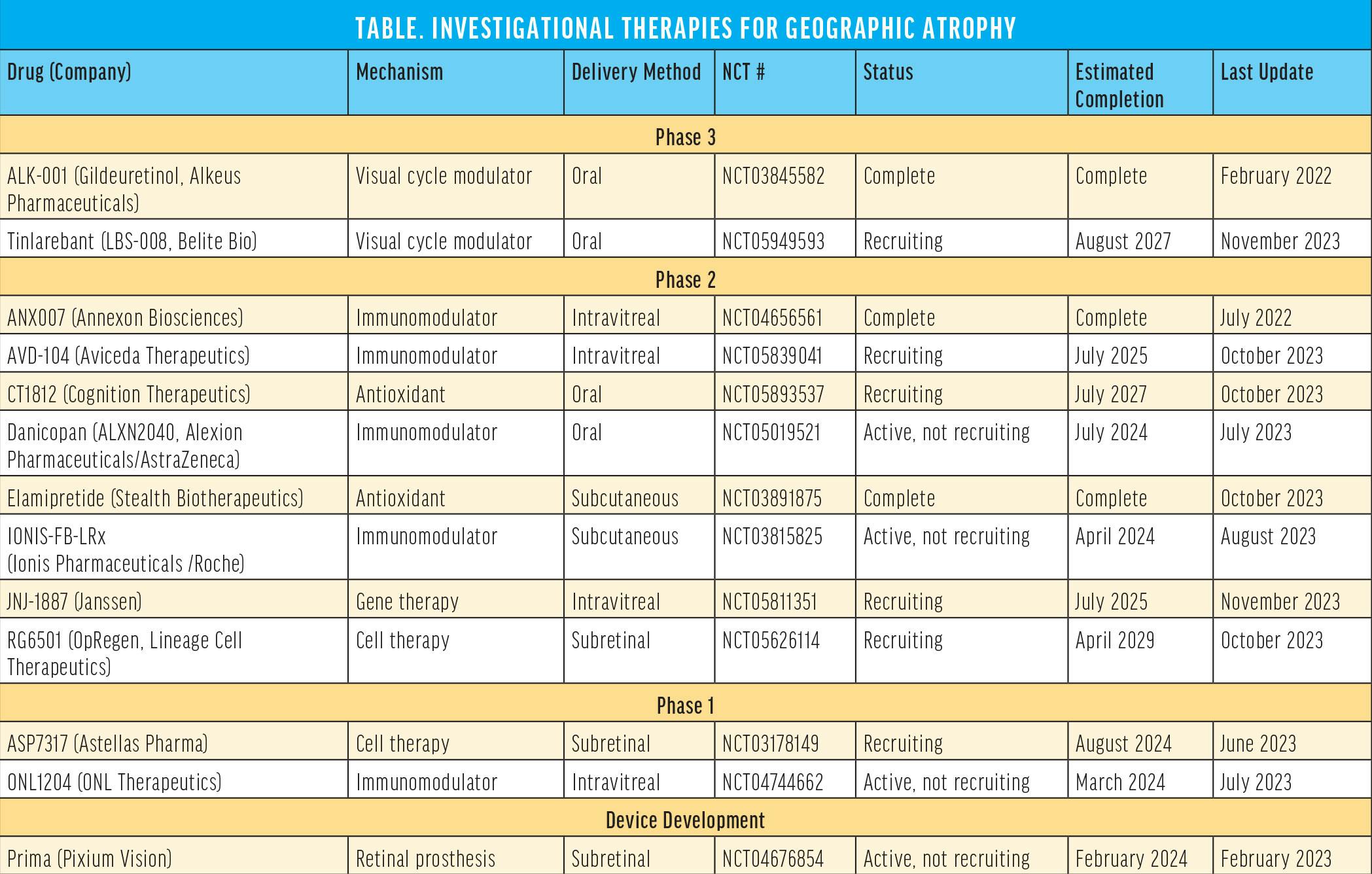
New treatments for geographic atrophy (GA) took center stage in the retina community this past year. With the approval of pegcetacoplan (Syfovre, Apellis Pharmaceuticals) in February, followed by avacincaptad pegol (Izervay, Iveric Bio/Astellas Pharma) in August, coining 2023 The Year of GA seems appropriate.1 As the year comes to a close, let’s review some of the promising new therapies for GA still in the pipeline, including antioxidants, gene and cell therapies, immunomodulators, a retinal prothesis, and visual cycle inhibitors (Table).
ANTIOXIDANTS
Elamipretide (Stealth Biotherapeutics) acts as a mitochondrial enhancer by binding to damaged cardiolipins to help restore oxidation within the mitochondria. The phase 2 ReCLAIM-2 trial (NCT03891875) found that patients who received subcutaneous delivery of elamipretide had a 43% reduction in ellipsoid zone total attenuation at 48 weeks (P = .003) compared with patients treated with placebo, which was associated with improvement in low-luminance visual acuity. Although the trial did not meet the primary endpoints of GA lesion progression and mean change in low-luminance visual acuity, the secondary endpoint results were promising enough for Stealth to support continued development of elamipretide in phase 3 trials.2
CT1812 (Cognition Therapeutics) is a selective σ-2 antagonist designed to regulate the damage-response processes that are impaired in GA. The phase 2 study (NCT05893537) is assessing the efficacy, safety, and tolerability of a single oral dose of 200 mg CT1812 compared with placebo. The primary endpoint is the change in GA lesion area from baseline over 104 weeks.3
GENE AND CELL THERAPIES
ASP7317 (Astellas Pharma), a subretinal therapy derived from human embryonic stem cells, is designed for the treatment of GA in patients who have already lost some central vision. The phase 1b trial (NCT03178149) is enrolling approximately 18 patients and is evaluating three different doses of ASP7317 in conjunction with immunosuppressive therapy. The primary outcomes include safety and tolerability at 52 weeks, with secondary endpoints of change in GA lesion area and BCVA at week 52.
JNJ-1887 (formerly HMR59, Janssen) is a one-time intravitreal injection under investigation for the treatment of both GA and wet AMD. The pooled phase 1 trial data showed that the therapy was well tolerated with no dose-limiting toxicities or serious or systemic adverse events.4 The phase 2 trial (NCT05811351) is evaluating a high and low dose in combination with prophylactic steroids compared with a sham arm.
RG6501 (OpRegen, Lineage Cell Therapeutics) is an allogeneic retinal pigment epithelial cell therapy that has shown promise in a phase 1 trial. The subretinally delivered therapy led to retinal structural improvement in five patients and an average BCVA gain of 12.8 letters at 1 year compared with baseline.5 The phase 2 trial (NCT05626114) is evaluating the proportion of patients (n = 60) successfully treated with the subretinal delivery method, as well as the incidence and severity of adverse events 3 months postoperatively.
IMMUNOMODULATORS
ANX007 (Annexon Biosciences) is a neuroprotective inhibitor of C1q. The phase 2 ARCHER trial (NCT04656561, n = 270) failed to meet the primary endpoint of statistically significant reduction in GA lesion growth at 12 months. However, there was a greater reduction in lesion growth between months 6 and 12 compared with months 1 to 6, suggesting a possible delayed effect with C1q inhibition and an improved effect with longer duration of therapy.6
ANX007 also showed a dose-dependent protection from vision loss and did not increase the rate of choroidal neovascularization conversion. At 12 months, the risk reduction of a ≥ 15 letter vision loss was 72% for monthly and 48% for every-other-month ANX007 injections. Plans are underway for phase 3 trials, and ANX007 received Priority Medicine designation by the European Medicines Agency for the treatment of GA.6
AVD-104 (Aviceda Therapeutics) is a sialic acid-coated nanoparticle designed to bind to specific sialic acid-binding immunoglobulin-type lectin receptors and repolarize overactivated macrophages into their resolution phenotype.7,8 AVD-104 also binds and upregulates complement factor H. Interim data from the phase 2 part 1 safety trial (NCT05839041) found a single intravitreal injection of AVD-104 was well tolerated with no drug-related or serious adverse events. Early efficacy data of the first patients (15/30) to reach the 3-month endpoint found 80% had visual acuity gain from baseline. Part 2 of the trial is actively enrolling (n = 290, 75% with extrafoveal GA lesions) to compare four treatment groups with a primary endpoint of rate of GA lesion change.7
Danicopan (ALXN2040, Alexion Pharmaceuticals/AstraZeneca) is a small-molecule inhibitor of complement factor D that is under investigation as an oral therapy. The phase 2 trial (NCT05019521, n = 332) is evaluating four treatment arms: 100 mg or 200 mg twice daily, 400 mg once daily, and matching placebo. The trial includes a 6-week screening period, a 104-week treatment period, and a 30-day follow-up period. Danicopan is also being investigated as a treatment for paroxysmal nocturnal hemoglobinuria.9
IONIS-FB-LRx (Ionis Pharmaceuticals/Roche) is an antisense oligonucleotide inhibitor of hepatic production of complement factor B, which is associated with hyperactivity of the alternative pathway seen in GA. Phase 1 studies found a significant dose-dependent reduction in plasma levels of complement factor B with subcutaneous injections of IONIS-FB-LRx compared with placebo. The phase 2 GOLDEN trial (NCT03815825, n = 330) is ongoing with data expected in early 2024.10
ONL1204 (ONL Therapeutics) is a Fas inhibitor aimed at reducing Fas-mediated retinal cell apoptosis and inflammatory cytokines. The phase 1b part 1 (n = 6) safety assessment (NCT04744662) of a single intravitreal injection of the study drug found early efficacy with an average reduction in GA lesion growth of 42% at 6 months compared with the untreated fellow eye.11 Further results from phase 1b part 2 (n = 16) assessing the safety and tolerability of two injections (every 3 months) are expected in early 2024. ONL1204 is also being tested in rhegmatogenous retinal detachment, central retinal artery occlusion, and glaucoma.
VISUAL CYCLE INHIBITORS
ALK-001 (Gildeuretinol, Alkeus Pharmaceuticals) is a deuterium-enriched vitamin A initially developed for Stargardt disease and GA. Orally administered ALK-001 replaces the body’s own vitamin A and, theoretically, slows the buildup of toxic vitamin A dimer formation. The phase 3 SAGA trial (NCT03845582, n = 200) is complete with data pending. The company recently announced positive data for the TEASE-1 trial for patients with Stargardt disease.12
Tinlarebant (LBS-008, Belite Bio), an oral antagonist of retinol-binding protein used to reduce the accumulation of vitamin A-based toxins, is in clinical trials for GA and Stargardt disease. The phase 1 trial (n = 71) confirmed that the drug is safe and tolerable, and that once-daily oral administration achieved potentially therapeutic levels.13 The phase 3 PHOENIX trial (NCT05949593) is enrolling approximately 430 patients and is evaluating the rate of change in GA lesion size with once-daily oral 5 mg tinlarebant.
RETINAL PROSTHESIS
The Prima System (Pixium Vision) is a retinal prothesis that stimulates a subretinal microchip for improving visual acuity in severe center-involving GA (see, Bionic Vision in the Pipeline). The European pivotal study (n = 5) showed that the implant was safe and well tolerated with early efficacy data demonstrating a mean visual gain of 32 ETDRS letters from baseline when patients used the system’s zoom feature. Results from the PRIMAvera trial (NCT04676854, n = 38) are expected by spring 2024.14
BIONIC VISION IN THE PIPELINE
Pixium Vision recently announced 48-month data for its Prima System, a subretinal implant stimulated by augmented-reality glasses.1 For more on this system and other vision-restoring approaches, see Macular Degeneration: Time to Focus on Vision in the May/June issue.
1. Pixium Vision announces 48-month trial results in severe atrophic AMD [press release]. Eyewire+. November 14, 2023. Accessed November 15, 2023. bit.ly/3R2fNPL
2023 RECAP
This year has been full of ups and downs in the GA research space, and we are learning much about clinical trial design, the regulatory pathway, tracking lesion growth, and drug delivery methods. Even failed trials have added significantly to our understanding of the GA therapeutic landscape. Next year is already shaping up to be another one for the record books, and we are excited to see the next steps in the era of GA therapy.
1. Kirkner RM. 2023: The year of geographic atrophy. A comprehensive look at 87 clinical programs for investigative treatments in retina. Retina Specialist. February 14, 2023. Accessed November 13, 2023. rb.gy/4vyb0m
2. Heier J. ReCLAIM-2 trial, a phase 2 trial of elamipretide in patients with non-central geographic atrophy. Presented at: American Society of Retina Specialists; July 14, 2022; New York, NY.
3. Cognition Therapeutics. Age-related macular degeneration. Accessed November 13, 2023. bit.ly/47bO58P
4. Lad EM, Chao DL, Pepio A, et al. Pooled safety analysis of a single intravitreal injection of JNJ-1887 (gene therapy, AAVCAGsCD59) in patients with age-related macular degeneration (AMD). Invest Ophthalmol Vis Sci. 2023;64:732.
5. RG6501 (OpRegen) phase 1/2a results show evidence of rapid improvement of outer retinal structure in patients with geographic atrophy secondary to age-related macular degeneration [press release]. BioSpace. October 5, 2023. Accessed November 13, 2023. bit.ly/47fUWOr
6. Lally D. Treatment of geographic atrophy secondary to AMD with intravitreal ANX007, a selective classical complement inhibitor: results of the ARCHER study. Presented at: AAO Eyecelerator; November 3, 2023; San Francisco, CA.
7. Genead M. Aviceda Therapeutics. Using nature’s design but better... pioneering a new wave of therapeutics using glycoimmunology. Presented at: AAO Eyecelerator; November 2, 2023; San Francisco, CA.
8. Aviceda: Our Approach. Accessed November 13,2023. www.avicedarx.com/approach
9. Boyer DD, Ko P-Y, Podos SD, et al. Danicopan, an oral complement factor D inhibitor, exhibits high and sustained exposure in ocular tissues in preclinical studies. Transl Vis Sci Technol. 2022;11(10):37.
10. Jaffe GJ, Sahni J, Fauser S, Geary RS, Schneider E, McCaleb M. Development of IONIS-FB-LRx to treat geographic atrophy associated with AMD. Invest Ophthalmol Vis Sci. 2020;(61):4305.
11. Wykoff CC. Fas inhibition with ONL1204 for the treatment of geographic atrophy: first-time interim results from a phase 1 open-label dose escalation study. Presented at: Macula Society; February 17, 2023; Miami, FL.
12. Alkeus Pharmaceuticals presents positive gildeuretinol trial results at American Academy of Ophthalmology, demonstrating significant slowing of retinal atrophic lesions in Stargardt disease [press release]. BioSpace. November 3, 2023. Accessed November 13, 2023. bit.ly/47OgTUT
13. Grigg JR, Chen FK, Chen T-C, et al. A phase 1b/2 study of the safety and tolerability of tinlarebant in adolescent patients affected by Stargardt disease–15 month preliminary data. Invest Ophthalmol Vis Sci. 2023;64:2597.
14. Muqit M, Mer YL, Koo LO, Holz F, Sahel J, Palanker D. Prosthetic visual acuity with the PRIMA System in patients with atrophic age-related macular degeneration at 4 years follow-up. medRxiv. 2023:2023.11.12.23298227.


_1784132761.jpg?auto=compress,format&w=75)





