

A 76-year-old woman who has been diagnosed with GA presented to the clinic reporting greater difficulty seeing while reading and sewing. BCVA OS was CF, and BCVA OD was 20/25; both had been stable for 3 years. First detection of GA lesion occurred 3 years ago, when OCT imaging depicted sub-RPE hypertransmission (Figure 1).
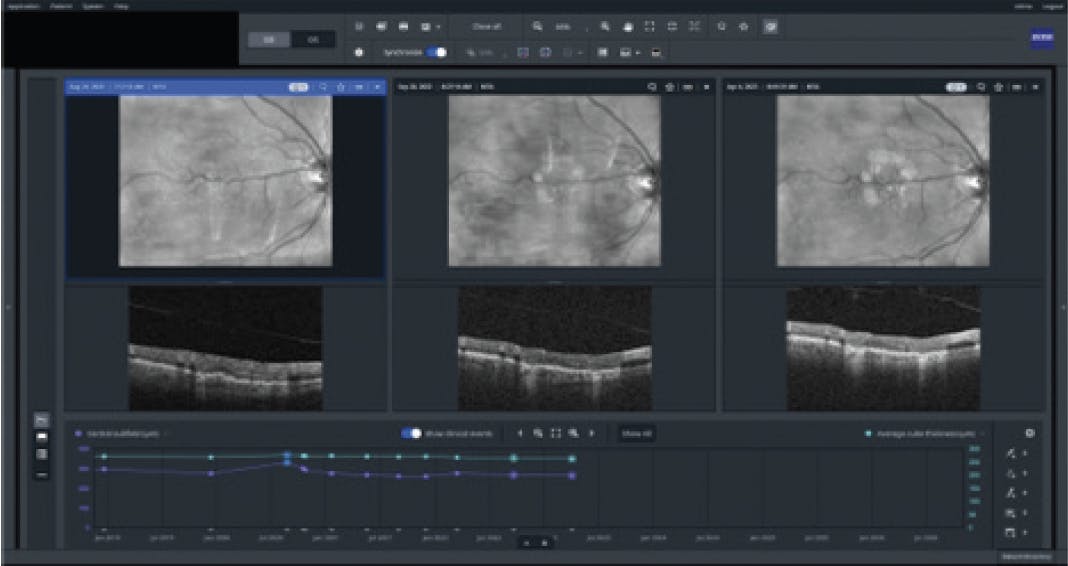
Figure 1. Average cube thickness (green line) and central subfield (purple line) remained stable from January 2019 to April 2023, with the exception of an aberration that was detected in August 2020. The occurrence of this aberration coincided with her GA diagnosis. Note that the OCT images on left, center, and right are, respectively, from August 2020, September 2022, and April 2023.
En face imaging showed that lesion growth in the 5-mm area around the foveal center had increased from 0.2 mm2 in August 2020 to 5.7 mm2 in April 2023 (Figure 2). Although the closest lesion distance from the foveal center remained unchanged, overall increase in lesion area may account for the patient’s visual changes. The patient is very motivated for GA treatment once available at our institution.
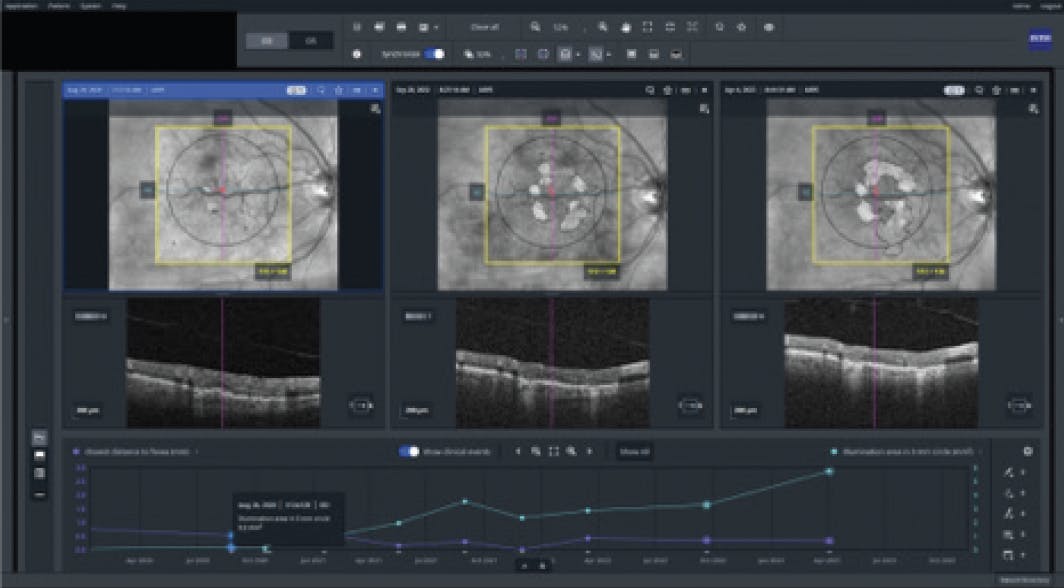
Figure 2. A marked increase in lesion area within 5 mm of the foveal center (green line) may be related to the patient’s subjective decline in central vision. Despite increased lesion area, the distance of lesions from the foveal center (purple line) remains largely unchanged.
The ZEISS Retina Workplace’s image registration software allowed me to ensure that I tracked the same regions of the patient’s retina over time. Showing a patient such as this a series of en face images depicting lesion growth alongside a line chart tracking lesion area over time may lead to better patient education. For providers, such longitudinal tracking and automatic quantification of data allows more data-driven care.
