




Rishi P. Singh, MD: Imaging geographic atrophy (GA) has taken on new importance now that therapies for GA are becoming available. Which imaging modalities are most effective for screening patients with possible GA?
Katherine E. Talcott, MD: I chiefly rely on OCT during the screening process. If the patient’s previous OCT images are available, either because they are a returning patient within our health system or because a referring provider sent images to our office, I compare their previous OCT images with the one I capture in the clinic to see if any significant changes warrant further exploration. Near infrared reflectance (NIR) also serves as a useful tool, as it can identify areas of atrophy that may be undetected on routine OCT.
Mrinali Gupta, MD: I, too, use OCT for screening potential GA patients. If I detect atrophy—even nascent atrophy that may not yet warrant treatment—I capture fundus photography and fundus autofluorescence (FAF) so I may longitudinally track lesion progression. FAF empowers my patients to better understand their disease, as the outputs of these reports are quickly grasped by patients. FAF also allows me to better assess the risk of lesion progression. If I see a banded lesion or patterns of diffuse hyperautofluorescence, then I know the patient is at higher risk of lesion growth.
Roger A. Goldberg, MD, MBA: We should note that NIR and FAF depict slightly different anatomic structures, with NIR showing the outer retina and FAF depicting the retinal pigment epithelium (RPE). In my experience, reports from these two modalities tend to correlate to each other.
Dr. Singh: A GA lesion’s proximity to the fovea is of particular concern because it threatens central vision. How exactly do we define foveal and non-foveal involvement?
Dr. Gupta: Classifying lesions of foveal or extrafoveal is complicated by the fact that various studies have defined the fovea differently. I tend to think of the fovea as the 250-µm radius around the foveal center, but others say that the only foveal center is the fovea. Given the varying definitions regarding what is and is not the fovea, I rely on imaging and functional vision to classify a patient’s disease as foveal-involving.
Dr. Goldberg: In my busy clinic, I define foveal involvement as a combination of lesion area, lesion location, and how those lesions have affected functional vision. It might not align with strict classifications, but it works for my practice.
Dr. Singh: How closely do you track and measure GA lesions that you detect on imaging? Do you leverage any particular software to assist you?
Dr. Talcott: Before a treatment was approved for GA, measuring GA lesion growth was a task that yielded little benefit; I typically measured GA lesion area only while screening patients for clinical trials. But now that we’re practicing in the GA treatment era, calculating lesion area and tracking it longitudinally has great benefit, particularly when seeing patients with extrafoveal disease that has yet to affect their vision. Extrafoveal lesion growth can sneak up on you if you’re not tracking it diligently.
Dr. Gupta: I rely on the ZEISS CIRRUS OCT to quantify lesion area and to display images from a previous visit alongside a current visit. Patients respond to straightforward data, and connecting lesion area to overall quality of vision is a straightforward concept. When they see how their lesions have changed, they quickly grasp whether their disease is progressing.
Dr. Goldberg: I like to compare three images: the first visit, the previous visit, and the current visit. GA is a relatively slow-moving disease, and changes from a visit 4 or 6 months prior may not be significant. But when I place recent images next to a years-old baseline image, the degree of lesion growth is obvious.
Pearl NO.1: Clinical Pearl from Dr. Goldberg
If capturing baseline FAF imaging that will not affect your immediate clinical decision-making, consider adjusting your workflow so that the patient sits for FAF imaging as they exit the clinic. This way, there are fewer bottlenecks on the patient’s journey to seeing the clinician.
Dr. Singh: Standardized nomenclature in GA is key to ensuring that our community can speak to each other about our findings. Dr. Gupta, can you provide a primer on the language surrounding GA and explain why it may be relevant to a discussion on imaging this disease?
Dr. Gupta: The Classification of Atrophy Meetings (CAM) convened to define specific terms relevant to retinal atrophy. When it came to characterizing GA as seen on OCT, the CAM group proposed that clinicians use two terms to more accurately characterize the anatomy of GA patients: complete RPE and outer retinal atrophy (cRORA) and incomplete RPE and outer retinal atrophy (iRORA).1 In particular, cRORA requires four distinct criteria to be met:1
- A region of hypertransmission of at least 250 µm in diameter;
- A zone of attenuation or disruption of the RPE of at least 250 µm in diameter;
- Evidence of overlying photoreceptor degeneration; and
- Absence of scrolled RPE or other signs of an RPE tear.
While we might not use terms like cRORA and iRORA in our conversations with patients—or, indeed, with other retina specialists—we nevertheless must rely on this standardized language lest we struggle to define the disease and communicate research findings.
Dr. Talcott: There is some confusion about the term hypertransmission. Sometimes phrases such as transillumination, transmission defect, or subillumination are used. In my experience, subillumination is a term I see almost exclusively in the ZEISS Retina Workplace, and it refers to any degree of anatomic disruption to the RPE as seen on OCT. Practically speaking, these terms are interchangeable.
Dr. Gupta: Some retina specialists may wish to show their patients how hypertransmission has changed over time, and B-scans are convenient adjuncts to en face images. Having both perspectives side-by-side in the ZEISS advanced RPE analysis software empowers clinicians to educate patients.
Peal NO.2: Clinical Pearl from Dr. Gupta
When using the Advanced RPE Analysis functions within the ZEISS system to illustrate longitudinal changes on en face imaging or OCT B-scans, ask your scribes to pull the most recent image and the previous image so that you can compare results with the patient; relying on staff to assist in this process will give you more face time with your patients. You can always toggle back further via manual selection if you want to find an older image against which to compare the most recent scan.
Dr. Singh: What other features of the ZEISS Retina Workplace are helpful when tracking GA progression?
Dr. Gupta: I like that the software measures not only overall lesion size, but also lesion distance from the fovea and calculates how that has changed over time.
Dr. Talcott: If you find an aberration in the longitudinal measurement of distance from the fovea, you can easily toggle back to other dates to see what happened. Sometimes, patients fixate eccentrically or the software gets confused. Manual override of this is rarely needed, but is easy to do.
Dr. Goldberg: Image registration—that is, the ability to standardize captured images and display them longitudinally so that you have confidence you’re measuring the same area over time—is a great tool for tracking patient progression (Figure). Now that we have approved therapy for GA, I suspect that doctors will rely on image registration more often.
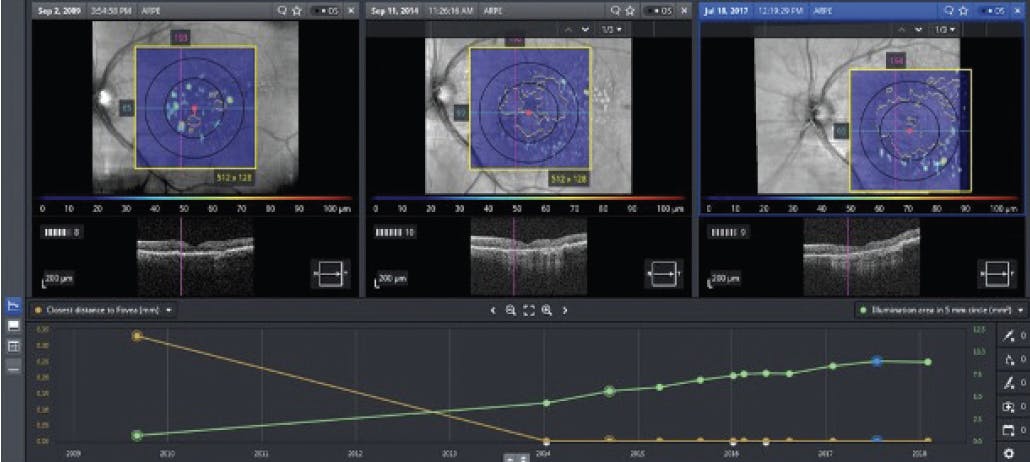
Figure. Longitudinal OCT data as displayed in the user interface of the Zeiss Retina Workplace. In this patient history, the three-up OCT display (top/middle rows) depicts three time points using the advanced RPE analysis tool tracking GA progression. The longitudinal analysis display (bottom row) tracks two separate metrics over time: closest lesion distance to the foveal center (yellow line) and illumination area within 5mm of the foveal center (green line). The latter metric is a reasonable surrogate of GA lesion size.
Image provided by Eric W. Schneider, MD.
Dr. Singh: What role does OCT angiography (OCTA) play when examining patients with suspected or diagnosed GA?
Dr. Goldberg: It may not be mainstream yet, but OCTA is helpful in some instances. I pay extra attention to patients who show either a double-layer sign or a flat pigment epithelial detachment on the edge of a GA lesion on OCT, as I worry that either may be a sign of impending or nascent neovascularization. In fact, I sometimes detect some evidence on OCTA of early neovascularization in a shallow PED.
Dr. Talcott: OCTA is less invasive and more widely available than fluorescein angiography, and it’s my preferred modality for the instances Dr. Goldberg describes above. I think the growing ubiquity of OCTA will lead to an uptick in use.
Dr. Goldberg: I would note that I do not bring patients back sooner than regularly scheduled if they demonstrate potential or actual neovascularization on OCTA. I’ve started patients on every-other-month regimens for GA therapy, and I think examination for neovascularization on that schedule is safe. After I explain that their unique features may place them at additional risk of exudation, I advise that they continue use of an Amsler grid and to call my office if visual disruption occurs.
Pearl NO.3: Clinical Pearl from Dr. Talcott
If you observe an area suspicious for exudative conversion on OCT when examining a GA patient scheduled to return to your clinic, consider ordering OCTA to be conducted upon their next visit if no choroidal neovascular membrane is seen on the initial one. By capturing OCTA imaging immediately after their routine OCT at their forthcoming appointment, you’ll barely notice a hiccup in workflow.
Dr. Singh: Questions abound about the role of imaging in GA as our experience with treatment deepens. Will we place greater emphasis on quantitative data later in the disease state but more emphasis on OCT transillumination early in the disease course? Will some doctors prefer to generate prognoses based on lesion location rather than lesion type as depicted on FAF?
It remains to be seen exactly how we’ll use imaging in the treatment of GA. But one thing is certain: Imaging has a role to play, and we will likely make treatment decisions for GA patients based on longitudinal data organized by technology such as the ZEISS Retina Workplace.
1. Sadda SR, Guymer R, Holz FG, et al. Consensus definition for atrophy associated with age-related macular degeneration on OCT: classification of atrophy report 3. Ophthalmology. 2018;125(4):537-548.
