


Patients with diabetic eye disease can be some of the most challenging patients to care for in the retina clinic. Nonetheless, clinicians shouldn't have to start from scratch when formulating a treatment plan for each new patient with diabetic macular edema (DME). Most patients with DME fit into one of three typical presentations of disease, and a flexible, evidence-based treatment algorithm can help clinicians care for patients efficiently and effectively.
AT A GLANCE
- Most presentations of diabetic macular edema fit into one of three categories, and implementing a flexible, evidence-based treatment algorithm can be efficient and effective.
- Cases of pure focal leakage, while rare, often do well with appropriately applied focal laser treatment.
- Mixed and diffuse leakage often do well with initial therapy with anti-VEGF agents; unresponsive patients may require steroids or grid laser.
START WITH IMAGING
The first step is to do a thorough clinical examination and perform OCT and fluorescein angiography (FA), unless it's contraindicated. Although FA is used less frequently with the advent of OCT angiography (OCTA), it remains an important imaging tool in terms of staging disease and tracking retinopathy. These imaging results will guide the initial treatment decisions based on whether the patient has focal, diffuse, or mixed leakage (Figure).
FOCAL LEAKAGE
The most obvious patients to identify are those who have predominantly focal leakage—this constitutes a minority (5% to 10%) of patients in our practice. On clinical examination and FA, patients with focal leakage have a relatively small number of microaneurysms that are responsible for most of the leakage and swelling of the macula. These cases often do well with appropriately applied focal laser therapy, as it is a durable treatment that can save patients from ongoing injections.
In addition, research suggests that microaneurysm-mediated leakage is less responsive to anti-VEGF therapy than diffuse leakage.1 For example, FA before and after anti-VEGF injections for DME demonstrates a more rapid resolution of leakage when it is diffuse, but frequently shows persistent leakage when it is focal.
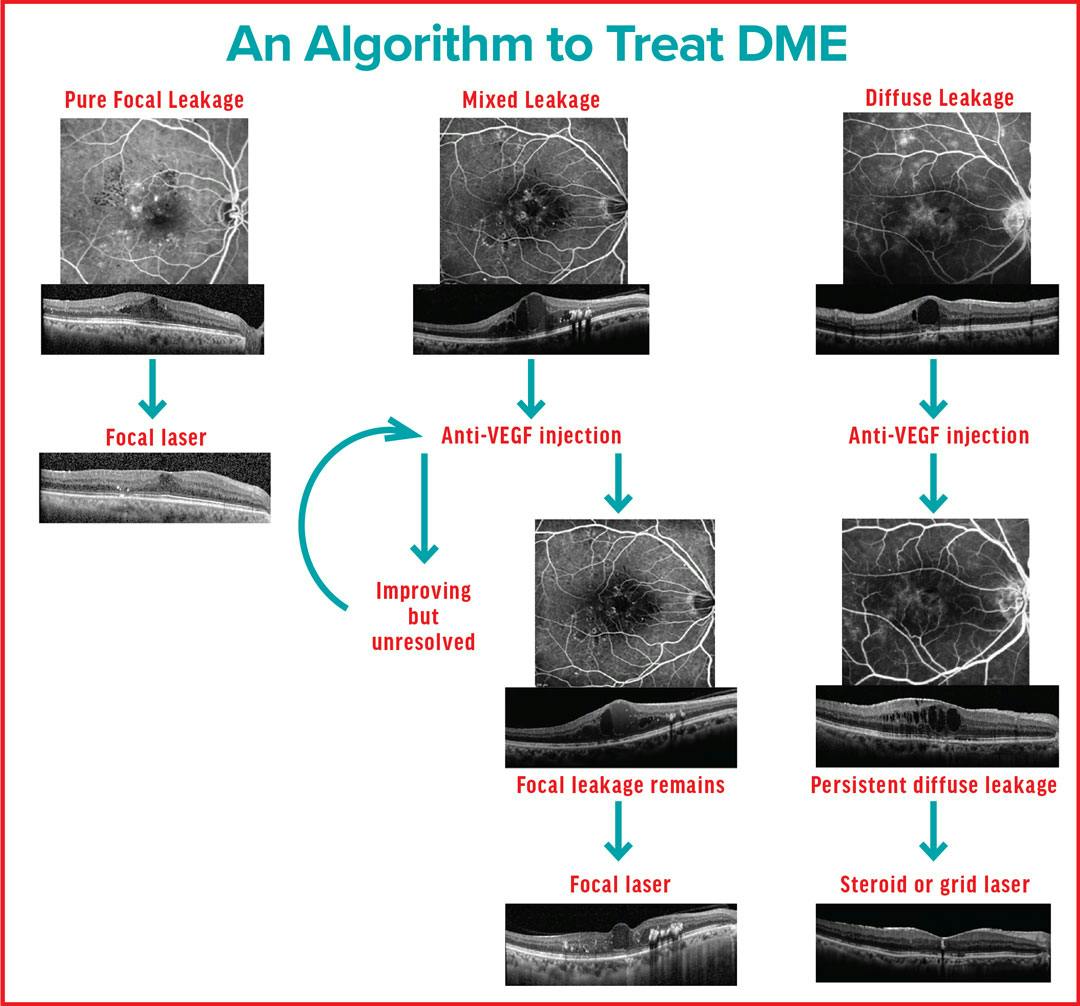
Figure. This algorithm, coupled with a careful assessment of the patient's individual needs, can help clinicians effectively treat DME based on the initial presentation and treatment response.
DIFFUSE/MIXED LEAKAGE
Most patients with DME present with either diffuse leakage or a mixture of both focal and diffuse leakage. Both groups do well with anti-VEGF injections as the first-line treatment. In my practice, we start with three monthly injections as a unit of treatment, adapted from the more complex 4-2-1-1-1-1 treatment plan used by the Diabetic Retinopathy Clinical Research (DRCR.net) Retina Network Protocol I.2
A single anti-VEGF injection rarely resolves the DME; in fact, studies show that most patients need eight or nine injections over the first year of treatment to reach the OCT criteria for withholding therapy.3
Because managing diffuse and mixed DME frequently requires long-term treatment, clinicians should consider performing OCT at each injection visit, particularly early in the process to ensure patients require ongoing therapy. Rarely (but it does happen), a patient may experience rapid resolution after a few injections and only require close monitoring. If the patient shows improvement with anti-VEGF injections, clinicians should treat until the patient's OCT shows resolution of fluid, vision has improved, and the fovea returns to its expected morphology. Patients with resolved DME still require frequent follow-up and imaging.
Cases of mixed leakage with incomplete response to anti-VEGF therapy may benefit from repeat FA and laser to address the microaneurysms.2,3 After all, anti-VEGF trials are often trials of anti-VEGF therapy plus rescue laser. In Protocol T, 40% of patients required rescue laser therapy, even with treatment with aflibercept (Eylea, Regeneron).2,3
Although many retina specialists may hesitate to add laser therapy, combination treatments are evidence-based and can benefit DME patients with focal and mixed leakage.2,3
For patients with diffuse leakage who do not improve on anti-VEGF therapy, the second line of treatment is either steroid or grid laser. I tend to avoid repeat anti-VEGF injections if the patient doesn't respond; instead, I often pivot to steroids. At Duke, we have excellent glaucoma colleagues with whom we collaborate before treating with steroids in cases where IOP response is a significant concern.
I often start with intravitreal dexamethasone (Ozurdex, Allergan/Abbvie) as the first steroid test because it is relatively short acting, and any steroid response is usually manageable with topical medications. For patients who do well with dexamethasone, I frequently move them to a fluocinolone acetonide intravitreal implant (Iluvien, Alimera Sciences). When I dose a patient with a short-acting steroid, I also seek prior authorization for the fluocinolone acetonide implant so that I have it as an option at follow-up.
If patients are not good candidates for steroids, grid laser is an option, but it is often reserved as a salvage treatment.
THE BIRTH OF AN ALGORITHM
The faculty at Duke Eye Center in Durham, North Carolina, led by Scott W. Cousins, MD, designed this treatment algorithm to help trainees and young attendings quickly understand what care most patients with DME need. Without an artificial intelligence platform to evaluate, with 100% accuracy, whether a patient would do well with any given therapy, this algorithm is the next best thing. The Duke faculty continuously update the algorithm as new therapies are approved and new research advances the field’s understanding of the disease.
INCORPORATING NEW THERAPIES
Treatment burden is a significant issue for this patient population, with patients averaging approximately 15 to 16 anti-VEGF injections over a 2-year period.3 Thus, longer-duration therapies are a welcome advancement. However, clinicians rarely use a treat-and-extend approach for patients with diabetes, and a more pulsatile treatment approach tends to work well. In Protocol T, patients required an average of eight or nine injections in the first year, three or four in the second year, and one or two in the third year.3
Clinicians and researchers are still working to determine which patients with diabetes might benefit from treatment with longer-acting or dual-action therapies, such as faricimab (Vabysmo, Genentech/Roche), the port delivery system with ranibizumab (Lucentis, Genentech/Roche), or 8 mg aflibercept (Eylea HD, Regeneron).
At 2 years, patients with DME treated with faricimab every 8 weeks in YOSEMITE and RHINE experienced a mean BCVA change of +10.7 and +10.9 ETDRS letters, respectively; those treated with a personalized treatment interval up to every 16 weeks had a mean BCVA change of +10.7 and +10.1 ETDRS letters, respectively.4 The researchers noted that more patients achieved resolution of their DME and an absence of intraretinal fluid with faricimab compared with aflibercept every 8 weeks through week 100.4 Faricimab may be useful for patients who do not achieve a good response with traditional anti-VEGF agents and who have glaucoma or are known steroid responders.
The 2-year results of the phase 3 PHOTON trial of 8 mg aflibercept showed that 89% of patients with DME in the treatment arm maintaining ≥ 12-week dosing through 2 years, 83% maintaining ≥ 16-week dosing, and 43% met the criteria for ≥ 20-week dosing by week 96.5
FUTURE ADVANCES
Given the treatment burden, researchers are looking at novel approaches to therapy, some of which are promising.
RGX-314 (Regenxbio) is a gene therapy that enables virus-mediated production of an anti-VEGF Fab fragment in ocular tissues. The phase 2 ALTITUDE is a dose-escalation study for diabetic retinopathy that is underway.6
OPT-302 (Opthea), an anti-VEGF therapy that targets VEGF-C and -D, is under investigation as a combination therapy with available anti-VEGF agents. The phase 2 data of patients with refractory DME treated with combination therapy showed that 52% of patients experienced improved VA ≥ 5 letters at 12 weeks compared with baseline.7
APX3330 (Ocuphire Pharma) is an oral therapy in phase 2 for the treatment of diabetic retinopathy. Preliminary data suggest that, at 24 weeks, no patients treated with APX3330 had a binocular ≥ 3-step worsening of DRSS from baseline compared with 16% of patients treated with placebo.8
These therapies, if successful, have the potential to improve patient care and disrupt the current DME treatment algorithm.
THE ART OF TREATMENT
While the treatment algorithm outlined in this article serves as a useful guide for an increasingly complex therapeutic landscape, the art of medicine remains paramount. There will always be patients for whom treatment burden, cost of therapy, or specific complications such as glaucoma surgery are an overriding concern. These patient concerns will help to inform the treatment approach, and, ultimately, physicians must tailor therapy to the individual patient.
1. Allingham MJ, Mukherjee D, Lally EB, et al. A quantitative approach to predict differential effects of anti-VEGF treatment on diffuse and focal leakage in patients with diabetic macular edema: a pilot study. Transl Vis Sci Technol. 2017;6(2):7.
2. Bressler SB, Odia I, Glassman AR, et al. Changes in diabetic retinopathy severity when treating diabetic macular edema with ranibizumab: DRCR.net Protocol I 5-year report. Retina. 2018;38(10):1896-1904.
3. Wells JA, Glassman AR, Ayala AR, et al. Aflibercept, bevacizumab, or ranibizumab for diabetic macular edema two-year results from a comparative effectiveness randomized clinical trial. Ophthalmology. 2016;123(6):1351-1359.
4. Lim JI, Wells JA; Eichenbaum DA; et al. Efficacy, durability, and safety of faricimab in diabetic macular edema: 2-year results from the phase 3 YOSEMITE and RHINE trials. Invest Ophthalmol Vis Sci. 2022;63:3850.
5. Two-year results for aflibercept 8 mg from PHOTON trial demonstrate durable vision gains at extended dosing intervals in DME [press release]. Eyewire+. June 27, 2023. Accessed July 3, 2023. bit.ly/46uMk6x
6. RGX-314 gene therapy administered in the suprachoroidal space for participants with diabetic retinopathy (DR) without center involved-diabetic macular edema (CI-DME) (ALTITUDE). November 17, 2022. Accessed July 3, 2023. bit.ly/45wQx8H
7. A dose ranging study of OPT-302 with aflibercept for persistent diabetic macular edema. Updated June 22, 2022. Accessed July 3, 2023. bit.ly/3YIntZx
8. Ocuphire presents APX3330 ZETA-1 clinical data in late-breaker session at the American Diabetes Association’s Annual Conference [press release]. Ocuphire. June 27, 2023. Accessed July 3, 2023. bit.ly/3sdF0N6


_1784132761.jpg?auto=compress,format&w=75)





