


Iris melanoma and Cogan-Reese syndrome (CRS), while pathologically distinct, share several clinical features that could lead to misdiagnosis. Each condition tends to present in middle-aged patients with structural changes to the iris, accompanied by obstruction of the iridocorneal angle and subsequent elevated IOP. Characteristics unique to CRS, a variant of iridocorneal endothelial (ICE) syndrome, include corneal endothelial “beaten metal” appearance, corneal edema, and broad peripheral anterior synechiae (PAS). Conversely, features particular to iris melanoma include a solid iris mass with additional iris stromal and angle seeding, as well as evidence of mass growth.1
The following case demonstrates the significant overlap in presentation between CRS and iris melanoma and outlines an approach to differentiate these diagnoses.
CASE REPORT
During a routine eye examination, a 60-year-old White man was discovered to have a thickened iris with an irregular pupil in his left eye, which is concerning for iris melanoma. The patient had an ocular history of glaucoma in his left eye that was controlled with topical medication. On examination, his BCVA was 20/30 OU with IOP of 12 mm Hg OD and 15 mm Hg OS. On slit-lamp and fundoscopic examination, the right eye was unremarkable. Dilated fundus examination of the left eye was also unremarkable.
The anterior segment of the left eye revealed a distorted pupillary margin dragged superotemporally with prominent ectropion irides, corectopia, and flattened iris appearance without crypts. The iris surface demonstrated multiple small, uniform nodules that were 300 µm in diameter (Figure 1). In the 2:30 meridian, there was an adhesion of the iris to the corneal endothelium with broad PAS. Close biomicroscopic inspection confirmed a corneal endothelium with a “beaten metal” appearance.
Imaging with ultrasound biomicroscopy and anterior segment OCT (AS-OCT) confirmed the presence of iris nodules and PAS (Figure 2). These features of regularly spaced iris nodules, broad PAS, and endothelial abnormalities were consistent with CRS masquerading as iris melanoma. Observation and continued treatment with IOP-lowering medications were recommended.
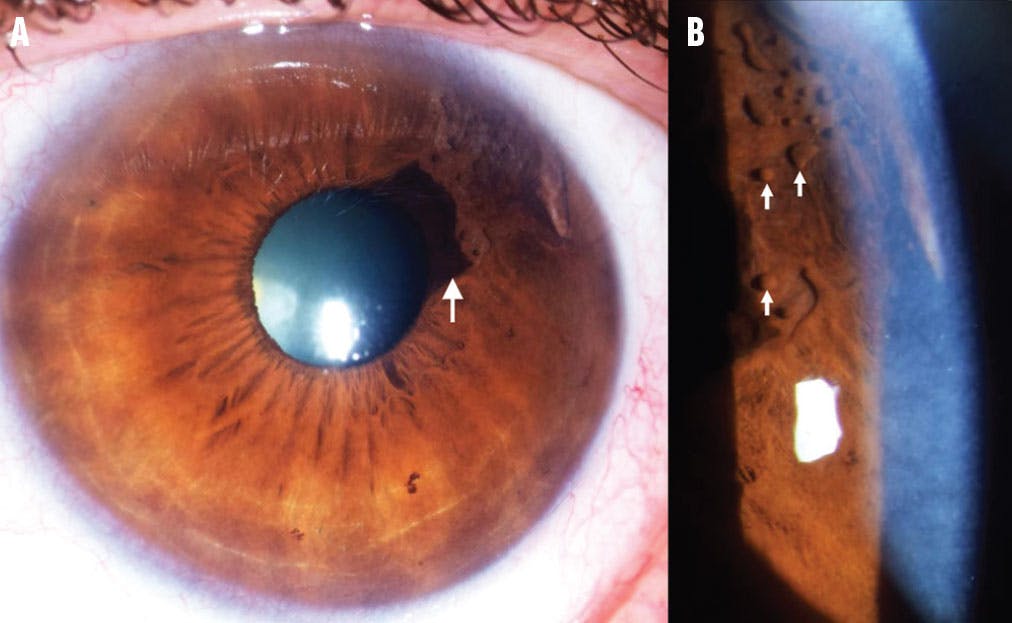
Figure 1. Slit-lamp photography showed ectropion uveae (A, white arrow) and multiple pedunculated nodules in the superotemporal quadrant of the left eye (B, white arrows).
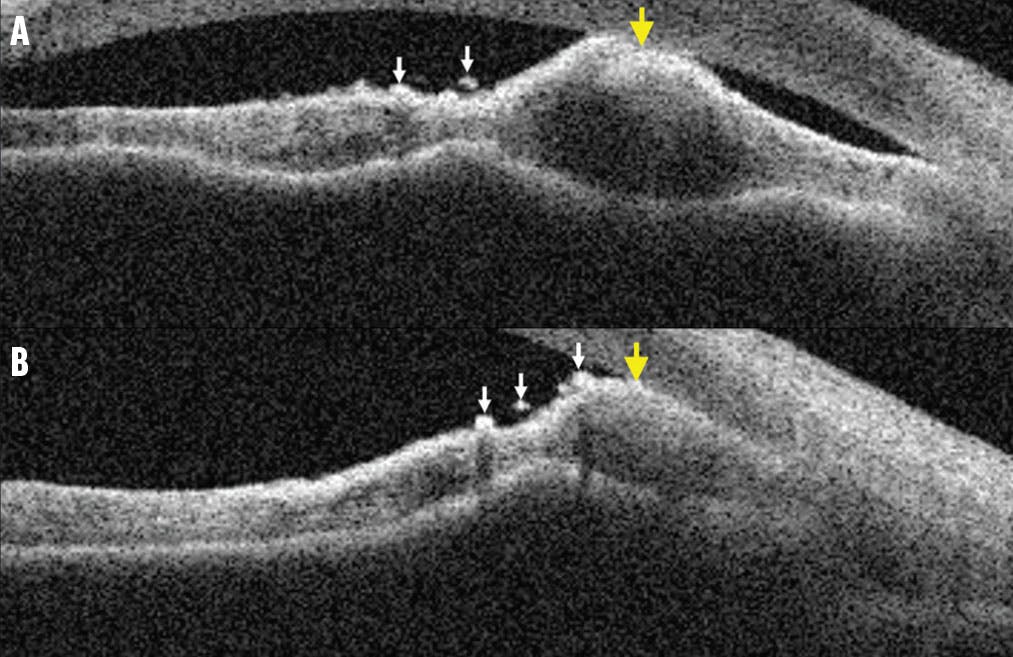
Figure 2. AS-OCT revealed multiple anterior iris nodules (A and B, white arrows) and iris adhesion to the corneal endothelium (yellow arrows) that was obstructing the iridocorneal angle outflow.
ABOUT CRS
ICE syndrome, an ophthalmic disorder characterized by abnormal corneal endothelial cells, is categorized into three variants: Chandler syndrome (CS), essential/progressive iris atrophy (EIA), and CRS.2-4 In ICE syndrome, pathologic endothelial cells (perhaps triggered by Epstein-Barr virus or herpes simplex virus infection) proliferate and migrate onto the iridocorneal angle and the iris surface, subsequently manifesting features such as PAS, corectopia, ectropion uveae, and secondary angle-closure glaucoma.5,6
CRS is unique compared with CS and EIA in that patients present with fine, pigmented iris nodules between a smooth, matted anterior iris stroma lacking crypts.3,7 The disrupted iris architecture seen in CRS is thought to result from the presence of epithelialization of the corneal endothelial cell layer, migrating onto the iris and causing it to flatten, with the nodules representing pinched-off portions of iris stroma.7
Although PAS is present in each of the three ICE variants, studies show that patients with CRS have more advanced glaucoma with higher IOP, worse glaucomatous optic atrophy, and greater visual field loss compared with that of CS and EIA.8-10 However, one study examining Indian patients found that the frequency of glaucoma and surgical intervention is not significantly different between the ICE variants.10 Corneal edema appears to be milder in CRS compared with CS.8,10-12
CRS typically affects adult women, as is typical of other ICE syndrome variants.8 Studies across different ethnicities/races, however, suggest that CRS may be the most common variant in East Asian countries compared with North America.8-10,12
Helpful Imaging
Two recent case reports suggest that AS-OCT is useful in detecting iris alterations characteristic of CRS for a definitive diagnosis.13,14 Serial AS-OCT may be useful in monitoring CRS progression by documenting increased iris folding and thickening, as well as nodule formation and PAS, as we found on AS-OCT in our patient.
Treatment Approaches
Antiglaucoma medications, including beta blockers, alpha agonists, and carbonic anhydrase inhibitors, are considered first-line therapies for elevated IOP secondary to PAS in patients with ICE syndrome.15 However, data show that many patients with ICE do not respond to medical therapy and require repeat surgical interventions, such as trabeculectomy with adjunctive antifibrotic agents or aqueous shunt surgery, to control their IOP.15-21 Patients with CRS, in particular, have been noted to require more frequent surgery compared with those with other ICE variants.8,12
Although corneal edema is less pronounced in CRS compared with CS, penetrating keratoplasty, Descemet stripping with endothelial keratoplasty, Descemet membrane endothelial keratoplasty, and deep lamellar endothelial keratoplasty have been successfully performed in patients with significantly diminished visual acuity due to ICE.22-25
SIGNS OF IRIS MELANOMA
Suspicion for melanoma may increase when the iris nodule features are accompanied by corectopia and elevated IOP. Shields et al reviewed 71 consecutive cases of ICE syndrome referred to an Ocular Oncology Service for possible iris nevus or melanoma.26 The data revealed that corneal guttata, corneal edema, multidirectional corectopia, iris atrophy, PAS, and elevated IOP from angle closure are features suggestive of ICE syndrome compared with circumscribed or diffuse iris melanoma.26 Features more suggestive of iris melanoma, on the other hand, included episcleral sentinel vessels, extrascleral extension of tumor, extensive iris mass, iris tumor seeds, solid mass in angle, and angle seeding.26 Tapioca melanoma, a rare type of diffuse iris melanoma, can also mimic CRS with multiple iris tumors, heterochromia, and elevated IOP.27-29
REMEMBER THESE CHARACTERISTIC FINDINGS
Ectropion uveae and iris nodules seen in patients with CRS can mimic the appearance of an iris melanoma. Unique to CRS and other ICE variants, however, are PAS and corneal endothelial cell dysfunction with lack of anterior chamber seeding and episcleral sentinel vessels.
In our case, the patient’s left iris exhibited ectropion uveae and multiple fine nodules superotemporally with corneal endothelial guttata-like changes and PAS, suggestive of CRS.
Support provided in part by the Eye Tumor Research Foundation, Philadelphia, PA (CLS). The funders had no role in the design and conduct of the study, in the collection, analysis and interpretation of the data, and in the preparation, review or approval of the manuscript. Carol L. Shields, MD, has had full access to all the data in the study and takes responsibility for the integrity of the data and the accuracy of the data analysis.
1. Shields CL, Kaliki S, Hutchinson A, et al. Iris nevus growth into melanoma: analysis of 1611 consecutive eyes: the ABCDEF guide. Ophthalmology. 2013;120(4):766-772.
2. Silva L, Najafi A, Suwan Y, Teekhasaenee C, Ritch R. The iridocorneal endothelial syndrome. Surv Ophthalmol. 2018;63(5):665-676.
3. Cogan DG, Reese AB. A syndrome of iris nodules, ectopic Descemet’s membrane, and unilateral glaucoma. Doc Ophthalmol. 1969;26:424-433.
4. Eagle RC, Jr., Font RL, Yanoff M, Fine BS. Proliferative endotheliopathy with iris abnormalities. The iridocorneal endothelial syndrome. Arch Ophthalmol. 1979;97(11):2104-2111.
5. Alvarado JA, Underwood JL, Green WR, et al. Detection of herpes simplex viral DNA in the iridocorneal endothelial syndrome. Arch Ophthalmol. 1994;112(12):1601-1609.
6. Tsai CS, Ritch R, Straus SE, Perry HD, Hsieh FY. Antibodies to Epstein-Barr virus in iridocorneal endothelial syndrome. Arch Ophthalmol. 1990;108(11):1572-1576.
7. Eagle RC, Jr., Font RL, Yanoff M, Fine BS. The iris naevus (Cogan-Reese) syndrome: light and electron microscopic observations. Br J Ophthalmol. 1980;64(6):446-452.
8. Wilson MC, Shields MB. A comparison of the clinical variations of the iridocorneal endothelial syndrome. Arch Ophthalmol. 1989;107(10):1465-1468.
9. Feng B, Tang X, Chen H, Sun X, Wang N. Unique variations and characteristics of iridocorneal endothelial syndrome in China: a case series of 58 patients. Int Ophthalmol. 2018;38(5):2117-2126.
10. Chandran P, Rao HL, Mandal AK, Choudhari NS, Garudadri CS, Senthil S. Glaucoma associated with iridocorneal endothelial syndrome in 203 Indian subjects. PLoS One. 2017;12(3):e0171884.
11. Zhang M, Chen J, Liang L, Laties AM, Liu Z. Ultrasound biomicroscopy of Chinese eyes with iridocorneal endothelial syndrome. Br J Ophthalmol. 2006;90(1):64-69.
12. Teekhasaenee C, Ritch R. Iridocorneal endothelial syndrome in Thai patients: clinical variations. Arch Ophthalmol. 2000;118(2):187-192.
13. Hollo G, Naghizadeh F. Optical coherence tomography characteristics of the iris in Cogan-Reese syndrome. Eur J Ophthalmol. 2014;24(5):797-799.
14. Loya-Garcia D, Hernandez-Camarena JC, Valdez-Garcia JE, Rodriguez-Garcia A. Cogan-Reese syndrome: image analysis with specular microscopy, optical coherence tomography, and ultrasound biomicroscopy. Digit J Ophthalmol. 2019;25(2):26-29.
15. Laganowski HC, Kerr Muir MG, Hitchings RA. Glaucoma and the iridocorneal endothelial syndrome. Arch Ophthalmol. 1992;110(3):346-350.
16. Kidd M, Hetherington J, Magee S. Surgical results in iridocorneal endothelial syndrome. Arch Ophthalmol. 1988;106(2):199-201.
17. Chandran P, Rao HL, Mandal AK, Choudhari NS, Garudadri CS, Senthil S. Outcomes of primary trabeculectomy with mitomycin-C in glaucoma secondary to iridocorneal endothelial syndrome. J Glaucoma. 2016;25(7):e652-e656.
18. Shields MB, Campbell DG, Simmons RJ. The essential iris atrophies. Am J Ophthalmol. 1978;85(6):749-759.;
19. Kim DK, Aslanides IM, Schmidt Jr CM, Spaeth GL, Wilson RP, Augsburger JJ. Long-term outcome of aqueous shunt surgery in ten patients with iridocorneal endothelial syndrome. Ophthalmology. 1999;106(5):1030-1034.
20. Doe EA, Budenz DL, Gedde SJ, Imami NR. Long-term surgical outcomes of patients with glaucoma secondary to the iridocorneal endothelial syndrome. Ophthalmology. 2001;108(10):1789-1795.
21. Mao Z, Guo X, Zhong Y, Liu X. Surgical outcomes of Ahmed glaucoma valve implantation in patients with glaucoma secondary to iridocorneal endothelial syndrome. Eye (Lond). 2021;35(2):608-615.
22. Rotenberg M, Downward L, Curnow E, et al. Graft survival after penetrating and endothelial keratoplasty in iridocorneal endothelial syndrome. Cornea. 2020;39(1):18-22.
23. Ao M, Feng Y, Xiao G, Xu Y, Hong J. Clinical outcome of Descemet stripping automated endothelial keratoplasty in 18 cases with iridocorneal endothelial syndrome. Eye (Lond). 2018;32(4):679-686.
24. Wu J, Dong X, Ouyang C, et al. Comparison of Descemet membrane endothelial keratoplasty for iridocorneal endothelial syndrome and Fuch endothelial dystrophy. Am J Ophthalmol. 2021;226:76-82.
25. Huang T, Wang Y, Ji J, Gao N, Chen J. Deep lamellar endothelial keratoplasty for iridocorneal endothelial syndrome in phakic eyes. Arch Ophthalmol. 2009;127(1):33-36.
26. Shields CL, Shields MV, Viloria V, Pearlstein H, Say EA, Shields JA. Iridocorneal endothelial syndrome masquerading as iris melanoma in 71 cases. Arch Ophthalmol. 2011;129(8):1023-1029.
27. Shields CL, Kaliki S, Shah SU, Luo W, Furuta M, Shields JA. Iris melanoma: features and prognosis in 317 children and adults. J AAPOS. 2012;16(1):10-16.
28. Reese AB, Mund ML, Iwamoto T. Tapioca melanoma of the iris. 1. Clinical and light microscopy studies. Am J Ophthalmol. 1972;74(5):840-850.
29. Iwamoto T, Reese AB, Mund ML. Tapioca melanoma of the iris. 2. Electron microscopy of the melanoma cells compared with normal iris melanocytes. Am J Ophthalmol. 1972;74(5):851-861.


_1784132761.jpg?auto=compress,format&w=75)





