


AT A GLANCE
- Vitreous hemorrhage is a significant problem during surgical repair of diabetic tractional retinal detachments (TRDs).
- Preoperative injection of an anti-VEGF agent can reduce the risk of postoperative complications—but surgeons must be careful of crunch.
- Some surgeons consider adding a buckle for support in some cases of combined rhegmatogenous RD/TRD.
- Performing panretinal photocoagulation in patients with a TRD or combined rhegmatogenous RD/TRD can help to reduce the risk of intraoperative hemorrhage.
Diabetic tractional retinal detachment (TRD) repair can be one of the most challenging surgical scenarios. Patient-specific factors, instrumentation, and even access to therapeutics all affect how you approach each case. Retina Today sat down with several experts from the San Antonio area to discuss their various techniques for tackling complex TRD and combined rhegmatogenous retinal detachment (RRD) surgeries.
RETINA TODAY: WHAT ARE SOME OF THE CHALLENGES THAT ARISE DURING COMPLEX DIABETIC TRD SURGERY?
Moises Chica, MD: Bleeding is the biggest concern for these surgeries, and you must work fast on tamponade when avulsing fibrovascular proliferation. You must stay on top of bleeders as they happen—and always keep a view. If visualization is a problem due to bleeding, I prefer to work under air. I use a soft tip to press lightly on a bleeding vessel, and I always consider panretinal photocoagulation (PRP) before I tackle a macular TRD. Lastly, patients need to be prepared for postoperative vitreous hemorrhage. I get preoperative widefield fluorescein angiography to document the extent of the ischemia, educate patients on the severity of their disease, and set appropriate expectations for surgery.
Roberto Diaz-Rohena, MD: I don’t want surprises, so I also get wide-angle photographs whenever possible. I check for ischemia and thin areas that may develop a hole or already have a retinal hole. The biggest frustration is trying to peel these very taut adherent membranes. I use a 27-gauge cutter for segmentation, but some membranes are so fused to the retina that you can’t separate them. Because you can’t delaminate or segment them, you are faced with tough decisions about whether to be aggressive with the membrane or leave it alone and continue your case.
Duncan Friedman, MD: It’s all about progression. I am often surprised by how advanced these membranes are. If the patient has some traction in the preretinal space that is limited to the posterior pole, the case should go smoothly. But if the patient presents with advanced, progressive, tacked-on membranes that are already pulling the retina up into a “tabletop” or “wolf-jaw” configuration, the case will be much more challenging.
I agree that visualization is key. You can see the membranes if there is no hemorrhage, but often it’s behind a sheet of blood, and you are entering the unknown. It can be frustrating to see it get to that point. Screening for diabetic eye disease in everyone could make a significant difference.
Juan Rubio, MD: So many patients still have uncontrolled diabetes who are noncompliant with treatment, and even if the operation goes well, they can show up the next day with these postoperative complications, such as severe hemorrhage. It can be disheartening (Figure).
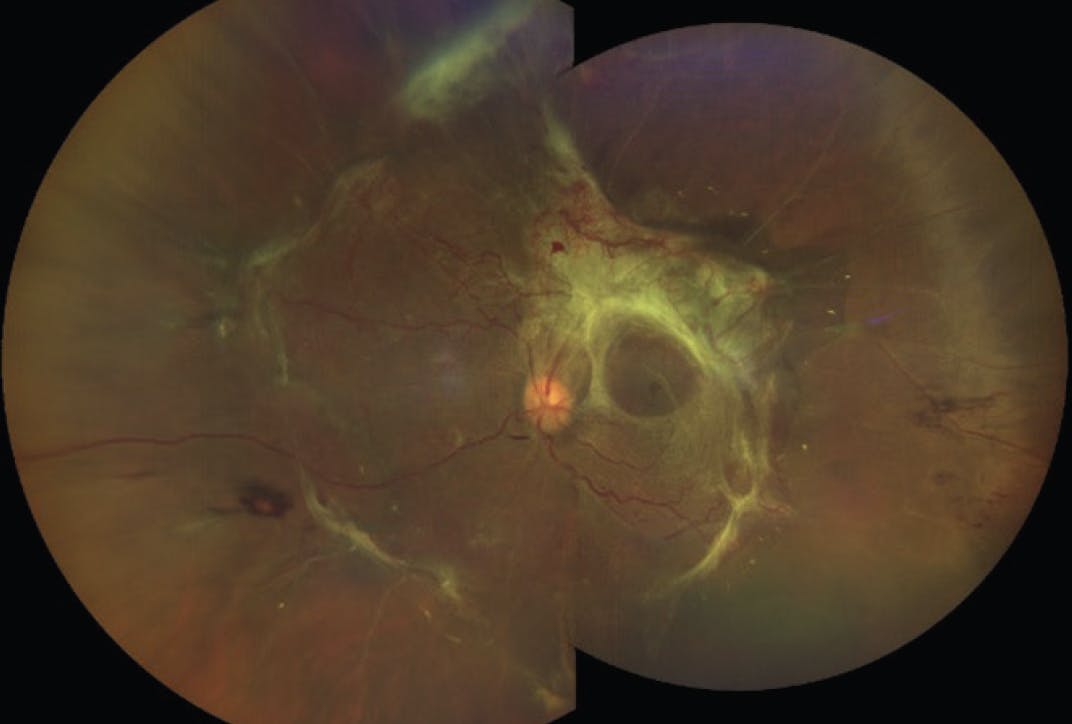
Figure. This 35-year-old Black man presented with uncontrolled diabetes and a hemoglobin A1c of 13. He was not adherent to follow-ups and eventually presented with a TRD in the left eye with a VA of counting fingers.
RT: HOW DO YOU LIMIT COMPLICATIONS?
Dr. Chica: Preoperatively, I inject an anti-VEGF agent a few days before surgery, and I consider cataract removal for patients presenting with a cataract and a nonurgent TRD. Intraoperatively, I carefully consider my choice of tamponade depending on the patient. If I used silicone oil, I consider adding an inferior peripheral iridotomy.
Postoperatively, I watch for neovascularization of the iris and keep a glaucoma colleague at the ready, monitor the hemorrhage with B-scan to check for redetachments, and educate the patient. I ask them to limit the use of anticoagulation medications (eg, heparin-free dialysis) if possible and avoid the Valsalva maneuver for a few weeks by limiting lifting and taking medications to reduce coughing or constipation.
Dr. Diaz-Rohena: I am in the OR on Mondays and tend to inject an anti-VEGF agent the prior Thursday or Friday. When the patient comes in then, I ensure that no issues will cancel the surgery and expect them in the OR on Monday. If I feel that the membranes are particularly taut, I might add a half dose of the anti-VEGF agent on the day of surgery.
Dr. Rubio: I operate on Wednesdays, and depending on the patient, I will inject them the Friday before. A select few patients might do well with an injection the day before.
Dr. Friedman: I always worry about crunch if patients miss surgery. After you do the injection, you’re on the clock, and it may be a problem if you cannot operate in a timely fashion.
Dr. Diaz-Rohena: Crunch is a real problem. There’s always a controversy about it, but I have seen it and try to ensure that I don’t let a patient go too long between the anti-VEGF injection and surgery.
Dr. Rubio: Because I can access it in the hospital, I also like to add an anti-VEGF injection at the end of surgery. For most patients with severe diabetes, it can help reduce the risk of postoperative complications.
Dr. Friedman: I’d like to use it at the end of the case, but access is an issue. During my fellowship, I used it routinely to stop postoperative hemorrhage and it worked wonders; I usually saw a clear eye at 1 week compared with patients who did not get an anti-VEGF injection at the end of surgery. Unfortunately, my ORs don’t stock it, and I can’t carry a syringe of an anti-VEGF agent in my pocket.
Dr. Diaz-Rohena: I also try to have cataracts removed before bringing a patient to the OR. I can better manipulate the eye with the lens out of the way. It also avoids the potential development of a cataract If I use a gas bubble. It’s much easier to visualize any postoperative hemorrhage.
DR. DIAZ-ROHENA: WHAT TAMPONADE DO YOU USE TO REDUCE THE RISK OF POSTOPERATIVE HEMORRHAGE?
Dr. Rubio: I’ll use a fluid-air exchange or SF6 gas. But now that we’re using 25-gauge instruments, do you routinely suture your sclerotomies for patients with diabetes? I find that hypotony can be an issue, and with these patients, I want an eye that’s not hypotonus after surgery. Depending on the patient and the type of surgery, they may wake up and experience nausea or a blood pressure spike, and I feel better having the sclerotomy sutured up.
Dr. Friedman: Having at least some air tamponade helps promote the clotting cascade and close small bleeds, which is why I prefer at least a partial air tamponade on most vitrectomies. I haven’t sutured a 25-gauge sclerotomy in years.
Dr. Diaz-Rohena: When I use 23-gauge instruments, I suture to maintain the IOP. But with the 27-gauge surgery, I don’t feel the need because it seems to close on its own.
RT: HOW ARE YOU INTEGRATING PRP?
Dr. Diaz-Rohena: I perform PRP on all my patients with diabetes who have proliferative disease, but with TRDs or combined RRD/TRD cases, I do as much laser as possible without getting too close to the traction to avoid causing contraction. Putting in some laser before surgery reduces the risk of intraoperative hemorrhage.
Dr. Friedman: If it is a nasal TRD, and most of the retina is still attached, I want to get as much laser in as I can. Often, they’ve already got vitreous hemorrhage, and you can’t see anything, but if I have a view, getting the laser in before going to the OR is to the patient’s benefit.
Dr. Rubio: For many patients, the eye with a TRD is their good eye, and they already have complications in the other eye. I make sure that the other eye is stable by doing as much PRP in both eyes before I take them to surgery.
RT: WHAT IS YOUR APPROACH TO COMBINED RRD/TRD?
Dr. Friedman: With combined detachment, you must take a stepwise approach. First, you take down all the anterior-posterior vitreous adhesion. Next, isolate the posterior traction and islands of tangential traction. Finally, address the rhegmatogenous component. At this point, if I know where the break is, I make sure that all tangential traction is off that break. I use that as a retinotomy, hit it with endo-cautery, and then drain as much as possible to get the eye as dry as possible. I then laser some more and treat it like an RRD, at which point I would put in a gas.
Dr. Diaz-Rohena: In addition, I always teach the residents to avoid pulling. When working on these tractional membranes, I gently lift them with the 25-gauge or 27-gauge beveled cutters to access that space and then cut, not pull. Pulling will lead to more tears.
Dr. Friedman: You must find your dissection plane—it’s not just one sheet most of the time. The membrane often consists of little fronds sticking up and causing fibrovascular proliferation, almost like a tent over the posterior retina. You must find an inroad and dissect along that plane with your cutter or peel along that plane and isolate those islands of traction to release everything to gain more access.
DR. RUBIO: HOW MUCH PFO DO YOU USE?
Dr. Diaz-Rohena: PFO is like mercury; it finds its way into the strangest areas. It’s heavy, so if you have a thin retina with traction, the PFO can make a hole, and the next thing you know, it’s under the retina, which is a disaster.
Rather than PFO, I used to do Healon dissection; however, with these new cutters, I’ve been using it less. Still, with particularly adherent membranes, I may consider using some Healon to dissect. For the same reason, I don’t particularly appreciate using oil because it can have some proinflammatory properties. I might have a case or two that requires oil, but I try to use gas more than oil.
Dr. Friedman: I don’t use PFO unless I have to, especially for TRDs. I prefer oil with multiple breaks; if the retina’s tearing and there’s a lot of bleeding, I will use oil.
Dr. Chica: With combined RRD/TRD cases with inferior pathology, I consider using medium-term PFO to tamponade for 2 to 3 weeks.
RT: WHEN WOULD YOU END THE CASE EARLY?
Dr. Friedman: I would say two scenarios. One is if there is too much bleeding that cannot be controlled. If the blood is clotting at the back of the eye, it’s a real challenge, and I might consider achieving as much hemostasis as possible and then exiting the eye. The second scenario would be if I see pliable membranes causing a bullous subretinal component with no counter traction. If I have already released the anterior-posterior traction and I’ve got good PRP in the eye, I would consider ending the case to let the subretinal fluid drain and create counter traction. I can bring the patient back to the OR in 1 to 2 weeks.
Dr. Rubio: If I have been in the eye for a long time and relieved the tractional attachment but the patient still has membranes, I feel comfortable putting in silicone oil, ending the case, and coming back another day. Sometimes the subretinal fluid dries up, and I can go back and deal with the remaining membranes later.
Dr. Diaz-Rohena: If I start to make more tears and holes as I try to clear up the membranes, it’s time to stop. I can put in an air or gas bubble, see how much that spreads the retina out, and return to fix the problem.
Dr. Chica: There are a few scenarios in which I consider stopping early and reevaluating the approach: in the setting of intractable bleeding or choroidal hemorrhage and if the patient is unstable. In addition, if the macula is attached before surgery, I will stop the case if I see an iatrogenic break leading to an RRD that threatens the macula.
DR. RUBIO: DOES ANYONE USE SCLERAL BUCKLES?
Dr. Diaz-Rohena: Rarely; I can’t think of the last time I put a buckle on an RRD/TRD case.
Dr. Friedman: I think that’s too much to do with the eye in one day. I have had cases that have come back that have been phakic and experienced anterior loop traction. For those I might consider an encircling band (style 42), but that’s not the first surgery.
Dr. Chica: I do use a buckle for support in some cases of combined RRD/TRD. Then, if peeling and buckling is unsuccessful and I still have traction, I consider a retinectomy.


_1773249222.png?auto=compress,format&w=75)





