
WHERE IT ALL BEGAN
My parents immigrated from India to Maryland and did an incredible job navigating a new country. Their stories and struggles shaped my childhood. My sister and I heard how my father used to study outside by streetlight because he did not have electricity growing up, and we watched our mother work odd jobs before going back to school. Their resilience instilled within me a strong work ethic and motivation to care for the underserved. I decided to become a doctor in high school and was admitted to a combined BA/MD program at the George Washington University.
MY PATH TO RETINA
I discovered ophthalmology late in medical school and completed a research year with Carol L. Shields, MD, at Wills Eye Hospital to explore the field. I was awestruck by the complexity of her clinic and her thoughtful, tailored care for each patient. I realized I wanted to emulate this in my own career and was particularly interested in posterior diseases. Dr. Shields has provided a phenomenal amount of support during my journey, and she was the first to suggest I consider vitreoretinal surgery because of my interests.
I attended the Cole Eye Institute for residency, where I worked with a dynamic retina and uveitis department. I developed a particular interest in uveitic retinal conditions and found their connections to systemic disease intriguing. Seeing the department provide end-of-the-line surgical care solidified my desire to train in both vitreoretinal surgery and uveitis. I completed my uveitis fellowship at the Casey Eye Institute in Portland, after which I returned to the Cole Eye Institute for my vitreoretinal fellowship.
SUPPORT ALONG THE WAY
In addition to Dr. Shields, I’ve had other invested and caring mentors throughout my training. At Cole Eye, I worked with many specialists who helped me build a foundation in retina and uveitis. A few include Peter K. Kaiser, MD, a phenomenal surgeon and teacher who treated me like family and has provided unwavering support; Justis P. Ehlers, MD, who helped me develop my imaging research interests; and Alex Yuan, MD, PhD, who walked me through my first surgeries. At Casey Eye, I watched Phoebe Lin, MD, PhD, and Eric B. Suhler, MD, MPH, approach complicated patients with grace and diligence, and they are still a sounding board for my diagnostic dilemmas.
I’ve also been struck by the willingness of many who have provided mentorship without directly training me. Gaurav K. Shah, MD; Christina Y. Weng, MD, MBA; Sophie J. Bakri, MD; Purnima S. Patel, MD; Steven Yeh, MD; Baker Hubbard, MD; and Jiong Yan, MD, have helped guide my early career, and I am indebted to them for their time and support.
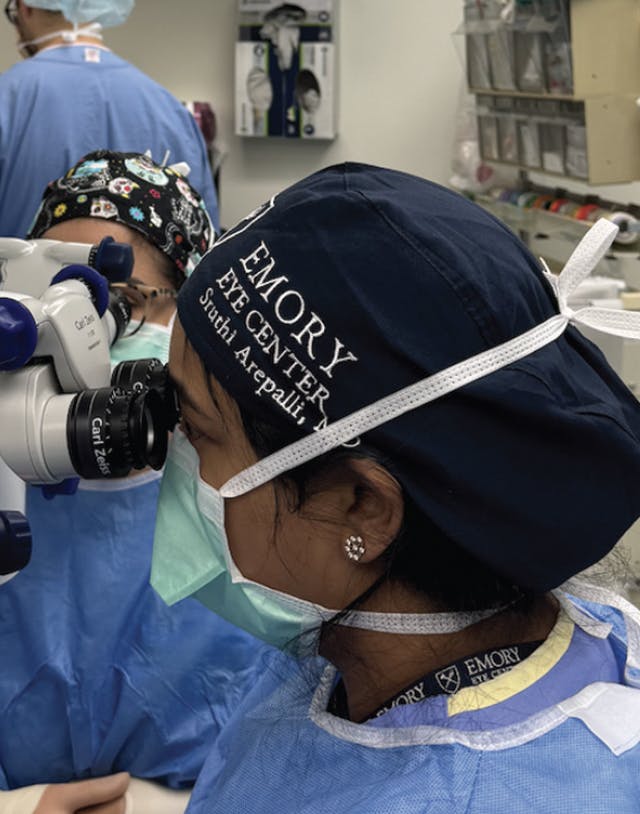
Dr. Arepalli’s Advice: Your journey after fellowship will be immensely rewarding but will also contain challenges. Treat these difficulties as an opportunity to learn. These experiences can enhance your clinical knowledge, help determine the career you want, and can make a future patient’s situation better.
AN EXPERIENCE TO REMEMBER
Being trusted to work with pediatric and young adult patients with difficult pathology has been an honor, and it has been immensely satisfying to preserve their vision so they can maintain independence. Recently, I took care of a young man without insurance with acute retinal necrosis, who later developed a detachment. To help pay for his care, our team applied for Emory charity funds. We successfully reattached his retina and improved his vision. At the last visit, his mother cried, hugged me, and told me how grateful she was to our team. Seeing the effect of our team’s work and enabling others to live full, productive lives regardless of their financial situation has been incredibly rewarding.
