

Thermal and subthreshold lasers serve specific purposes to address retinal diseases and conditions. Knowing when to use each laser is dependent on the nature and severity of the condition.
A BREAKDOWN OF KEY USES
Subthreshold lasers. The primary goal of subthreshold laser therapy is to improve retinal pigment epithelium (RPE) function without causing cell death. The focus of the treatment is to induce microenvironmental changes that achieve a therapeutic effect. A subthreshold laser is well suited to address diabetic macular edema (DME), central serous retinopathy (CSR), and microaneurysm closure.
Thermal lasers. The primary goal of thermal laser therapy is to use heat to cause intentional damage to targeted retinal tissues. This treatment, which eliminates RPE cells and often photoreceptors, is well suited to address proliferative diabetic retinopathy (PDR), retinal tears and detachment, retinal holes, and peripheral retinal tumors.
TARGET THE RPE, NOT THE RETINA
Most retinal laser systems use photocoagulation to target treatment at the retina. We now know, however, that the laser’s energy is absorbed by RPE cells during treatment for macular disease, altering the microenvironment and subsequently leading to microaneurysm closure. Additionally, a sublethal zone—the area where cells are not dead but undergo changes in response to laser treatment—facilitates the absorption of edema.
The difficulty is finding the optimal energy level to avoid an insufficient effect or excessive tissue damage. Subthreshold lasers address these challenges by delivering energy in pulses, allowing the tissue to cool between pulses, increasing the sublethal zone, and reducing the dead zone (Figure). On the other hand, thermal lasers leave behind a scar that progressively enlarges with time.
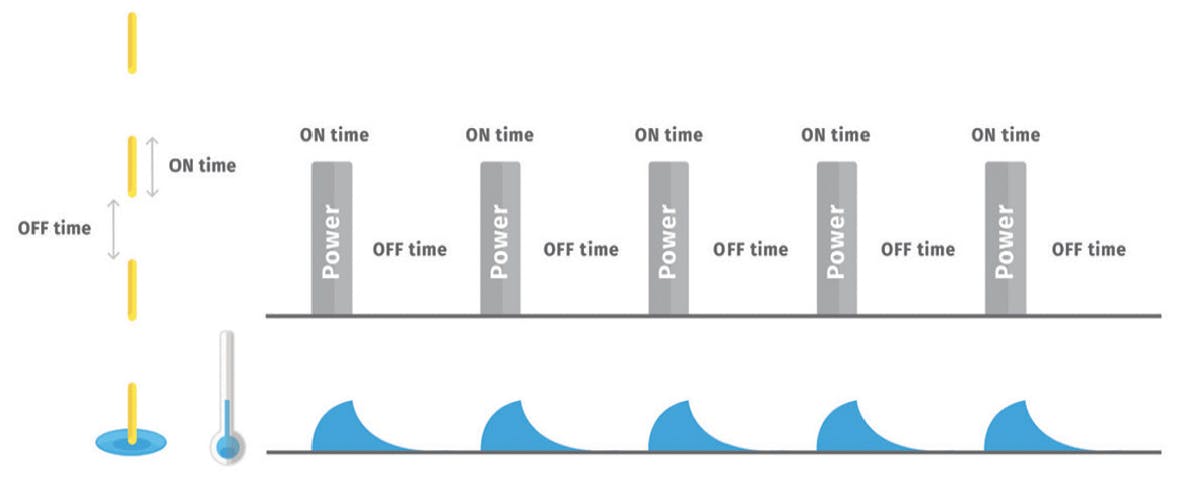
SHORT- AND LONG-TERM BENEFITS
Thermal and subthreshold lasers have unique benefits. A study of 266 patients with DME, the DIAMONDS study, found that, while both treatments were equally effective in the short term, eyes treated with Subthreshold Laser Therapy had less visible scarring,1 suggesting possible long-term benefits compared to thermal laser therapy. All eyes in the study had a central retinal thickness of less than 400 µm.
Treatment with a thermal laser is the best option for PDR, where the aim is to destroy the ischemic retina. A thermal laser also has benefits for treating retinal tears and peripheral retinal tumors, as well as other specific cases.
CONCLUSION
Subthreshold lasers can enhance RPE function without causing cell death. Its main uses are for the treatment of DME and CSR. Alternatively, thermal multispot lasers are better to target cell and photoreceptor destruction for conditions like PDR and retinal tumors.
1. Lois N, Campbell C, Waugh N, et al. Diabetic macular edema and diode subthreshold micropulse laser: a randomized double-masked noninferiority clinical trial. Ophthalmology. 2023;130(1):14-27.
