


A 54-year-old otherwise healthy woman with a diagnosis of Bietti crystalline dystrophy (BCD) has been followed by our clinic for 15 years. In her last routine visit, her BCVA was 20/40 OD. The anterior segment examination was unremarkable, and no corneal crystals were found, although we noted chorioretinal atrophy and a few retinal crystalline deposits at the posterior pole of her right eye (Figure).
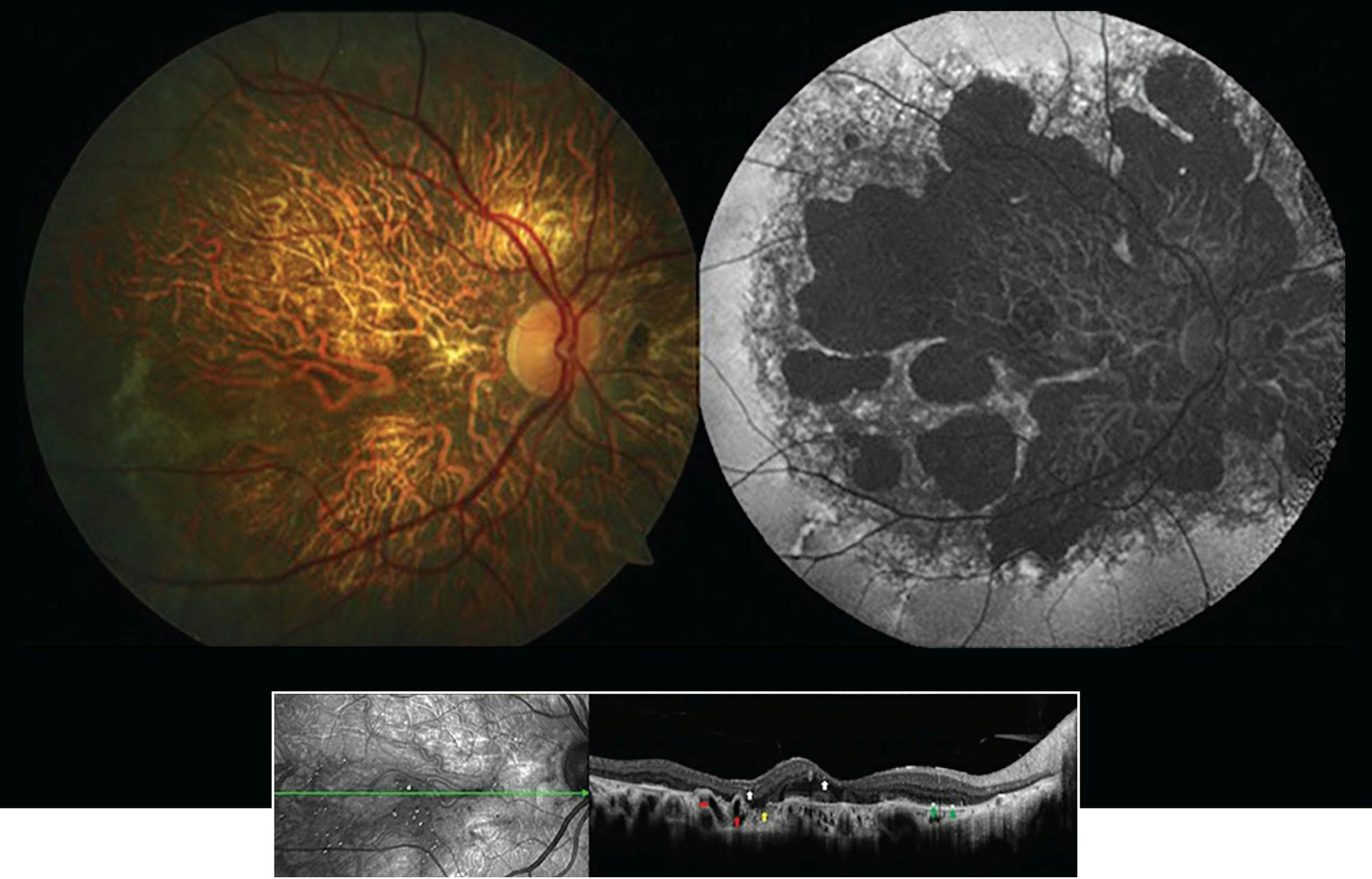
On OCT (Inset), we noticed the presence of choroidal caverns (red arrows), intraretinal hyperreflective dots (white arrows), bright plaques on top of the Bruch membrane-retinal pigment epithelium (RPE) complex (green arrows), mild epiretinal membrane, incomplete posterior vitreous detachment, and parafoveal choroidal excavation (yellow arrow).
AN UNEXPECTED FINDING WITH BCD
BCD is a rare, genetically determined chorioretinal dystrophy characterized by intraretinal crystalline deposits and varying degrees of progressive chorioretinal atrophy, commencing at the posterior pole. In some cases, there may also be concomitant corneal crystals.1,2 OCT findings include intraretinal hyperreflective dots, bright plaques on top of the Bruch membrane-RPE complex, outer retinal tubulations, macular hole, cystoid macular edema, macular neovascular membrane, and subfoveal neurosensory detachment.3,4
Choroidal caverns were first defined by Querques et al in patients with geographic atrophy.5 These are small lesions within the choroid that appear as circular areas of low reflectivity, mainly located in the Sattler and Haller layers of the choroid on OCT sections. Histologic studies have demonstrated that choroidal caverns are lipid globules and may represent a common normal physiologic lipid depot for photoreceptor metabolism.6
Choroidal caverns have been reported in eyes with pachychoroid spectrum disease, Stargardt disease, Best vitelliform dystrophy, rod-cone dystrophy, and choroidal osteoma, as well as in normal eyes.7,8 To the best of our knowledge, this is the first reported case of choroidal caverns in the presence of BCD.
1. Yuzawa M, Y Mae, M Matsui. Bietti’s crystalline retinopathy. Ophthalmic Paediatr Genet. 1986;7(1):9-20.
2. Saatci AO, Doruk HC. An overview of rare and unusual clinical features of Bietti’s crystalline dystrophy. Med Hypothesis Discov Innov Ophthalmol. 2014;3(2):51-56.
3. Saatci AO, Kayabasi M, Avci R. Asymptomatic unilateral full-thickness macular hole in a patient with Bietti crystalline dystrophy during 13-year follow-up with optical coherence tomography. Turk J Ophthalmol. 2022;52(3):212-215.
4. Saatci AO, Doruk HC, Yaman A, Oner FH. Spectral domain optical coherence tomographic findings of bietti crystalline dystrophy. J Ophthalmol. 2014;2014:739271.
5. Quesrques G, Costanzo E, Miere A, Capuano V, Souied EH. Choroidal caverns: a novel optical coherence tomography finding in geographic atrophy. Invest Ophthalmol Vis Sci. 2016;57(6):2578-2582.
6. Dolz-Marco R, Glover JP, Gal-OR O, et al. Choroidal and sub-retinal pigment epithelium caverns: multimodal imaging and correspondence with Friedman lipid globules. Ophthalmology. 2018;125(8):1287-1301.
7. Mucciolo DP, Giorgio D, Lippera M, et al. Choroidal caverns in Stargardt disease. Invest Ophthalmol Vis Sci. 2022;63(2):25.
8. Guo X, Zhou Y, Gu C, et al. Characteristics and classification of choroidal caverns in patients with various retinal and chorioretinal diseases. J Clin Med. 2022;11(23):6994.


_1773249222.png?auto=compress,format&w=75)





