


The 24th annual Advanced Vitreoretinal Techniques and Technology (AVTT) Symposium, held August 18-20, 2023, provided a comprehensive summary of the latest advances and best practices in the field of retina. Although the course was designed for second-year fellows, it was also open to residents, first-year fellows, and community ophthalmologists to connect and hear from the leaders in the field.
DAY 1: SETTING THE STAGE
The AVTT Symposium kicked off with an early breakfast, during which attendees had the opportunity to explore exhibits showcasing cutting-edge technologies. Meeting organizer William F. Mieler, MD, provided a warm welcome, setting the tone for a day packed with insightful discussions and a hands-on wet lab.
The morning session focused on career development and the state of ophthalmology. Dr. Mieler began by delving into current practice patterns and demographics in ophthalmology—the good news is that female representation has increased to 40% of incoming residents, but there is still work to be done. To that end, R.V. Paul Chan, MD, MSc, MBA, spoke about the AAO’s Leadership Development Program, various international alliances, and global ophthalmology.
Other speakers included Sunil Srivastava, MD, who shared his thoughts on the transition from fellow to mentor; Jennifer I. Lim, MD, who discussed the pros and cons of participating in clinical trials and scientific advisory boards; and Anita Agarwal, MD, who provided a framework for early career development. Mary Elizabeth Harnett, MD, gave an interesting talk on how fellows can incorporate clinical research into their long-term career goals, and Yannek Leiderman, MD, PhD, provided a glimpse into the medical device development process.
Wrapping up the first session of the meeting was SriniVas R. Sadda, MD, who shared tips for remaining active in academics, and George A. Williams, MD, past AAO president, who gave a talk that highlighted issues with prior authorization and the lack of inflation adjustment for physician fee schedules.
A highlight of the day, and the entire meeting, was the wet lab. The afternoon started with lectures by Peter K. Kaiser, MD, and Dr. Leiderman on vitrectomy dynamics and how to prepare for surgical success. Residents and fellows were then able to practice vitrectomy techniques on the latest systems, including Alcon’s Ngenuity, Bausch + Lomb’s Stellaris Elite, and DORC’s Eva Nexus, with one-on-one instruction from faculty (Figure).
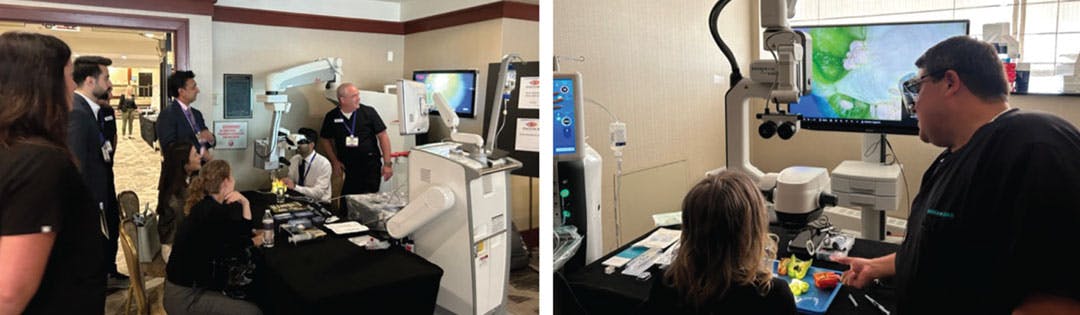
Figure. During the AVTT wet lab, residents and fellows tested out various microscopes and had the chance to operate on practice eyes and peppers.
Other stations were set up to give attendees an opportunity to experiment with various medication injections, including intravitreal dexamethasone (Ozurdex, Allergan/Abbvie) and fluocinolone acetonide intravitreal implants (Iluvien and Yutiq, Alimera Sciences). While the other half of the group waited for their chance in the wet lab, Dr. Agarwal, Dr. Sadda, and Amani A. Fawzi, MD, led a discussion of medical and surgical cases.
DAY 2: BACK TO THE CLASSROOM
The second day took attendees through a whirlwind tour of retinal imaging, tumors, retinopathy of prematurity, and treatment algorithms for diabetic eye disease. The day ended with a surgical session that provided pearls on topics such as internal limiting membrane peeling, retinectomies, subluxated IOL management, and scleral buckling versus primary vitrectomy for rhegmatogenous retinal detachments.
Interspersed between these lectures were spirited debates on controversial topics, including the role of internal limiting membrane peeling for epiretinal membranes, use of steroids in diabetic macular edema, implementation of AI, the advent of home monitoring for the detection of choroidal neovascularization, and the value of 3D heads-up displays. The debates pitted old friends against each other, and the speakers battled for audience votes with friendly banter. Perhaps the most interesting debate—and one that received a lot of laughs—was between Dr. Mieler and Dr. Williams on the utility of vitrectomy to treat floaters; it ended with Dr. Williams recommending a vitrectomy for Dr. Mieler!
DAY 3: THE SUMMIT OF KNOWLEDGE
The last day began with updates on ongoing clinical trials and the latest treatments for AMD. This was followed by debates on the use of anti-VEGF biosimilars, the role of complement inhibition in geographic atrophy, and the need for OCT angiography for the management of choroidal neovascularization.
The meeting concluded with a great session on uveitis, which covered pediatric uveitis, masquerade syndromes, white-dot syndromes, and vitreoretinal surgery for patients with uveitis.
UNTIL NEXT YEAR
The AVTT Symposium brought together experts, innovators, and trainees to share insights, discuss challenges, and envision ways to incorporate the latest advances that have improved patient care. We hope to see you all at next year’s meeting!
August 9-11, 2024 • Chicago, Illinois


_1784132761.jpg?auto=compress,format&w=75)





