




The 2024 Vit-Buckle Society (VBS) meeting, held in Miami Beach, Florida, April 4-6, exceeded expectations with its innovative surgical videos, lively debates, and vast educational opportunities. Here, we highlight the surgical cases and medical retina debates.
SURGICAL CASE SESSION IN BRIEF
The Friday morning surgical case session, moderated by Philip J. Ferrone, MD, and Adrienne W. Scott, MD, included an array of exceptional and complex surgical cases.
Ahmed Mansour, MD, MSc, began by noting that funnel retinal detachments (RDs) can be challenging, especially if they present after trauma, and that these cases often have poor outcomes. The optimal time to intervene is 7 to 10 days following the initial injury or closure, he said, but the decision to intervene remains a matter of debate.
He presented two cases of funnel RDs, through which he demonstrated several techniques, including a hand-over-hand technique to remove subretinal proliferative vitreoretinopathy (PVR) and napkin ring fibrosis; the use of chandeliers provides adequate visualization, and radial cuts help to relax and flatten the retina.
Next, Durga S. Borkar, MD, MMCi, highlighted a case of a 72-year-old man who had multiple large posterior retinal breaks and PVR after an initial RD repair with vitrectomy. After peeling the PVR membranes and performing a retinectomy, a large macular break remained. Dr. Borkar placed an amniotic membrane over the large break using a bimanual technique, and the patient did well. However, 2 years later, the amniotic membrane had contracted, which prompted a vibrant discussion regarding how to orient the amniotic membrane, whether methotrexate would be useful, and the best next steps.
Juan Carlos Gutierrez Hernandez, MD, presented the case of a 38-year-old man he treated after a motor vehicle accident. Initially, the team thought the patient had vitreous hemorrhage after a scleral wound repair. However, at the time of vitrectomy, they found a large glass intraocular foreign body. Dr. Gutierrez Hernandez used 0.12 forceps to remove the object through a scleral wound, and the patient did well with a postoperative BCVA of 20/40.
Christopher G. Fuller, MD, stunned the audience (as he usually does) with a one-of-a-kind video that focused on the changes he experienced after the private equity acquisition of his ambulatory surgery center. Some examples included more difficulties with adding on late cases, limitations in the use and selection of instrumentation, and the required use of off-brand preoperative dilating drops.
Greg Budoff, MD, showed off his use of the laser-locking technique to address postoperative IOL tilt (Figure 1). He used the laser on a continuous setting through an anterior paracentesis to laser the optic-haptic junction. He said a grayish discoloration at the edge of the haptic indicates that the junction is locked into a new planar configuration, resolving the IOL tilt.
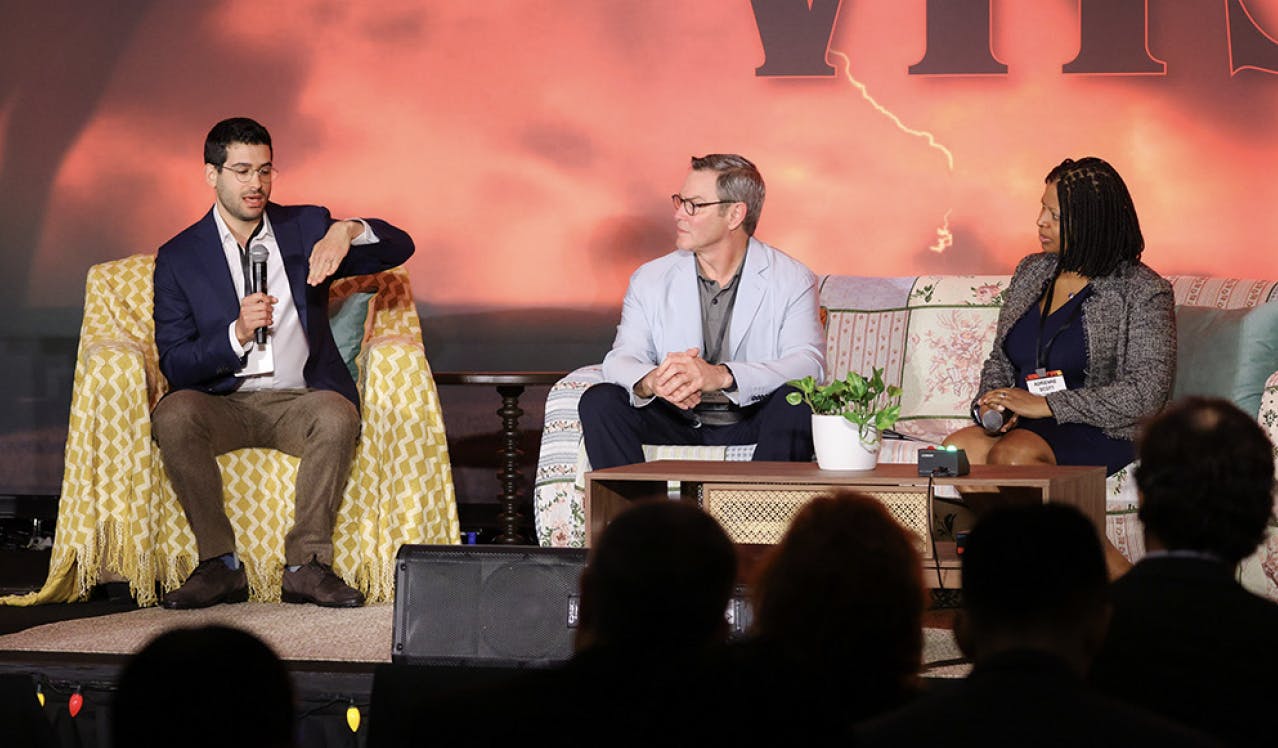
Figure 1. Dr. Budoff explains the laser-lock technique with Drs. Ferrone and Scott. Image courtesy of Kevin Caldwell Photography.
Hasenin Al-khersan, MD, presented the case of a patient with a large metallic intraocular foreign body, which he removed using an anterior approach. Anterior vitrectomy, lensectomy, and a core vitrectomy revealed a focal rhegmatogenous RD. He used dispersive viscoelastic on the corneal surface to assist with deturgescence and removal of the corneal epithelium, as well as cohesive viscoelastic in the anterior chamber to further assist with deturgescence. Despite these challenges, the RD was successfully repaired.
Ninel Z. Gregori, MD, described a chorioretinal biopsy technique using a 19-gauge blunt-ended needle. During vitrectomy, she uses a laser to demarcate the area of retinal biopsy and separates the retina from the underlying retinal pigment epithelium with a subretinal cannula. She uses vertical scissors to cut along the laser line, leaving a small hinge of tissue. She then creates a sclerotomy and uses the blunt, unfiltered 19-gauge needle on a 3-cc syringe to gently aspirate the retinal sample.
Next, she uses intravitreal diathermy to cauterize the choroidal vessels at the edges of the biopsy site, excises the intended portion of the choroid with vertical scissors, and uses the 19-gauge blunt-ended needle to remove the choroidal sample with gentle aspiration.
Vinay A. Shah, MD, presented a four-port vitrectomy technique that gives the attending physician access to the intraocular space through a fourth cannula. With this technique, the operating fellow maintains control of two instruments through the superior cannulas, and the attending can provide direct and physical instruction intraoperatively. Dr. Shah also mentioned that as the fellow becomes more comfortable with the four-port technique, the attending can hold the light pipe through one of the cannulas, and the fellow can then hold two non-illuminated instruments.
Patrick C. Staropoli, MD, wrapped up the surgical case session with a case of a patient with a recurrent PVR-associated RD. Intraoperatively, there was a large subretinal plaque beneath the inferior arcade, requiring him to venture into the subretinal space to gain access to the plaque. Using the light pipe and forceps, he lysed the adhesions between the subretinal plaque and underside of the retina, leading to adequate retinal laxity and mobility. Two weeks later, the retina was attached.
MEDICAL RETINA DEBATES
In the first debate, Marianeli Rodriguez, MD, PhD, argued that faricimab (Vabysmo, Genentech/Roche) was the best long-acting agent and listed the advantages of inhibiting both the Ang-2 and VEGF pathways with the drug, which has been associated with reduced vascular leakage and inflammation compared with traditional anti-VEGF agents.
In patients with diabetic macular edema, Dr. Rodriguez noted faricimab’s superiority in drying the retina, as well as a significant decrease in central subfield thickness, which was maintained through 2 years. She also pointed out the lack of a single report of retinal vasculitis over the 2-year period. Dr. Rodriguez’s arguments were supported by her personal experience extending the interval between injections when switching patients from aflibercept (Eylea, Regeneron) to faricimab.
Merina Thomas, MD, argued for 8 mg aflibercept (Eylea HD, Regeneron), highlighting the extensive experience retina specialists have with the drug and its long-standing safety profile. She presented the results of the PULSAR and PHOTON trials and noted that there is no clinically meaningful difference in IOP when injecting 0.07 cc (8 mg aflibercept) versus 0.05 cc (2 mg aflibercept).
Both speakers discussed the excellent safety profile of these agents and recommended thoughtful patient selection based on individual needs. The audience voted narrowly in favor of Dr. Thomas and 8 mg aflibercept (Figure 2).

Figure 2. Dr. Thomas celebrates her victory during the medical retina debate about which long-acting anti-VEGF agent is best. She is joined on stage by session moderators Dimitra Skondra, MD, PhD, and Ajay E. Kuriyan, MD, as well as her opponent, Dr. Rodriguez. Image courtesy of Kevin Caldwell Photography.
The next medical retinal debate was on the emerging treatment choices for geographic atrophy (GA). Ella Leung, MD, discussed pegcetacoplan (Syfovre, Apellis) and the OAKS/DERBY trial data and dosing flexibility. Dr. Leung highlighted the longer follow-up and larger number of clinical trial participants compared with avacincaptad pegol (Izervay, Iveric Bio/Astellas), as well as the ability to decrease GA progression by as much as 42% compared with 14% with avacincaptad pegol. She also touched on the microperimetry data, photoreceptor loss, and retinal pigment epithelium cell loss in the clinical trials and the low risk of optic neuropathy, occlusive vasculitis, and endophthalmitis.
Sruthi Arepalli, MD, discussed avacincaptad pegol and the results of the GATHER clinical trials. She highlighted the known risk of retinal vasculitis with pegcetacoplan, stating that avacincaptad pegol may be safer than pegcetacoplan and more effective than observation. She referenced the ASRS Research and Safety in Therapeutics Committee report, detailing 13 cases of retinal vasculitis in patients after their first injection of pegcetacoplan.
Finally, Nicolas A. Yannuzzi, MD, argued for the observation of GA. Dr. Yannuzzi pointed out the risk of conversion to wet AMD with both medications and the increased treatment burden for patients who develop wet AMD. He highlighted the treatment burden of these medications in general and discussed the risk of intraocular inflammation and the lack of proven functional benefit. Dr. Yannuzzi noted the high dropout rates of 20% to 30% in the OAKS/DERBY studies and 20% in GATHER2, further underscoring his concerns about treatment efficacy and patient adherence.
The audience agreed with Dr. Yannuzzi, making him the debate winner.
During the third debate, Safa Rahmani, MD, MS, argued for the need to treat choroidal neovascular membranes and diabetic macular edema in pregnant patients according to standard protocol. Dr. Rahmani noted the lack of proven adverse effects of anti-VEGF agents in pregnancy and the retrospective reports that demonstrate no increased detrimental effects compared with the general population in these patients. She also emphasized the systemic safety of anti-VEGF agents in infants with retinopathy of prematurity.
Irena Tsui, MD, shared reasons to avoid using anti-VEGF agents in patients who are pregnant. She outlined the adverse effects seen in animal studies and noted that the package inserts suggest potential harm of these agents in pregnancy. She highlighted the importance of VEGF in pregnancy/placental physiology and the reports of adverse pregnancy outcomes in patients undergoing anti-VEGF injections in the first trimester.
The audience chose Dr. Rahmani as the winner of the debate by a small margin, voting 55% in favor of the use of anti-VEGF agents in pregnancy.
The last medical retina debate ventured in a very different direction, and Nitish Mehta, MD, shared the experience of a whole-eye transplant at New York University. He emphasized the retinal perfusion seen through postoperative fluorescein angiography. Further, he suggested that whole-eye transplant could serve as a feasible method of addressing many causes of blindness for which there is no treatment.
Frank L. Brodie, MD, MBA, argued against whole-eye transplant, citing the lack of innovation in neuroprotection and the current lack of functional outcomes data. He spoke about the necessary research into optic nerve regeneration and other innovative research that is lacking. Dr. Brodie cited the more than $100 million that the National Institutes of Health has spent on neuroregeneration research, the more than $550 million spent on neuroprotection research in general, and the lack of clinically actionable progress that has been made through this work.
The debate winner, by a large margin, was Dr. Brodie.
SAVE THE DATE: MARCH 20-22, 2025
Austin, Texas
13th Annual Vit-Buckle Society Meeting


_1784132761.jpg?auto=compress,format&w=75)




