


AT A GLANCE
- Relevant family ocular and medical history should be included in the request for genetic testing to aid in the interpretation of results.
- A genetic test report may be nondiagnostic because the condition is not genetic, the panel did not include the causative gene, the variant has yet to be classified as disease-causing, or the genetic variant has yet to be discovered.
- Clinicians should consider retesting every 2 to 5 years in patients with a suspected inherited retinal disease with nondiagnostic genetic testing.
The AAO's Task Force of Genetic Testing and the European Reference Network for Rare Eye Disease recommend that all individuals with a presumed or suspected inherited retinal disease (IRD) undergo genetic testing.1,2 To date, more than 300 causative genes have been identified in IRDs. Emerging genetic testing technologies, such as next-generation sequencing and whole exome sequencing, have led to more accurate IRD diagnoses and reduced testing costs.3-5
Although single-gene testing may be sufficient for some diagnoses (eg, CHM is the only disease-causing gene for choroideremia), the heterogeneity of IRDs—both the ocular phenotype and underlying genetic causes—makes multigene panels a more logical choice. For example, more than 100 causative genes exist for retinitis pigmentosa, and, in most cases, it cannot be differentiated by phenotype.1,6 With the advent of next-generation sequencing, multiple genes can be assessed with a single assay.7
GENETIC TESTING PEARLS
Before proceeding with genetic testing, clinicians must obtain a comprehensive family history, medical history, ocular examination, and directed ocular imaging. A detailed family history (eg, hearing loss, developmental or cognitive delays, polydactyly, etc) can help establish heritability and determine whether the retinal findings are part of a syndromic disease. These findings should be included in the lab request for genetic testing to aid in the interpretation of results (Figure).
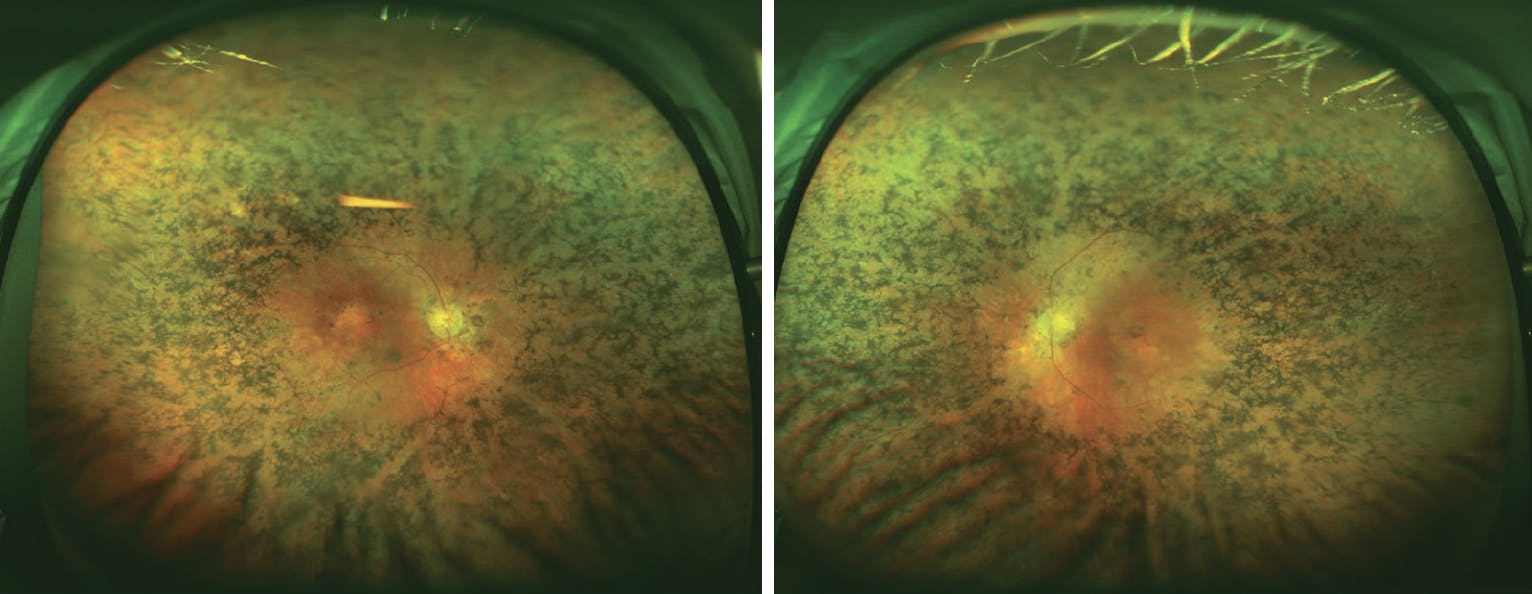
Figure. This patient with congenital hearing loss and progressive vision loss had pathogenic variants in the MYO7A gene, consistent with Usher type 1B.
However, an absence of family history is not indicative of the likelihood of heritability. The possibility of de novo or recessive variants, limited communication of symptoms within a family, or reduced penetrance can all mask a potential genetic cause.
Patients should undergo genetic counseling to fully understand the benefits, limitations, and possible implications of ocular genetic testing for themselves and their family members. Genetic counseling can ensure accurate interpretation of results, their implications for prognosis, and identification of at-risk family members.
In the United States, telemedicine-based genetic counseling is becoming more prominent, improving access to this important step for community-based retina specialists.
CHOOSING THE RIGHT TEST
The choice of an appropriate IRD gene panel requires careful consideration and can be directed by history and clinical findings in the patient and their family. Testing in the United States should be done in a lab that is CLIA-certified. Certain panels may be more inclusive than others; for example, the panels may include a larger number of genes or genes for associated syndromic diseases such as Joubert syndrome, Bardet Biedl syndrome, or mitochondrial DNA. Some labs have more experience interpreting IRD variances than others, and this, potentially, is reflected in the results. Clinicians must be aware of the potential limitations of the testing to ensure a proper understanding of the potential yield of a diagnostic result, which averages around 60% to 70% (personal data).3
Variant interpretation is performed using a five-tier system defined by the American College of Medical Genetics (Table).8 Variants may be classified as benign due to several criteria, including variant frequency in the general population, functional data showing no deleterious effects of the variant on protein function or splicing, or lack of segregation in affected members of a family. Likely benign variants are those with an estimated > 90% certainty of being benign; these are typically unreported on standard genetic tests when detected. Pathogenic variants are those with solid evidence of being disease-causing. Variants classified as likely pathogenic are those with > 90% certainty of being disease-causing.8
A determination of variant of uncertain significance (VUS) is used when there is insufficient evidence to fulfill the classification of benign or pathogenic or if the evidence for benign or pathogenic is contradictory.8 VUSs should be reported with caution and should not be used in clinical decision making.8 As evidence regarding a variant evolves, VUSs may be reclassified. Thus, clinicians should periodically inquire if a VUS has been reclassified if it is related to the primary phenotype and if the lab has not proactively provided an update.
HANDLING A NEGATIVE TEST IN THE CLINIC
It is discouraging when a genetic test result comes back negative or nondiagnostic, and there are several possible explanations for such results. The retina pathology may not be related to an inherited cause, but rather some other etiology such as trauma, toxicity, inflammation, or infection. Further ocular imaging, patient history, or lab testing may aid in proper diagnosis. A great example of this is a patient with a pigmentary maculopathy associated with long-term pentosan polysulfate sodium use that may mimic an IRD.9
However, negative testing does not mean that a patient’s condition is not genetic. Every ocular genetic testing panel has limitations, and it is possible the panel did not include the causative gene. Directed further testing after a negative panel can sometimes lead to a diagnosis. For example, in a patient with early-onset hearing loss, diabetes, and macular degeneration, mitochondrial DNA testing could be pursued to rule out maternally inherited diabetes and deafness. Additionally, complete sequencing of some genes is limited by inclusion or exclusion of intronic regions or complicated by the presence of pseudogenes. A patient with skin laxity, peau d’orange appearance of the retina, and angioid streaks may clinically fit a diagnosis of pseudoxanthoma elasticum, but causal variants in ABCC6 are detected in just under 90% of cases, likely due to the presence of a pseudogene.10
Another factor is that variant classification is a dynamic process. For example, the detection of causal variants is reduced in some genes such as ABCA4 and USH2A.11 The detection rate improved for ABCA4 when the variant c.5603A>T (p. Asn1868llez), a common polymorphism, was shown to be a risk factor for late-onset Stargardt disease when paired with a disease-causing variant.12 Previously, this was considered a benign variant and not reported on genetic tests.
A variant or two may be reported that matches the patient’s phenotype and suspected mode of inheritance but is still classified as a VUS. In these cases, further clinical testing (eg, an electrooculogram for a BEST1 variant) or familial testing may provide evidence that could lead to reclassification of the variant. A variant may also be classified as a VUS due to not matching the patient phenotype. However, the understanding of the spectrum of disease related to certain genes changes over time. Neuronal ceroid lipofuscinoses genes, such as CLN3 and MFSD8, have only recently been known to cause non-syndromic retinal disease.13,14
It is possible that the causative gene or variant in a known gene has yet to be discovered. As more ocular genetic testing is performed, the number of variants identified continues to grow. Research has also led to the identification of new disease-causing genes.15
Clinicians should consider retesting every 2 to 5 years in patients with a suspected IRD with nondiagnostic genetic testing. New testing will be substantially different than previous analyses, and the potential diagnostic utility of this may vary. In all situations, clinicians must coordinate between the patient and a genetic counselor to facilitate appropriate genetic testing.
NEVER GIVE UP
Genetic testing for individuals with an IRD is highly recommended but can come with possible challenges in interpretation. For patients with a presumed IRD, solving the case can potentially be life-changing, as it can direct medical decision making, give peace of mind in understanding of the disease, identify family members at risk, and help guide patients toward any current or emerging clinical trials.
1. Stone EM, Aldave AJ, Drack AV, et al. Recommendations for genetic testing of inherited eye diseases: report of the American Academy of Ophthalmology task force on genetic testing. Ophthalmology. 2012;119(11):2408-2410.
2. Black GC, Sergouniotis P, Sodi A, et al. The need for widely available genomic testing in rare eye diseases: an ERN-EYE position statement. Orphanet J Rare Dis. 2021;16(1):142.
3. Britten-Jones AC, Gocuk SA, Goh KL, Huq A, Edwards TL, Ayton LN. The diagnostic yield of next generation sequencing in inherited retinal diseases: a systematic review and meta-analysis. Am J Ophthalmol. 2023;249:57-73.
4. Del Pozo-Valero M, Riveiro-Alvarez R, Martin-Merida I, et al. Impact of next generation sequencing in unraveling the genetics of 1036 Spanish families with inherited macular dystrophies. Invest Ophthalmol Vis Sci. 2022;63(2):11.
5. Turro E, Astle WJ, Megy K, et al. Whole-genome sequencing of patients with rare diseases in a national health system. Nature. 2020;583(7814):96-102.
6. Duncan JL, Pierce EA, Laster AM, et al. Inherited retinal degenerations: current landscape and knowledge gaps. Transl Vis Sci Technol. 2018;7(4):6.
7. Chiang JP, Trzupek K. The current status of molecular diagnosis of inherited retinal dystrophies. Curr Opin Ophthalmol. 2015;26(5):346-351.
8. Richards S, Aziz N, Bale S, et al. Standards and guidelines for the interpretation of sequence variants: a joint consensus recommendation of the American College of Medical Genetics and Genomics and the Association for Molecular Pathology. Genet Med. 2015;17(5):405-424.
9. Pearce WA, Chen R, Jain N. Pigmentary maculopathy associated with chronic exposure to pentosan polysulfate sodium. Ophthalmology. 2018;125(11):1793-1802.
10. Legrand A, Cornez L, Samkari W, et al. Mutation spectrum in the ABCC6 gene and genotype-phenotype correlations in a French cohort with pseudoxanthoma elasticum. Genet Med. 2017;19(8):909-917.
11. González-Del Pozo M, Martín-Sánchez M, Bravo-Gil N, et al. Searching the second hit in patients with inherited retinal dystrophies and monoallelic variants in ABCA4, USH2A and CEP290 by whole-gene targeted sequencing. Sci Rep. 2018;8(1):13312.
12. Zernant J, Lee W, Collison FT, et al. Frequent hypomorphic alleles account for a significant fraction of ABCA4 disease and distinguish it from age-related macular degeneration. J Med Genet. 2017;54(6):404-412.
13. Roosing S, van den Born LI, Sangermano R, et al. Mutations in MFSD8, encoding a lysosomal membrane protein, are associated with nonsyndromic autosomal recessive macular dystrophy. Ophthalmology. 2015;122(1):170-179.
14. Ku CA, Hull S, Arno G, et al. Detailed clinical phenotype and molecular genetic findings in CLN3-associated isolated retinal degeneration. JAMA Ophthalmol. 2017;135(7):749-760.
15. Retinal Information Network. The University of Texas-Houston Health Science Center. Accessed June 3, 2024. web.sph.uth.edu/RetNet


_1784132761.jpg?auto=compress,format&w=75)





