


AT A GLANCE
- Stem cell therapy aims to restore vision in patients with inherited retinal diseases through the release of neurotrophic factors and/or cell repair, regeneration, or replacement.
- Optogenetics uses light-sensitive channels to enable remaining retinal circuitry to respond to light stimuli.
- Retinal prosthesis involves an implantable device that converts light into electrical signals that are transmitted to the remaining retinal circuitry.
In recent years, there has been significant progress in our understanding of the pathogenesis of inherited retinal diseases (IRDs). Variants in more than 300 genes have been identified; however, the molecular diagnosis remains unknown in approximately 30% to 50% of patients with an IRD.1-3 As such, the development of therapeutic approaches that are gene-agnostic is essential to provide treatment options for all patients with an IRD, not just those with specific variants. Here, we provide an overview of select gene variant-agnostic approaches, including pharmacologic therapies, optogenetics, stem cell therapy, and retinal prosthesis.
PHARMACOLOGIC THERAPIES
Treatments that slow disease progression and promote cell survival are particularly attractive because they are gene variant-agnostic. Although promising for other retinal diseases, encapsulated cell technology releasing ciliary neurotrophic factor did not yield long-term improvements in functional outcomes in patients with IRDs.4 There are several other neurotrophic factors being investigated, including pigment epithelium-derived factor and rod-derived cone viability factor.5 There has also been interest in targeting pathways that promote cellular dysfunction. This includes N-acetylcysteine, which reduces oxidative stress and may improve cone photoreceptor function; one therapeutic agent is currently in a phase 3 clinical trial (NCT05537220).6
THE PROMISE OF STEM CELLS
Stem cell therapy aims to restore vision through the release of neurotrophic factors and/or cell repair, regeneration, or replacement. Cell replacement requires proper alignment and integration of donor photoreceptors with the remaining neuronal circuitry of the recipient retina. Induced pluripotent stem cells (iPSCs) have significantly advanced the field of stem cell therapy by providing a renewable therapeutic cell source. iPSCs are derived from the trans-differentiation of somatic cells using a set of pluripotency transcription factors.7,8 Using stepwise protocols, these cells can be differentiated into retinal progenitor cells followed by rod and cone photoreceptors.9-11
Photoreceptor transplantation in preclinical models has demonstrated successful integration of donor photoreceptors within the recipient retina, and, crucially, cone transplantation has gained traction as a possible treatment for foveal atrophy in AMD (Figure).12 Studies in preclinical models also demonstrated the transfer of cytoplasmic material from donor to recipient photoreceptors,13 and the therapeutic implications of this mechanism across multiple genetic variants is being studied. Several challenges remain, including graft rejection and inflammatory manifestations. Gene editing of autologous iPSCs or gene editing of HLA haplotype resulting in an immunocompatible iPSC line would potentially bypass concerns for graft rejection.14
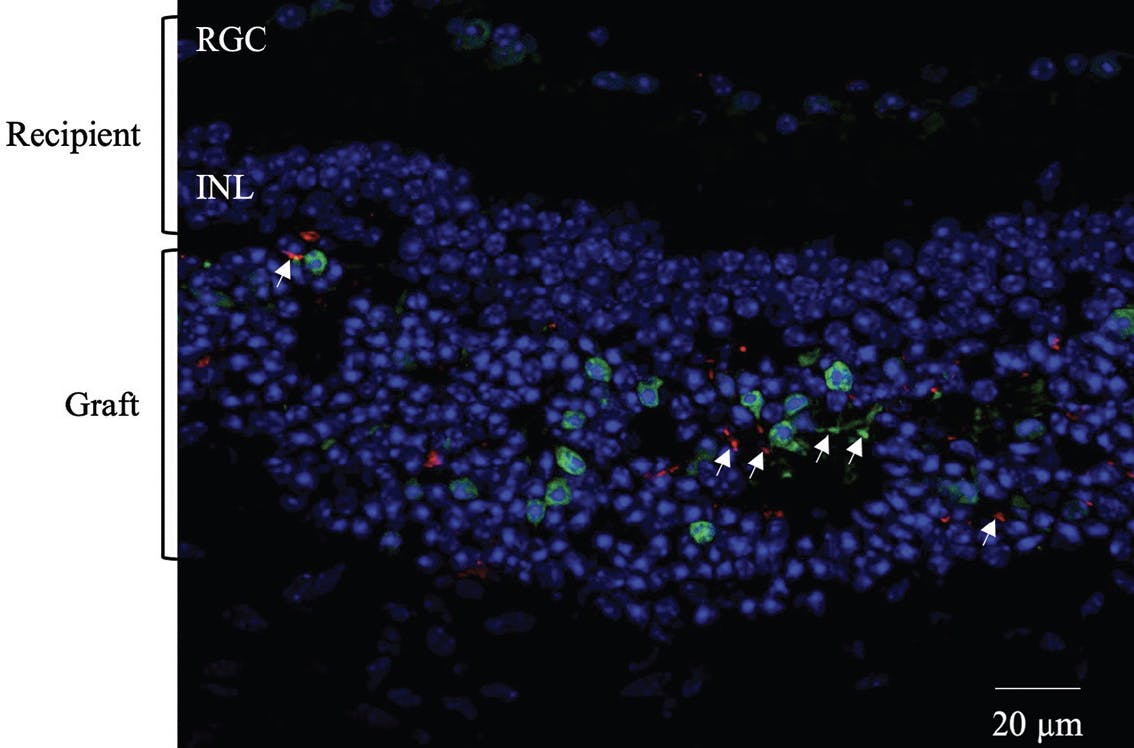
Figure. Cone photoreceptor cells were collected from a cone-rich donor mouse strain and transplanted into the subretinal space of an immunodeficient recipient mouse in an allogeneic approach.12 Three months post-transplantation, numerous donor cones survived and elaborated key cellular structures, including cone outer segments (arrows). Abbreviations: INL, inner nuclear layer; RGC, retinal ganglion cell. Data (unpublished) from Kang Li, Ying Liu, and Singh M at Wilmer Eye Institute, Johns Hopkins University.
REDIRECTING LIGHT
Optogenetics uses light-sensitive channels to enable the remaining retinal circuitry to respond to light stimuli.15 This requires transfecting existing neurons (ie, bipolar or retinal ganglion cells) with genes encoding light-sensitive channels. Since viable photoreceptors are not absolutely necessary for optogenetics-based therapies, this approach can be used for advanced disease stages. Delivery approaches being studied include adeno-associated virus and nanoparticles.
In 2021, Sahel et al published a case report of a blind patient treated with ChrimsonR-based optogenetics, demonstrating object recognition and improved performance on psychophysical tests and electroencephalography.16 ChrimsonR, which is activated with red-shifted wavelengths, requires lower light intensities and is thought to reduce light-mediated retinal damage.17 This technology requires goggles to detect changes in light intensity and project them as red-shifted (595 nm) light pulses onto the retina in real time. Optogenetics clinical trials include several types of opsins: ChrimsonR (GenSight Biologics), ChR2 (AbbVie), ChronosFP (Bionic Sight), and MCO-010 (Nanoscope Therapeutics).15
Retinal prosthesis involves an implant that converts light into electrical signals that are transmitted to the remaining retinal circuitry. Various implant designs include epiretinal, subretinal, suprachoroidal, optic disc, and cortical.18 The Argus II device (Second Sight Medical) was approved by the FDA in 2013. Briefly, visual signals from a camera are converted into a brightness map that is transmitted wirelessly to the implant, which then transmits these signals to functioning neurons as pulse amplitudes. Five-year follow-up data show persistent improvement on functional vision assessment tasks, such as locating objects or directionality of motion.19 However, visual gains were modest, and patients required intensive vision rehabilitation. Of note, the best visual acuity attained with the Alpha AMS retinal prosthetic device (Retina Implant AG) was 1.39 LogMAR and 20/500 or 6/150 Snellen.20 Future directions include the use of AI to improve the implant and visual processing algorithms.21
GENE-DEPENDENT APPROACHES: AN UPDATE
Voretigene neparvovec-ryzl (Luxturna, Spark Therapeutics), which targets biallelic RPE65-associated retinal dystrophy with viable retinal cells, was the first FDA-approved gene therapy for IRD.1 Initial functional improvement was noted following the subretinal delivery of voretigene neparvovec-ryzl, but questions arose regarding the degree of long-term therapeutic effect.2-5 A subset of patients also developed progressive post-treatment chorioretinal atrophy, although these lesions have not generally been associated with vision loss.5 Adeno-associated virus-mediated inflammation and direct toxicity are hypothesized to contribute to chorioretinal atrophy.
1. Maguire AM, Russell S, Wellman JA, et al. Efficacy, safety, and durability of voretigene neparvovec-rzyl in RPE65 mutation-associated inherited retinal dystrophy: results of phase 1 and 3 trials. Ophthalmology. 2019;126(9):1273-1285.
2. Bainbridge JW, Smith AJ, Barker SS, et al. Effect of gene therapy on visual function in Lebers congenital amaurosis. N Engl J Med. 2008;358(21):2231-9.
3. Jacobson SG, Cideciyan AV, Roman AJ, et al. Improvement and decline in vision with gene therapy in childhood blindness. N Engl J Med. 2015;372(20):1920-1926.
4. Testa F, Maguire AM, Rossi S, et al. Three-year follow-up after unilateral subretinal delivery of adeno-associated virus in patients with Leber congenital amaurosis type 2. Ophthalmology. 2013;120(6):1283-1291.
5. Gange WS, Sisk RA, Besirli CG, et al. Perifoveal chorioretinal atrophy after subretinal voretigene neparvovec-rzyl for RPE65-mediated Leber congenital amaurosis. Ophthalmol Retina. 2022;6(1):58-64.
THE WAY FORWARD
There has been a rapid advance in clinical trials encompassing both variant-dependent and variant-independent therapeutic strategies for IRDs. With exciting variant-independent therapeutics in the pipeline, we can envision a future when every IRD patient, regardless of the causal gene variant, will have at least one treatment option to consider. In addition to enabling molecular diagnosis, providing heredity information to families, monitoring progression, and addressing ocular comorbidities and systemic associations, retina specialists may soon be able to create active therapeutic partnerships with their patients with IRD.
1. Perea-Romero I, Gordo G, Iancu IF, et al. Genetic landscape of 6089 inherited retinal dystrophies affected cases in Spain and their therapeutic and extended epidemiological implications. Sci Rep. 2021;11(1):1526.
2. Pontikos N, Arno G, Jurkute N, et al. Genetic basis of inherited retinal disease in a molecularly characterized cohort of more than 3000 families from the United Kingdom. Ophthalmology. 2020;127(10):1384-1394.
3. Carss KJ, Arno G, Erwood M, et al. Comprehensive rare variant analysis via whole-genome sequencing to determine the molecular pathology of inherited retinal disease. Am J Hum Genet. 2017;100(1):75-90.
4. Birch DG, Bennett LD, Duncan JL, Weleber RG, Pennesi ME. Long-term follow-up of patients with retinitis pigmentosa receiving intraocular ciliary neurotrophic factor implants. Am J Ophthalmol. 2016;170:10-14.
5. Maeda A, Mandai M, Takahashi M. Gene and induced pluripotent stem cell therapy for retinal diseases. Annu Rev Genomics Hum Genet. 2019;20:201-216.
6. Campochiaro PA, Iftikhar M, Hafiz G, et al. Oral N-acetylcysteine improves cone function in retinitis pigmentosa patients in phase I trial. J Clin Invest. 2020;130(3):1527-1541.
7. Takahashi K, Yamanaka S. Induction of pluripotent stem cells from mouse embryonic and adult fibroblast cultures by defined factors. Cell. 2006;126(4):663-676.
8. Yu J, Vodyanik MA, Smuga-Otto K, et al. Induced pluripotent stem cell lines derived from human somatic cells. Science. 2007;318(5858):1917-1920.
9. Lamba DA, Karl MO, Ware CB, Reh TA. Efficient generation of retinal progenitor cells from human embryonic stem cells. Proc Natl Acad Sci. 2006;103(34):12769-12774.
10. Hirami Y, Osakada F, Takahashi K, et al. Generation of retinal cells from mouse and human induced pluripotent stem cells. Neurosci Lett. 2009;458(3):126-131.
11. Meyer JS, Shearer RL, Capowski EE, et al. Modeling early retinal development with human embryonic and induced pluripotent stem cells. Proc Natl Acad Sci. 2009;106(39):16698-16703.
12. Liu YV, Teng D, Konar GJ, et al. Characterization and allogeneic transplantation of a novel transgenic cone-rich donor mouse line. Exp Eye Res. 2021;210:108715.
13. Singh MS, Balmer J, Barnard AR, et al. Transplanted photoreceptor precursors transfer proteins to host photoreceptors by a mechanism of cytoplasmic fusion. Nat Commun. 2016;7:13537.
14. Deng WL, Gao ML, Lei XL, et al. Gene correction reverses ciliopathy and photoreceptor loss in iPSC-derived retinal organoids from retinitis pigmentosa patients. Stem Cell Reports. 2018;10(4):1267-1281.
15. Prosseda PP, Tran M, Kowal T, Wang B, Sun Y. Advances in ophthalmic optogenetics: approaches and applications. Biomolecules. 2022;12(2).
16. Sahel JA, Boulanger-Scemama E, Pagot C, et al. Partial recovery of visual function in a blind patient after optogenetic therapy. Nat Med. 2021;27(7):1223-1229.
17. Gauvain G, Akolkar H, Chaffiol A, et al. Optogenetic therapy: high spatiotemporal resolution and pattern discrimination compatible with vision restoration in non-human primates. Commun Biol. 2021;4(1):125.
18. Ramirez KA, Drew-Bear LE, Vega-Garces M, Betancourt-Belandria H, Arevalo JF. An update on visual prosthesis. Int J Retina Vitreous. 2023;9(1):73.
19. da Cruz L, Dorn JD, Humayun MS, et al. Five-year safety and performance results from the Argus II retinal prosthesis system clinical trial. Ophthalmology. 2016;123(10):2248-2254.
20. Cehajic Kapetanovic J, Troelenberg N, Edwards TL, et al. Highest reported visual acuity after electronic retinal implantation. Acta Ophthalmol. 2020;98(7):736-740.
21. Wu KY, Mina M, Sahyoun JY, Kalevar A, Tran SD. Retinal prostheses: engineering and clinical perspectives for vision restoration. Sensors (Basel). 2023;23(13).


_1784132761.jpg?auto=compress,format&w=75)





