


Retina specialists are experts at spotting the classic signs of AMD and diabetic eye disease. But occasionally, a patient walks in the door with signs and symptoms that have you broadening your differentials and thinking outside the box. The mystery cases presented here are designed to help you hone your diagnostic skills and remember that it isn’t rare if it’s in your chair.
- Rebecca Hepp, MA, Editor-in-Chief
MYSTERY CASE #1
By Sarah J. Garnai, MD, and Abigail T. Fahim, MD, PhD
A 29-year-old man presented for a routine examination for glasses, where he was found to have uncorrectable vision and cystoid macular edema (CME). He was referred to a retina specialist for further evaluation. His past medical history was significant for sensorineural hearing loss diagnosed at age 6, autism, bipolar disorder, developmental delay, thrombocytopenia, hypothyroidism, Raynaud disease, balance difficulties, and possible nephrolithiasis.
His VA was 20/50 OD and 20/40 OS. Visual field testing demonstrated moderate constriction bilaterally with a cecocentral scotoma in the right eye. Fundus autofluorescence (FAF) showed changes to the fovea and posterior pole in each eye (Figure 1A and B). OCT revealed further retinal changes (Figure 1C and D). Electroretinography demonstrated rod-cone dysfunction, with rods at 25% function bilaterally and asymmetric cone function (60% in the left eye and borderline in the right).
MYSTERY CASE #2
By Ronaldo Nuesi, MD, and Jesse D. Sengillo, MD
A 51-year-old woman with a history of HIV, well controlled on highly active antiretroviral therapy, presented with right-eye redness and pain for 1 day. Her VA was light perception OD and 20/60 OS, which she stated was her baseline. On examination of the right eye, she exhibited 1+ pigmented cell in the anterior chamber, a pale nerve, and retinal changes noted in Figure 2A. In the left eye, she had superior prior laser scars and retinal changes noted in Figure 2B. OCT imaging revealed several findings, including outer retinal loss in the peripheral macula of the left eye (Figure 3). FAF was of poor quality in the right eye but demonstrated a hyperautofluorescent macular ring in the left eye (Figure 4). She had last been seen 10 years prior, at which time she underwent fundus imaging and a full infectious/inflammatory workup that was negative aside from known HIV.
The patient's repeat inflammatory and infectious lab workup was negative; however, given the presence of bone spicules in the periphery, a hyperautofluorescent ring on FAF, and significant outer retinal loss, an inherited retinal disease was suspected, and genetic testing was performed.
MYSTERY CASE #3
By Zachary Kroeger, MD, MS, and Paul Yang, MD, PhD
A 61-year-old man was referred to our clinic for concern of posterior uveitis. His workup included a complete blood count, comprehensive metabolic panel, erythrocyte sedimentation rate, syphilis testing, tuberculosis serology, and sarcoid markers, all of which were negative. He had an ocular history of wet AMD in each eye and was receiving regular bilateral anti-VEGF injections. Despite regular treatment, he noted a sharp decline in vision in the right eye after his last intravitreal injection 3 months prior. His VA at presentation was 20/50 OD and 20/20 OS with normal IOP.
Fundus examination of the right and left eye was notable for macular drusen and pigmentary changes (Figure 5A and B). FAF of each eye demonstrated areas of hypoautofluorescence with surrounding areas of hyperautofluroescence (Figure 5C and D). Fluorescein angiography (FA) in each eye showed staining of the drusen without leakage (Figure 5E and F). OCT imaging of each eye captured the drusen, pigmentary changes, and ellipsoid attenuation (Figure 6).
He recently underwent an annual physical examination with his primary care physician. Review of systems revealed ongoing hematuria for several years but no other underlying etiology.
RETINAL IMAGING
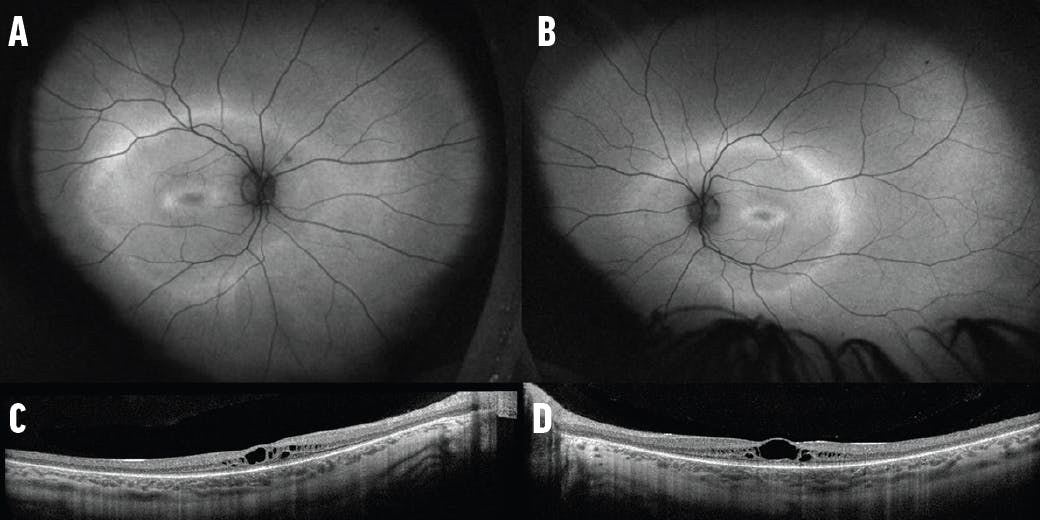
Figure 1. FAF of the right (A) and left (B) eye showed a double hyperfluorescent ring around the fovea and posterior pole bilaterally. OCT of the right (C) and left (D) eye showed a thin retina, severe outer retinal atrophy, bare ellipsoid and outer nuclear layer at the fovea, and schisis-like CME bilaterally.
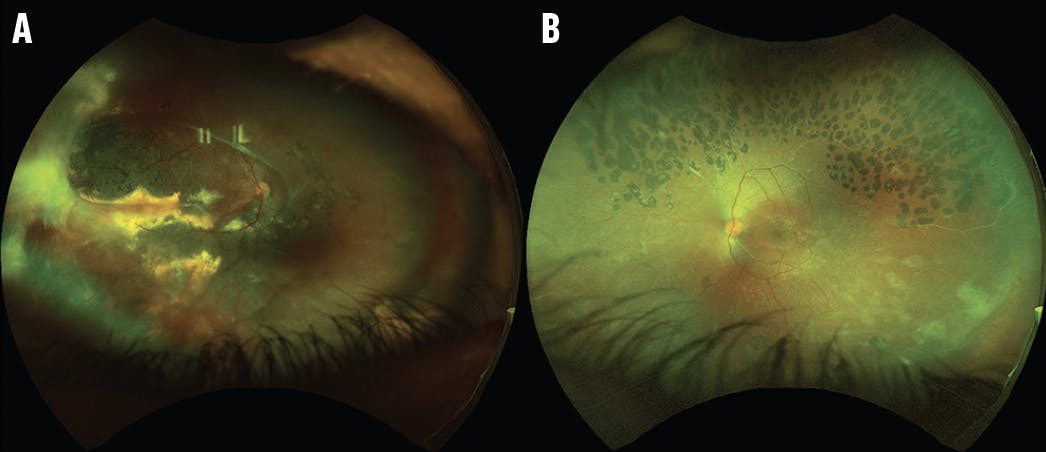
Figure 2. Fundus imaging of the patient’s right eye revealed a pale nerve, severe exudation, a tractional retinal detachment, and pigment migration in the periphery (A). The left eye showed superior laser scars, attenuated sclerotic vessels, and an area of inferior pigment migration (B).
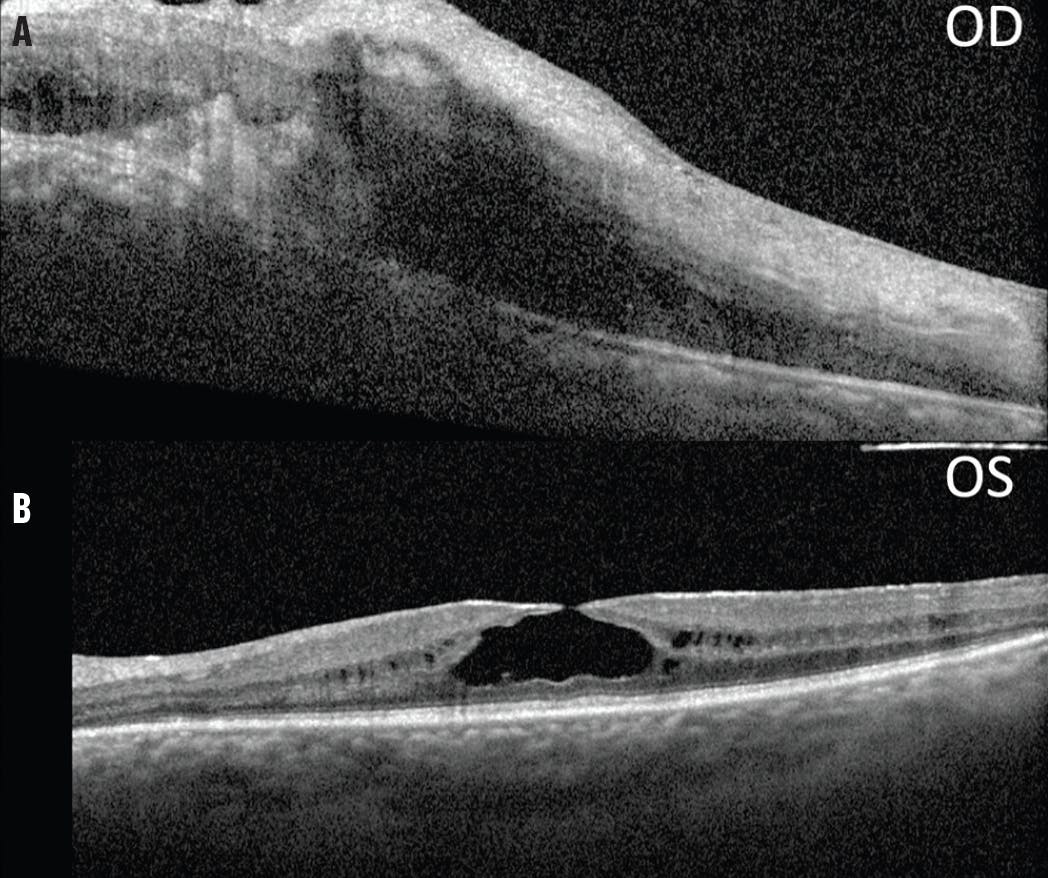
Figure 3. OCT imaging showed foveal dragging with subretinal fibrosis, subretinal fluid, and diffuse outer retinal loss in the right eye (A). The left eye showed peripheral outer retinal loss with a preserved photoreceptor layer centrally, CME, and an early lamellar hole/large cyst in the fovea (B).
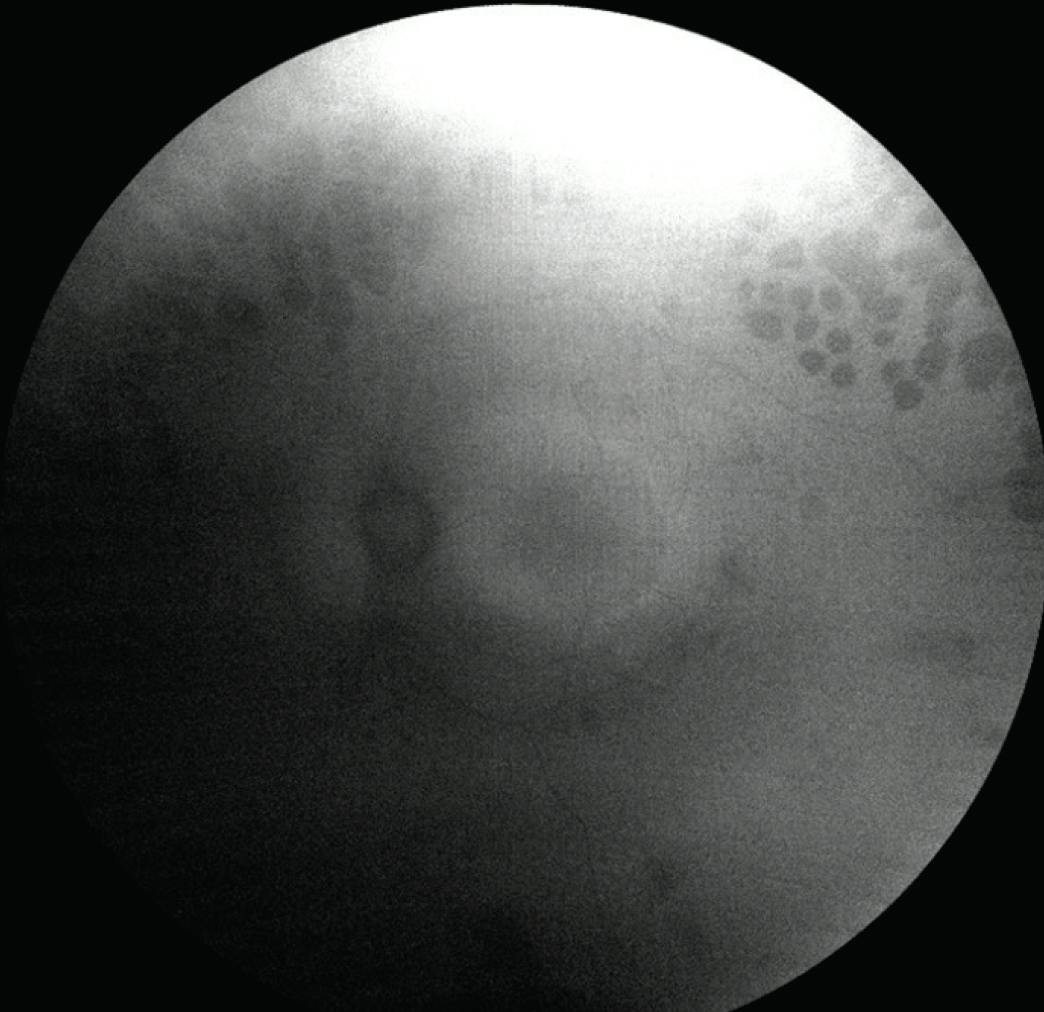
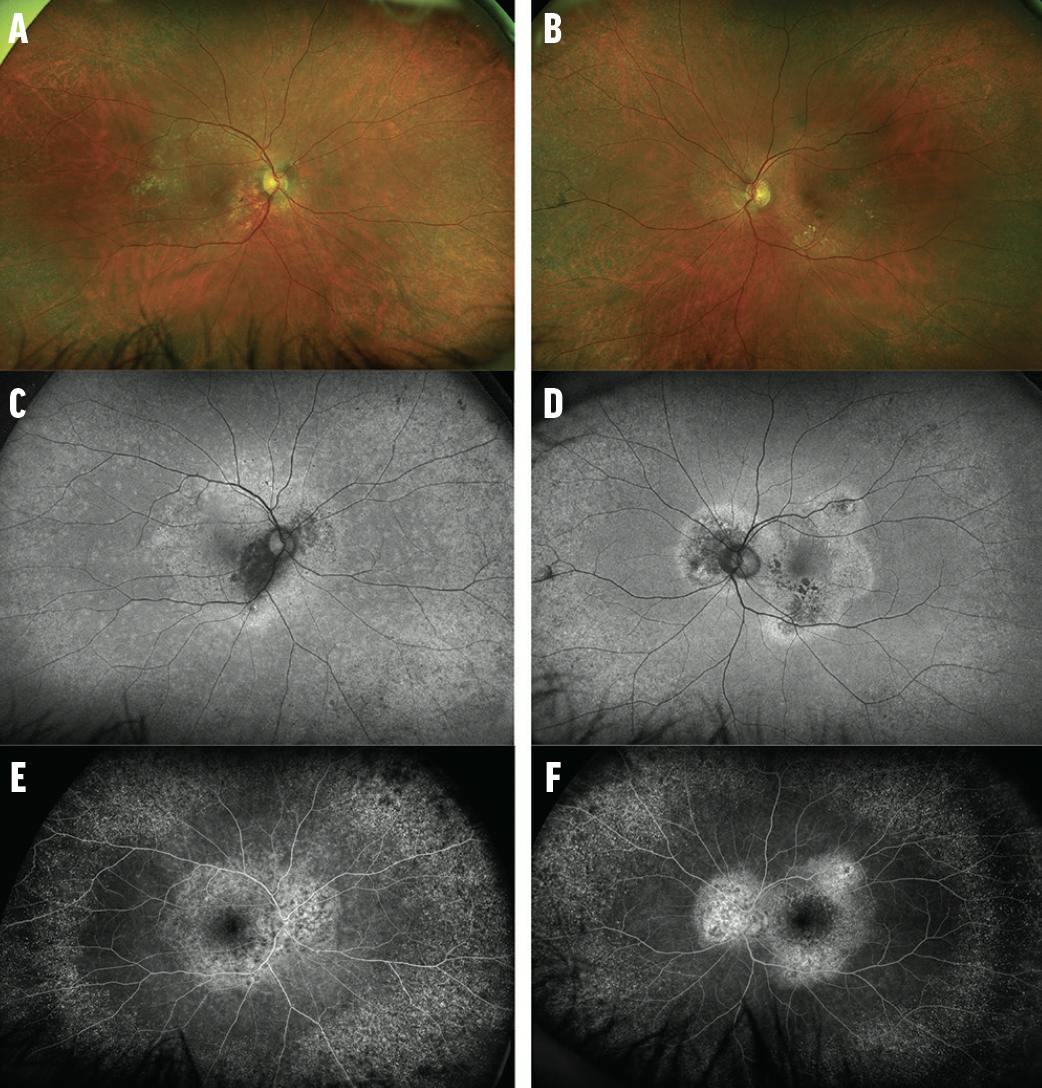
Figure 5. Fundus imaging of the right (A) and left (B) eye showed macular pigment clumping and extensive hard drusen that extended from the macula to the periphery. FAF of the right (C) and left (D) eye showed hypoautofluorescence emanating from the nerves with surrounding areas of hyperautofluroescence. Late frames on FA of the right (E) and left (F) eye showed staining of the macular and peripheral drusen.

Figure 6. OCT of the right (A) and left (B) eye revealed numerous cuticular drusen, low-lying pigment epithelial detachments, and focal areas of ellipsoid attenuation.
DISCUSSION
Case No. 1: Mucopolysaccharidosis IIIA
Genetic testing was significant for two variants of unknown significance, c.1130G>A(p.Arg377His) and c1186T>C(p.Phe396Leu), in N-sulfoglucosamine sulfohydrolase (SGSH), which encodes heparan-N-sulfatase. Homozygous or compound heterozygous mutations in SGSH are responsible for mucopolysaccharidosis (MPS) IIIA, also known as Sanfilippo syndrome, an autosomal-recessive lysosomal storage disease that results from impaired degradation of heparan sulfate.1 Urine mucopolysaccharide testing revealed elevated heparan sulfate, and heparan-N-sulfatase activity in the blood was undetectable, confirming this patient’s diagnosis of MPSIIIA despite the technically inconclusive genetic results. These variants were later classified as likely pathogenic in ClinVar.2
Patients with MPSIIIA have severe central nervous system involvement, which can include behavioral disturbances, intellectual deterioration, and dementia. Somatic symptoms are relatively mild and include skeletal and joint pathology and hepatosplenomegaly.3 Ocular manifestations of MPSIIIA include retinopathy with pigmentary retinal degeneration and electroretinography changes and, less commonly, corneal opacification, glaucoma, and optic nerve anomalies.4
There is wide phenotypic variability, from severe to attenuated, which has been reported to be correlated with genotype.5 MPSIIIA frequently leads to early mortality in adolescence or early adulthood; thus, this patient’s presentation was relatively mild.
Case No. 2: Retinitis Pigmentosa With Coats-Like Response
Genetic testing identified four variants in the EYS gene, of which one was already known to be pathogenic: a heterozygous variant at c.3443+1G>T. With this genetic testing and the constellation of findings, the patient was diagnosed with likely autosomal-recessive retinitis pigmentosa (RP) and a Coats-like response in the right eye. This exudation is thought to be present in up to 5% of RP cases and can present at the initial diagnosis, although it more commonly presents later as the disease progresses.6 The diagnosis of RP is often made with the combination of clinical examination, patient and family history, and multiple imaging modalities, including FAF, OCT, and electroretinogram.
RP is often diagnosed late and may masquerade as a uveitis-like picture, especially when presenting with CME or a coats-like response. FAF is a useful tool because hyperfluorescent rings are highly suggestive of retinal dystrophies and become smaller as the disease progresses.
There is currently no treatment for EYS-associated RP, although the Coats-like exudation has been reported to respond favorably to intravitreal anti-VEGF treatment in some cases.7,8 The use of oral carbonic anhydrase inhibitors can also be used for RP-associated CME.9 Genetic and sometimes premarital counseling is recommended for stratifying risk in other family members.
Case No. 3: CFH-Associated Early-Onset Macular Drusen
The differential diagnosis included AMD, Sorsby macular dystrophy, dominant drusen (Doyne honeycomb retinal dystrophy), and CFH-associated early-onset macular drusen.
Genetic testing revealed a pathogenic nonsense mutation in the complement factor H (CFH) gene (c.2575C>T; p.Gln859*). Pathogenic variants in the CFH gene have been associated with C3 glomerulopathy, atypical hemolytic uremic syndrome, and early-onset macular drusen.10,11
The CFH gene is responsible for production of the protein complement factor H, which regulates activation of the complement system. Specifically, it protects host cells by downregulating the alternative pathway and limiting the convergence of all pathways through inactivation of deposited C3b on host cell surfaces.10,11 The early-onset drusen are likely a consequence of complement dysregulation. The drusen are typically basal laminar (or cuticular), have a hard appearance on examination, and may be present as early as the first decade of life. This patient’s FA demonstrated a classic drusen appearance, coined stars-in-sky. There is one CFH variant (Tyr402His) that does not have the phenotype of early-onset macular drusen but instead is thought to increase the retinal pigment epithelium’s susceptibility to damage and is a major genetic predictor of AMD.10,11
Given his history of hematuria, this patient was referred to a nephrologist for further evaluation. Nephropathy due to CFH comes with a poor prognosis, but early detection allows for proper evaluation and access to potential therapies.
1. Scott HS, Blanch L, Guo XH, et al. Cloning of the sulphamidase gene and identification of mutations in Sanfilippo A syndrome. Nat Genet. 1995;11(4):465-467.
2. Landrum MJ, Lee JM, Riley GR, et al. ClinVar: public archive of relationships among sequence variation and human phenotype. Nucleic Acids Res. 2014;42(Database issue):D980-985.
3. van de Kamp JJ, Niermeijer MF, von Figura K, Giesberts MA. Genetic heterogeneity and clinical variability in the Sanfilippo syndrome (types A, B, and C). Clin Genet. 1981;20(2):152-160.
4. Ashworth JL, Biswas S, Wraith E, Lloyd IC. Mucopolysaccharidoses and the eye. Surv Ophthalmol. 2006;51(1):1-17.
5. Valstar MJ, Neijs S, Bruggenwirth HT, et al. Mucopolysaccharidosis type IIIA: clinical spectrum and genotype-phenotype correlations. Ann Neurol. 2010;68(6):876-887.
6. Moinuddin O, Sathrasala S, Jayasundera KT, et al. Coats-like exudative vitreoretinopathy in retinitis pigmentosa: ocular manifestations and treatment outcomes. Ophthalmol Retina. 2021;5(1):86-96.
7. Kao CC, Chen KJ, Cheng KC. Application of intravitreal aflibercept to treat bilateral exudative retinal detachment secondary to retinitis pigmentosa: Case report and review of literature. Medicine (Baltimore). 2023;102(51):e36589.
8. Miyata M, Oishi A, Oishi M, et al. Long-term efficacy and safety of anti-VEGF therapy in retinitis pigmentosa: a case report. BMC Ophthalmol. 2018;18:248.
9. Bakthavatchalam M, Lai FHP, Rong SS, Ng DS, Brelen ME. Treatment of cystoid macular edema secondary to retinitis pigmentosa: a systematic review. Surv Ophthalmol. 2018;63(3):329-339.
10. Boon CJ, van de Kar NC, Klevering BJ, et al. The spectrum of phenotypes caused by variants in the CFH gene. Mol Immunol. 2009;46(8-9):1573-1594.
11. Taylor RL, Poulter JA, Downes SM, et al; United Kingdom Inherited Retinal Dystrophy Consortium. Loss-of-function mutations in the CFH gene affecting alternatively encoded factor H-like 1 protein cause dominant early-onset macular drusen. Ophthalmology. 2019;126(10):1410-1421.


_1784132761.jpg?auto=compress,format&w=75)




