


Several new drug treatments have made their way into retina practices recently, which should remind everyone just how essential it is to carefully consider coding and documentation guidelines. When outlining practice protocols, retina specialists and practice managers must recognize that new drug guidelines may stray from the standard protocols regarding treatment frequency, indications, billing practices, and required modifiers.
TREATMENT FREQUENCY
Frequency limitations for intravitreally injected medications are determined by the FDA label. For more than a decade, payers limited anti-VEGF treatments to no sooner than every 28 days. This limitation was based mostly on the FDA label for ranibizumab (Lucentis, Genentech/Roche) and 2 mg aflibercept (Eylea, Regeneron), and then the off-label use of bevacizumab (Avastin, Genentech/Roche). However, many new retina drugs have different frequency limitations per their unique FDA label.
For example, 8 mg aflibercept (Eylea HD, Regeneron) can be administered every 28 days, give or take a week, for the first three doses. Then the treatment can be extended to 8 to 12 (diabetic retinopathy [DR]) or 16 (wet AMD or diabetic macular edema [DME]) weeks.
Geographic atrophy (GA) therapies—pegcetacoplan (Syfovre, Apellis Pharmaceuticals) and avacincaptad pegol (Izervay, Iveric Bio/Astellas)—also have varied treatment intervals per their individual labels. Pegcetacoplan can be injected every 25 to 60 days, while avacincaptad pegol is a monthly injection, given every 28 days, give or take a week, for up to 12 months.
TREATMENT INDICATION
Medical necessity for intravitreal injections is also determined by the FDA label. This corresponds to specific ICD-10 codes that are payable with the intravitreal injection, CPT code 67028, and the HCPCS code for the drug.
For example, 8 mg aflibercept/0.07 mL and 2 mg aflibercept/0.05 mL have similar indications; however, the former does not include treatment for macular edema following retinal vein occlusion (RVO) or retinopathy of prematurity, while the latter does.
Faricimab (Vabysmo, Genentech/Roche), a dual pathway treatment, has indications for wet AMD, DME, and macular edema following RVO. DR, however, is not currently an FDA-approved indication.
Both pegcetacoplan and avacincaptad pegol are indicated for GA secondary to AMD. The FDA approval of these new GA drugs in 2023 was a significant change in covered diagnosis codes for an intravitreal injection.
Additionally, newer to the retina space are two ranibizumab biosimilars, ranibizumab-nuna (Byooviz, Samsung Bioepis/Biogen) and ranibizumab-eqrn (Cimerli, Coherus BioSciences). These two drugs have similar indications as ranibizumab with one exception: ranibizumab-nuna is not indicated for DR or DME.
TREATMENT BILLING
For injected medications, billing units are reported in item 24g of the CMS-1500 or EDI loop 2400. The HCPCS descriptor indicates the dosage in mg that would equal 1 unit. The total billing units are then calculated accordingly.
For example, 0.1 mg of faricimab, HCPCS J2777, would equate to 1 unit. The dosage for faricimab is 6 mg/0.05 mL, so the billing units would be 60. The Table provides this information for other new drugs.
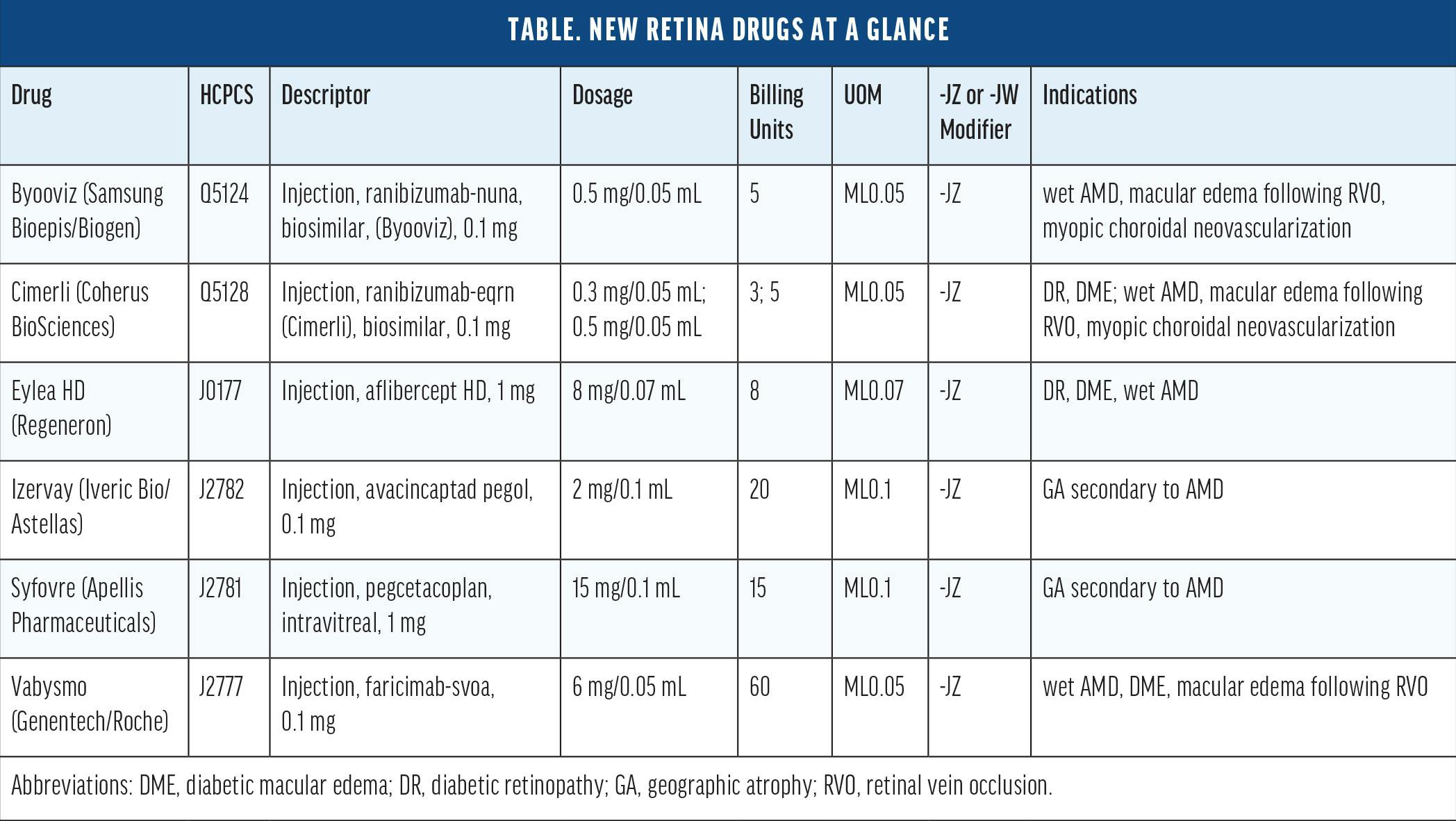
To reduce denied claims, practice managers and billing experts must appropriately report the unit of measure (UOM) on the claim in item 24a of the CMS-1500 or EDI loop 2410, following the NDC number and indicating the volume of the drug. The UOM is measured in ML, the liquid medication volume. Many retina drugs have a volume of 0.05 mL (eg, 2 mg aflibercept, faricimab, ranibizumab, bevacizumab), but new drugs may vary.
For example, 8 mg aflibercept has a volume of 0.07 mL and would be reported on the claim as ML0.07. GA treatments pegcetacoplan and avacincaptad pegol are reported with ML0.1, as the volume of each is 0.1 mL.
TREATMENT MODIFIER
For each new drug, clinicians must consider if a -JW or -JZ modifier is appropriate. When the discarded drug is less than 1 unit as determined by the HCPCS descriptor, or is considered overfill, append the -JZ modifier to the HCPCS code for the drug. Most new drugs are reported with the -JZ modifier; however, there are many examples of -JW modifier use in retina practices.1
NEW TO PRACTICE
CPT code 67028, intravitreal injection of a pharmacologic agent (separate procedure), is reported for most retina treatments. However, there are new CPT codes that represent a new approach. For example, CPT code 67516, suprachoroidal space injection of a pharmacologic agent (separate procedure), effective January 1, 2024, is currently used for suprachoroidal triamcinolone acetonide (Xipere, Bausch + Lomb and Clearside Biomedical). Additionally, Category III code 0810T, subretinal injection of a pharmacologic agent, including vitrectomy and one more retinotomy, is used to bill for a novel delivery method for gene therapy.
As retina treatments continue to evolve, remember that the status quo may be challenged, whether that is frequency limitations, indications, or coding. To stay current with these changes, visit aao.org/retinapm.
1. Practice management for retina. American Academy of Ophthalmology. Accessed May 14, 2024. aao.org/retinapm


_1784132761.jpg?auto=compress,format&w=75)





