WHERE IT ALL BEGAN
I was born and raised in Oklahoma City, Oklahoma, but attended college at St. Louis University in Missouri, where I was accepted into a program that guaranteed my acceptance into medical school out of high school. I grew up knowing that I wanted to become a physician because my dad was a general practioner in Oklahoma before passing away.
MY PATH TO RETINA
I went into medical school thinking I wanted to become an interventionist or surgeon. However, during my first year of medical school, a lecture by Sophia Chung, MD, a neuro-ophthalmologist (now at the University of Iowa), opened my eyes to the field of ophthalmology and changed my trajectory. Then, during my third year of medical school, I shadowed a retina surgeon, and I was hooked. I enjoyed other rotations during residency, but from the start I always knew I wanted to do retina. I like being able to do everything in the eye and being the last line of defense when things go south.
SUPPORT ALONG THE WAY
So many people have been instrumental in my career. My current chair, Sophie J. Bakri, MD, MBA, was my mentor during residency and molded me into who I am today from an academic standpoint. Dr. Bakri demands perfection, and she held me accountable during residency to strive to be the best. In fellowship at Wills Eye Hospital in Philadelphia, I was fortunate to learn from Allen C. Ho, MD; Carl D. Regillo, MD; Arunan Sivalingam, MD; Richard S. Kaiser, MD; Marc J. Spirn, MD; James P. Dunn, MD; Jason Hsu, MD; James Vander, MD; Carl H. Park, MD; Sonia Mehta, MD; Allen Chiang, MD; Mitchell Fineman, MD; Omesh P. Gupta, MD; Michael A. Klufas, MD; Yoshihiro Yonekawa, MD; Ajay E. Kuriyan, MD, MS; and Michael N. Cohen, MD. I still connect with these mentors regularly to discuss various problems and patient encounters. Now in practice, I try to emulate Dr. Yonekawa’s clinical and research habits—something no one can really do. He has always pushed me to critically evaluate my research and how I can move the field forward.
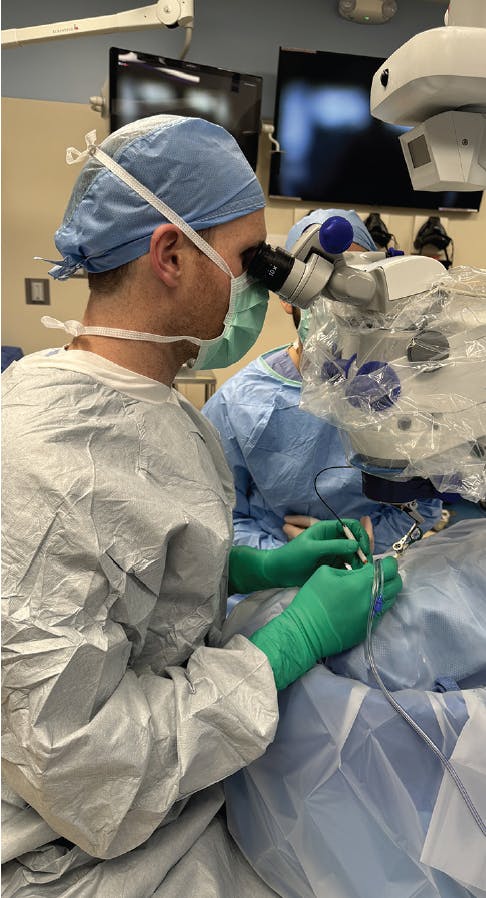
Dr. Starr’s advice: To quote Charles P. Wilkinson, MD, “Read all you can, do all you can, assist all you can.” Retina is hard; you must stay late, see that extra patient, and do the extra project because that is how you learn and develop relationships that will continue to guide you along your career path.
AN EXPERIENCE TO REMEMBER
The hardest part after fellowship was learning to deal with complications. Ten months after fellowship, I did a perfect surgery in a young teenager who developed a terrible complication 2 weeks postoperatively and another set of issues almost 1 year later that no one could have predicted. This patient has lost a considerable amount of vision in both eyes. When discussing the most recent issues with the family, I asked if they wanted me to leave so that they could discuss their options, and they replied, “You are part of the family now.” Despite everything this family had been through, they still put their child’s eyes in my hands to fix. This experience is one of the many reasons why I do what I do.
