

The complement pathway is a complex and multifactorial component of the innate immune system, and it plays a direct role in the development of geographic atrophy (GA). Pegcetacoplan, a peptide-based drug, specifically targets one element of this pathway, the C3 component. By binding to C3, pegcetacoplan inhibits its downstream effects within the complement pathway, providing a therapeutic approach to slow down the progression of GA.1 This intervention holds promise for managing GA and potentially preserving patients’ vision.
Two pivotal phase 3 trials, OAKS and DERBY, substantiated pegcetacoplan’s effectiveness in reducing GA lesion growth over 24 months, whether used every month or every other month.2 Significant for patients is that both studies demonstrated functional benefits which included preservation of the mean threshold sensitivity in the perilesional zone, as well as a reduction in the number of scotomatous points, effectively reducing the expansion of blind spots experienced by patients. Additionally, the GALE extension study further substantiated the reductions in GA lesion growth over a 30-month period.3
GA Treatment in the Real World
As promising as those clinical trial results are, we as clinicians need to be mindful that treating patients in the real world can be different. When selecting patients for treatment, it’s important to keep several key factors in mind such as considering their age and any other underlying medical conditions and recognize the importance of treating the whole person, not just their eye condition. Also physicians should assess whether patients can easily reach the clinic for frequent injections, and take into account the health of their fellow eye, as well as the characteristics and progression of the GA lesions.
In terms of patient management, it’s important to focus on effective treatment and monitoring. This entails maintaining clear and open communication with the patient about their treatment plan, also determining the appropriate dosing protocol, whether it’s monthly or every-other-month injections, and emphasizing the importance of adherence to the treatment plan. Monitoring a patient’s progress is crucial, and clinicians rely on imaging to do so. Optical coherence tomography (OCT) should be conducted with every injection ensuring the safety of patients (absence of conversion to the wet form of AMD) throughout the treatment process.
Clinical Trials vs the Real World
The trials reported certain adverse events, such as intraocular inflammation, endophthalmitis, and retinal detachment. It’s important to note that these complications, although infrequent, are also observed with anti-VEGF agents and are not unique to pegcetacoplan. Furthermore, the trials identified rare occurrences of choroidal neovascular events and ischemic optic neuropathy associated with pegcetacoplan, which are unusual and emergent.
In real-world settings, there have been very rare instances of retinal vasculitis. Interestingly, no such cases were observed during the clinical trials, which involved more than 25,000 injections. However, these events have been actively investigated and analyzed in-depth in real-world practice to ensure comprehensive safety monitoring. Situations like this highlight how clinical trials and real-world experiences can differ and outline the importance of carefully monitoring patients for adverse events.

Managing GA Patients in Today’s Practice
Age-related macular degeneration (AMD) patients often experience varying levels of visual deficits and speed of progression. In our clinic, a 70-year-old male presented for an evaluation of AMD, complaining about significant vision deterioration in his right eye, which resulted in headaches. Autofluorescence and OCTA revealed that the foveal area in the right eye was becoming affected by the AMD lesion, which was much smaller in the left eye, explaining the difference in vision quality (Figure 1). Another patient (73-year-old female) had 20/20 vision at first examination with no significant complaints. However, over time, her vision declined and in less than three years, her right eye’s vision had deteriorated drastically. In contrast to the images in Figure 1 her GA lesions were multifocal and very small.
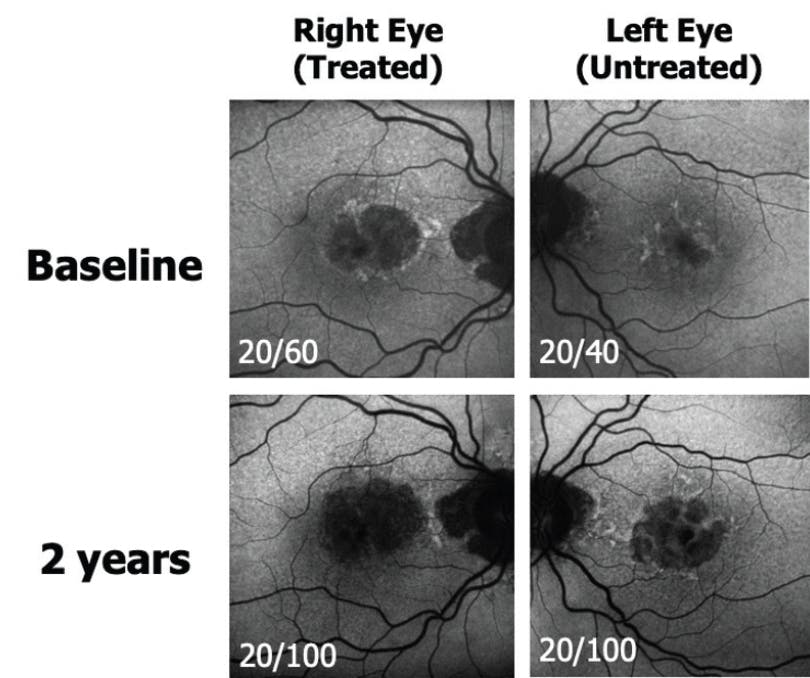
Figure 1. The autofluorescence images of a 70-year-old male patient reveal a slower progression of both the atrophic lesion size and the decline in visual acuity in the treated eye at 2 years when compared to the untreated eye.
Courtesy of Dr. Lad
A thorough discussion regarding the risks, benefits, and alternative treatment options took place with both patients. The male patient received monthly injections in the right eye, followed by standard care for two years. At the end of this period, a slower progression of the atrophic lesion size and reduced decline in visual acuity were observed in the treated eye, however the vision in the left eye had declined significantly. For the female patient with the multifocal lesions the recommendation was to initiate pegcetacoplan treatment in both eyes, with the primary goal of preserving central vision. It’s important to note that the frequency of treatment should be tailored to the individual patient’s needs and their willingness to balance safety and efficacy in their specific case.
In summary, it is essential to remember that managing GA in patients aims to slow down disease progression to preserve functional vision and enhance their quality of life. Being proactive and diligent in the management of GA is crucial to achieving treatment goals and providing the best possible care for our patients.
Disclosures:
Scientific Advisor to 4-DMT, Alexion, Allegro, Annexon, Apellis, Aspen Neuroscience, Blue Rock, Boehringer Ingelheim, Broadwing Bio, Complement Therapeutics, Galimedix, Iveric Bio/Astellas, Janssen, Kriya Therapeutics, LumiThera, Lutronic Vision, Nanoscope Therapeutics, NGM Biopharmaceuticals, Novartis, Ocular Therapeutics, Osanni Bio, Perceive Bio, Regeneron, Retrotope, Roche, Sanofi, Thea Laboratoires
Received research funding from Alexion, Apellis, Belite Bio, Boehringer Ingelheim, Gemini Therapeutics, IVERIC Bio, Janssen, LumiThera, Neurotech, NGM Biopharmaceuticals, Novartis, Roche.
Stock options from Osanni Bio and Provisional Patent: 63162741: “A System And Method To Predict Progression Of Age-Related Macular Degeneration”
The views and opinions expressed in this content may not necessarily represent those of Bryn Mawr Communications or Retina Today.
1. Desai, D., & Dugel, P. U. (2022). Complement cascade inhibition in geographic atrophy: a review. Eye, 36(2), 294-302.
2. Heier, J. S., Lad, E. M., Holz, F. G., Rosenfeld, P. J., Guymer, R. H., Boyer, D., ... & Rao, L. J. (2023). Pegcetacoplan for the treatment of geographic atrophy secondary to age-related macular degeneration (OAKS and DERBY): two multicentre, randomised, double-masked, sham-controlled, phase 3 trials. The Lancet, 402(10411), 1434-1448.
