

While we possess substantial knowledge about the average progression rates in GA, it’s important to recognize that these rates represent general trends. As depicted in Figure 1, the variability in disease progression from a baseline visit is notably wide, the observed averages may not necessarily apply, making it uncertain whether their lesion size will increase, and visual function will deteriorate. Furthermore, it is conceivable that individuals experiencing fast versus slow GA progression may respond differently to treatment. Therefore, it is of utmost significance to determine early on to which group patients belong.
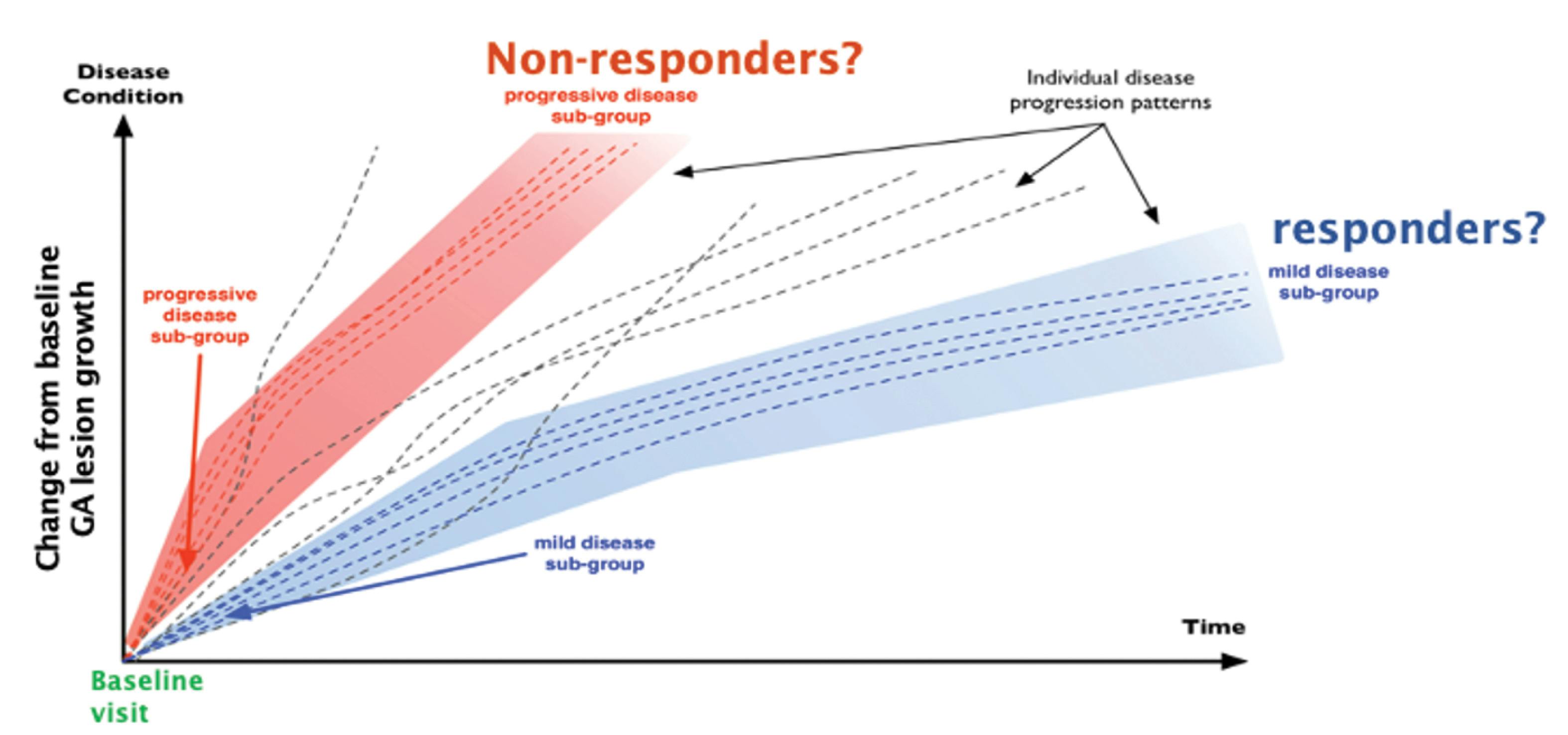
Figure 1. GA results in progressive lesion growth. The rate of growth varies widely, as shown by the individual dashed lines. Those undergoing rapid vs slow growth (termed here as progressive disease and mild disease sub-groups) may differ in their response to treatment or require different treatment strategies.
Courtesy of Prof. Schmidt-Erfurth
Best-corrected visual acuity (BCVA) is often used as a functional measure of disease progress for various disorders of the eye. This measure, however, primarily reflects the functionality of the fovea, and in patients with GA, the foveal area can range from being completely unaffected to entirely compromised. As a result, BCVA is an unreliable indicator for assessing disease activity and monitoring treatment effectiveness. Instead, photoreceptor (PR) degeneration has emerged as an FDA-recognized clinical trial endpoint for GA as a morphological correlate for function.
Photoreceptor Degeneration as a Marker of GA Progression
Tracking PR morphology changes, however, is no simple task. Fundus autofluorescence (FAF) is a valuable tool for assessing retinal pigment epithelium (RPE) end-stage loss in patients with GA, but it is not able to provide direct visualization or quantitative assessment of the stage of PR degeneration. Instead, we turn to optical coherence tomography (OCT), which is capable of assessing PR morphology in high-resolution detail.1,2
We have harnessed deep learning to develop algorithms to analyze standard OCT imaging to identify both RPE loss and PR degeneration. Importantly, automatically identified areas of RPE loss on OCT have a consistent correlation to manual FAF imaging annotations, yet are fully quantified and localized within their retinal context.3 While as expert clinicians, we cannot recognize the intricacies at the level of PR in the images, OCT can provide this capability, and artificial intelligence (AI) can extract these pathognomonic markers of GA disease with single pixel precision, allowing for visualization and quantification of these critical aspects.
This AI-assisted analysis of OCT revealed for the first time a critical sequence: PR degeneration precedes and exceeds the loss of the RPE. Consequently, in cases where the area of PR loss exceeds that of RPE loss, the RPE lesion will consistently expand to cover the concomitant PR loss area. This ratio therefore signifies active disease progression, making therapeutic intervention highly beneficial for the patients demonstrating a higher PR/RPE ratio. Conversely, in another patient, you may observe that the boundaries of RPE and PR loss have already merged. In such instances, further progression will not occur, and therapy may not be advantageous because there is no ongoing disease activity. Exemplars of these two types of lesion states are shown in Figure 2. This insight not only provides a more precise understanding of the disease but also enables a personalized and tailored approach to its management, allowing us to initiate efficient treatment instead of deferring treatment to observe further anatomical and functional progression.
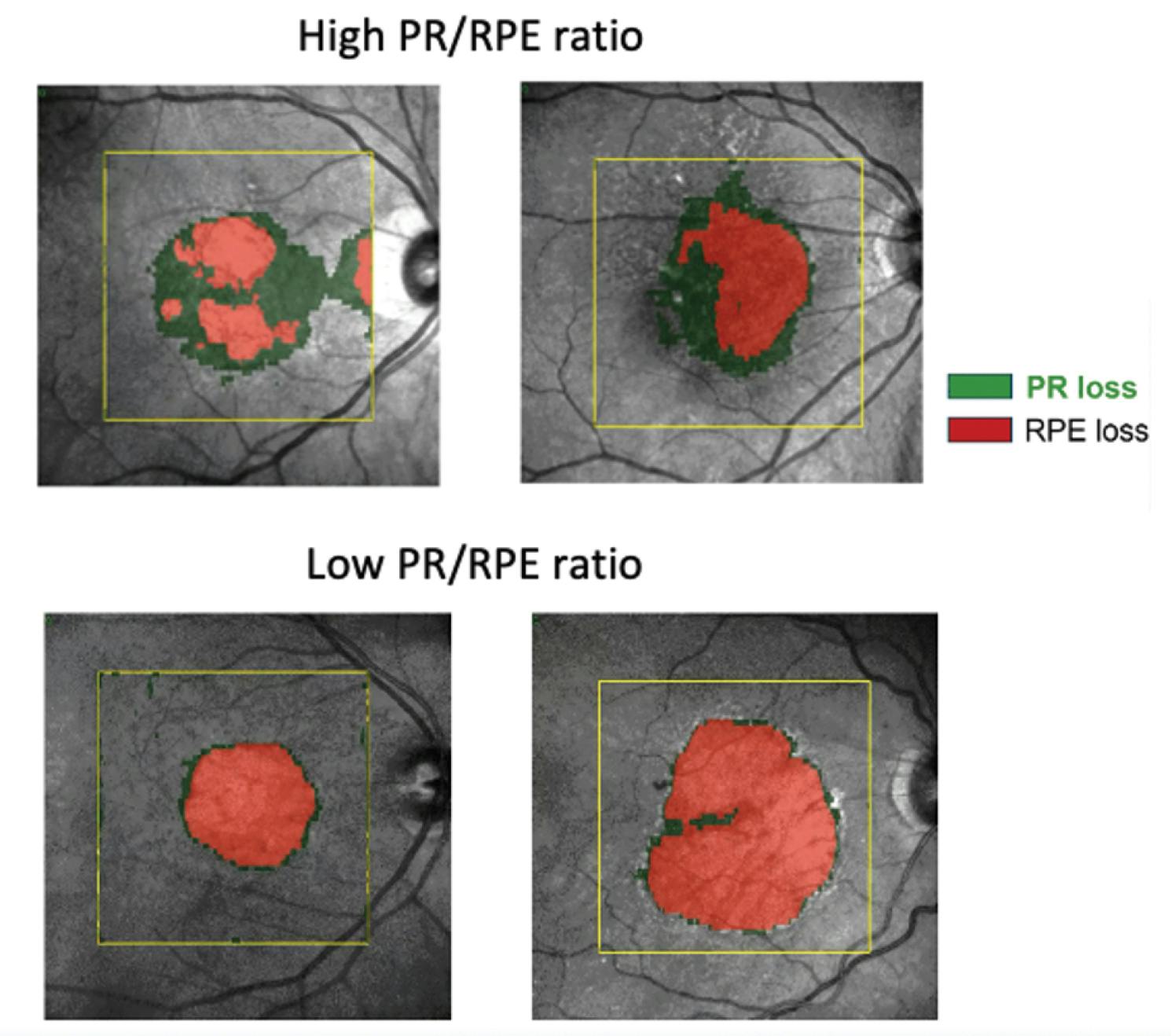
Figure 2. The top images showcase where the area of PR loss is much greater than RPE loss, resulting in high PR/RPE ratios. The bottom images showcase where the area of PR and RPE loss were closely matched, resulting in low PR/RPE ratios and no relevant progression of disease.
Courtesy of Prof. Schmidt-Erfurth
Therapeutic Impact of PR Degeneration
Two recent phase 3 clinical trials, OAKS and DERBY, demonstrated the therapeutic effects of C3 and C3b complement inhibition in the treatment of GA.4 The post hoc analysis of OCT scans conducted using the aforementioned algorithms yielded several key observations.5 Firstly, in the sham-treated patients the growth of the PR lesion was much steeper than the RPE lesion growth. This benefit for PR maintenance arises because RPE loss represents a slower, secondary change, while the primary disease activity occurs at the level of the PR. Secondly, complement inhibition proves effective in slowing the progression of both RPE and PR loss, but the impact on PR degeneration is far more pronounced, with progressive PR degeneration being almost entirely halted. This highlights the therapeutic potential of complement inhibition in addressing the core disease activity at the level of PR.
Additionally, analysis categorized patients based on whether, at baseline, there is a low PR/RPE ratio (indicating that PR and RPE lesion sizes are closely matched, and the disease is considered inactive) or a high PR/RPE ratio (indicating that the PR lesion is significantly larger than the RPE lesion, and the latter is expected to grow). What was found is that for patients with the lowest ratio, there is minimal growth, regardless of whether there was any treatment administered. In contrast, for patients with the highest PR/RPE ratio, there is a rapid expansion of the PR lesion in sham-treated patients, but a substantial therapeutic effect, a slowing of PR lesion growth, is observed with complement inhibition and reached the highest statistical significance of p<0.0001.
These findings underscore that disease activity and treatment efficacy hinge on the ratio between clinically visible RPE and PR degeneration, which can be assessed at baseline using AI-based specialized software in real-time and on standard OCT diagnostics. The GA monitor (RetInSight, Vienna, Austria) is already in use in multiple practices in the EU and as an exploratory tool in the US.

Clinical Application of Automatic PR & RPE Lesion Detection
The algorithm outlined is designed for application in routine OCT, having undergone both validation and regulatory approval in Europe. Notably, its versatility extends to compatibility with various devices, seamlessly integrating with your existing instrumentation. Upon initial use, this innovative software provides an immediate visual representation, superimposing RPE and PR lesion location and size, facilitating the swift identification of the PR/RPE ratio. This eliminates the need for prolonged observation, preventing patient dissatisfaction due to disease progression. By instantly visualizing and measuring the trajectory of the condition, the algorithm offers a precise and proactive approach and selects the right patients to benefit significantly. While many in our field currently express confusion in managing GA, I firmly believe that the solution lies in a simple mouse click, streamlining the diagnostic and decision-making process for enhanced patient care by bringing together state-of-the-art diagnostics and therapeutic innovation.
Disclosures:
Grants or contracts from Genentech, Heidelberg Engineering, Kodiak, Novartis, Roche, RetInSight, and Apellis Pharmaceuticals
Consulting fees from Apellis Pharmaceuticals, Bayer, EcoR1, AbbVie, Medscape, Johnson & Johnson, Allergan, Roche, Böhringer, Heidelberg, Novartis, and Galimedix
Payment or honoraria for lectures, presentations, speakers bureaus, manuscript writing or educational events from Apellis, Roche
Support for attending meetings and/or travel from AbbVie and Apellis
The views and opinions expressed in this content may not necessarily represent those of Bryn Mawr Communications or Retina Today.
1. Orlando, J.I., Gerendas, B.S., Riedl, S. et al. Automated quantification of photoreceptor alteration in macular disease using optical coherence tomography and deep learning. Sci Rep 10, 5619 (2020). https://doi.org/10.1038/s41598-020-62329-9
2. Lachinov, D., Seeböck, P., Mai, J., Goldbach, F., Schmidt-Erfurth, U., & Bogunovic, H. (2021). Projective skip-connections for segmentation along a subset of dimensions in retinal OCT. In Medical Image Computing and Computer Assisted Intervention–MICCAI 2021: 24th International Conference, Strasbourg, France, September 27–October 1, 2021, Proceedings, Part I 24 (pp. 431-441). Springer International Publishing.
3. Mai, J., Riedl, S., Reiter, G. S., Lachinov, D., Vogl, W. D., Bogunovic, H., & Schmidt-Erfurth, U. (2022). Comparison of fundus autofluorescence versus optical coherence tomography–based evaluation of the therapeutic response to pegcetacoplan in geographic atrophy. American Journal of Ophthalmology, 244, 175-182.
4. Heier, J. S., Lad, E. M., Holz, F. G., Rosenfeld, P. J., Guymer, R. H., Boyer, D., ... & Rao, L. J. (2023). Pegcetacoplan for the treatment of geographic atrophy secondary to age-related macular degeneration (OAKS and DERBY): two multicentre, randomised, double-masked, sham-controlled, phase 3 trials. The Lancet, 402(10411), 1434-1448.
5. Schmidt-Erfurth, U., Mai, J., Reiter, G. S., Vogl, W. D., Sadeghipour, A., McKeown, A. S., & Bogunovic, H. (2023). Therapeutic effect of pegcetacoplan on retinal pigment epithelium (RPE) and photoreceptor (PR) integrity in geographic atrophy (GA) in the phase III OAKS and DERBY trials. Investigative Ophthalmology & Visual Science, 64(8), 919-919.
