

The success of any treatment hinges on classifying the stage of atrophic age-related macular degeneration (AMD) and geographic atrophy (GA)/macular atrophy. Reviewing historical and contemporary methods for staging dry AMD and GA support ongoing efforts to identify how function correlates to structural biomarkers.
Methods of Staging GA
In the past, the stage of AMD (early, intermediate or advanced AMD) was determined using AREDS classification criteria, which categorized AMD severity based on the type and size of drusen and the presence of pigmentary changes using stereoscopic color fundus photographs.1 With the advent of optical coherence tomography (OCT) it quickly became indispensable for a more accurate classification of drusen. Thanks to this technology, we can now identify various types of drusen, not only in the sub-retinal pigment epithelium (RPE) level but also in the subretinal space, so called subretinal drusenoid deposits. Beyond that, we have access to a wide array of imaging modalities that offer significantly greater precision in determining the location and progression of atrophic lesions.
While the traditional classifications are still in place, these newer technologies have helped to refine the criteria for categorizing the disease stages. Classification of atrophy is now based on the CAM reports (Table 1).2,3 These are complete RPE and outer retinal atrophy (cRORA), incomplete RPE and outer retinal atrophy (iRORA), complete outer retinal atrophy (cORA), and incomplete outer retinal atrophy (iORA). The term GA can be still used for patients with cRORA without any evidence of macular neovascularization. This classification system doesn’t rely solely on OCT; it is also corroborated by corresponding histological findings, which validate what is observed through imaging modalities.
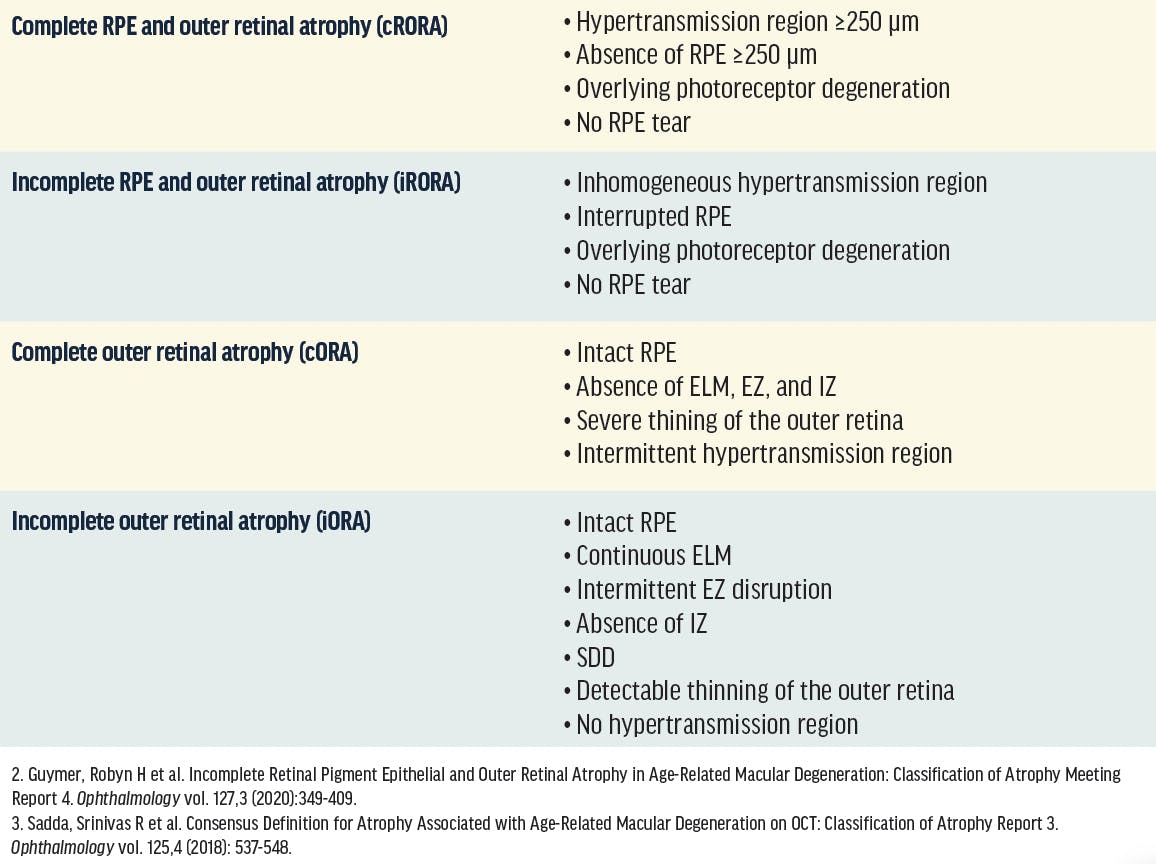
Table 1. The CAM Report classification system stages dry AMD and GA/macular atrophy based on the condition of the RPE and outer retinal function.
Courtesy of Dr. Zweifel
Beyond the stage of AMD, the specific location of the atrophic lesion holds significant importance. In the initial stages, there’s often foveal sparing, and the patterns of atrophy progression can vary. Typically, the central foveal region remains unaltered, while the lesion expands outward into the periphery. The progression of macular atrophy differs from one patient to another, with considerable variability based on individual characteristics and features.
When assessing the progression of macular atrophy, several factors come into play. These include the baseline lesion size, which serves as a prognostic indicator, as well as the presence of multifocality and patterns observed in autofluorescence. For instance, there’s the well-known “diffuse trickling” phenotype, known for its aggressive nature with the highest growth rate, reaching up to three square millimeters per year. This underscores the significance of employing newer imaging modalities and technologies to identify patients who are fast progressors who might benefit from potential therapies.
Functional Measures of AMD Stages
Overall significant progress has been made in defining the structural markers to categorize the stages of AMD and macular atrophy. However, finding a reliable functional correlate for these stages has proven to be a challenging and ongoing endeavor. Traditionally, we have relied on visual acuity as the primary outcome measure. Yet, given the lack of a significant correlation between best-corrected visual acuity (BCVA) and the expansion of macular atrophy lesions, it is not a valid or valuable outcome measure, particularly in the early stages of the disease.

Alternative measures like low luminance visual acuity and microperimetry have emerged as more suitable options. Still, we face the ongoing challenge of establishing a consistent and reliable functional test. Notably, these tests exhibit substantial variability, both within individuals and across different assessments.
In light of these difficulties, it is crucial to persist in the efforts to explore new outcome measures that encompass both functional and structural aspects. Additionally, structural parameters should be investigated that can serve as proxies for functional indicators. Recognizing that the relationship between structural changes and functional outcomes is not always straightforward, it’s important to navigate this complexity with diligence and creativity.
Treating Macular Atrophy
For patients with intermediate AMD who are progressing to iRORA, it is clear that many of them will likely advance to cRORA within the next two to five years.4 The key objective is to offer treatment options at an earlier stage in the disease’s progression, rather than waiting for extensive atrophic lesions to develop.
In an ideal scenario, we would be able to reverse the natural course of the disease, but currently, we do not have that capability. Instead, the aim is to slow down the progression.
Considering the critical factor of life expectancy in managing this disease, the goal is to intervene as early as possible. With the emergence of two treatment options that have received approval in the United States in 2023 and hopefully will become available in Europe as well, this would be possible. These treatments represent a significant step forward in addressing the needs of patients with dry AMD at various stages of progression.
Conclusions
In summary, there is progress in developing a new classification system for AMD. This classification aims to define endpoints at an earlier stage of the disease. However, there are still challenges in establishing clinically meaningful functional outcomes or identifying anatomical clinical outcomes that can serve as surrogates for functional outcomes.
Ideally, our goal is to initiate treatment before the onset of atrophy becomes apparent. A personalized approach is essential when dealing with this patient group. It’s not just about the limited time window for intervention to alter the disease’s course; it’s also about recognizing the varying progression rates in each individual. We need to identify highly progressive lesions and prioritize treatment for those patients.
Disclosures:
Consultant/Advisor to Alcon, Allergan, Bayer, Novartis, Roche, Zeiss, Apellis, Endogena.
Received grant support from Bayer and Novartis.
The views and opinions expressed in this content may not necessarily represent those of Bryn Mawr Communications or Retina Today.
1. Bressler SB, et al. Retina. 5th ed. WB Saunders; 2013:1150-1182.
2. Guymer, Robyn H, et al. Incomplete Retinal Pigment Epithelial and Outer Retinal Atrophy in Age-Related Macular Degeneration: Classification of Atrophy Meeting Report 4. Ophthalmology vol. 127,3 (2020): 394-409.
3. Sadda, Srinivas R et al. Consensus Definition for Atrophy Associated with Age-Related Macular Degeneration on OCT: Classification of Atrophy Report 3. Ophthalmology vol. 125,4 (2018): 537-548.
4. Corradetti, G., Corvi, F., Nittala, M. G., Nassisi, M., Alagorie, A. R., Scharf, J., ...& Sarraf, D. (2021). Natural history of incomplete retinal pigment epithelial and outer retinal atrophy in age-related macular degeneration. Canadian Journal of Ophthalmology, 56(5), 325-334.
