

WHERE IT ALL BEGAN
I grew up in the suburbs of Detroit, Michigan, the son of Iraqi immigrants who taught me a strong work ethic. I went to Duke University for undergraduate and became a lifelong Duke basketball fan. I went to Oakland University William Beaumont School of Medicine, where I was first introduced to retina. During residency at the University of Minnesota, I met some incredible retina mentors, which led me to fellowship at the Cole Eye Institute, Cleveland Clinic, where I was surrounded by retina and uveitis puzzles that kept me engaged.
MY PATH TO RETINA
Throughout medical school, I was adamant that I would not “do eyes,” since I enjoyed everything. This wide interest was the first sign that vitreoretinal surgery and uveitis might be right for me. My roommate was interested in ophthalmology from day one, and when I was still undecided as to my career path, he took me to meet Yoshihiro Yonekawa, MD, still a friend today, who instantly involved me in a project. Ashkan Abbey, MD, was about to scrub in with Antonio Capone, MD, and he allowed me to join them in the OR. I was hooked; it was vitreoretinal surgery or bust for me.
SUPPORT ALONG THE WAY
I have worked with many amazing surgeons, but I have room to mention only a few. In medical school, I was inspired by Dr. Yonekawa; Dr. Capone; Lisa Faia, MD; and George A. Williams, MD. In residency, I had amazing experiences with Sandra Montezuma, MD, and Mehdi Najafi, MD; they had an infectious enthusiasm for retina that stuck with me. At the Retina Consultants of Minnesota, Polly Quiram, MD, and John Davies, MD, were incredibly selfless with their time and nurtured my interest in retina. Every faculty member at Cole influenced how I practice today. Most notable are Sunil Srivastava, MD, for his ability to manage complex cases; Dan Martin, MD, for his encyclopedic knowledge of the history of retinal treatments; and Jonathan Sears, MD, for his utmost compassion for patients.
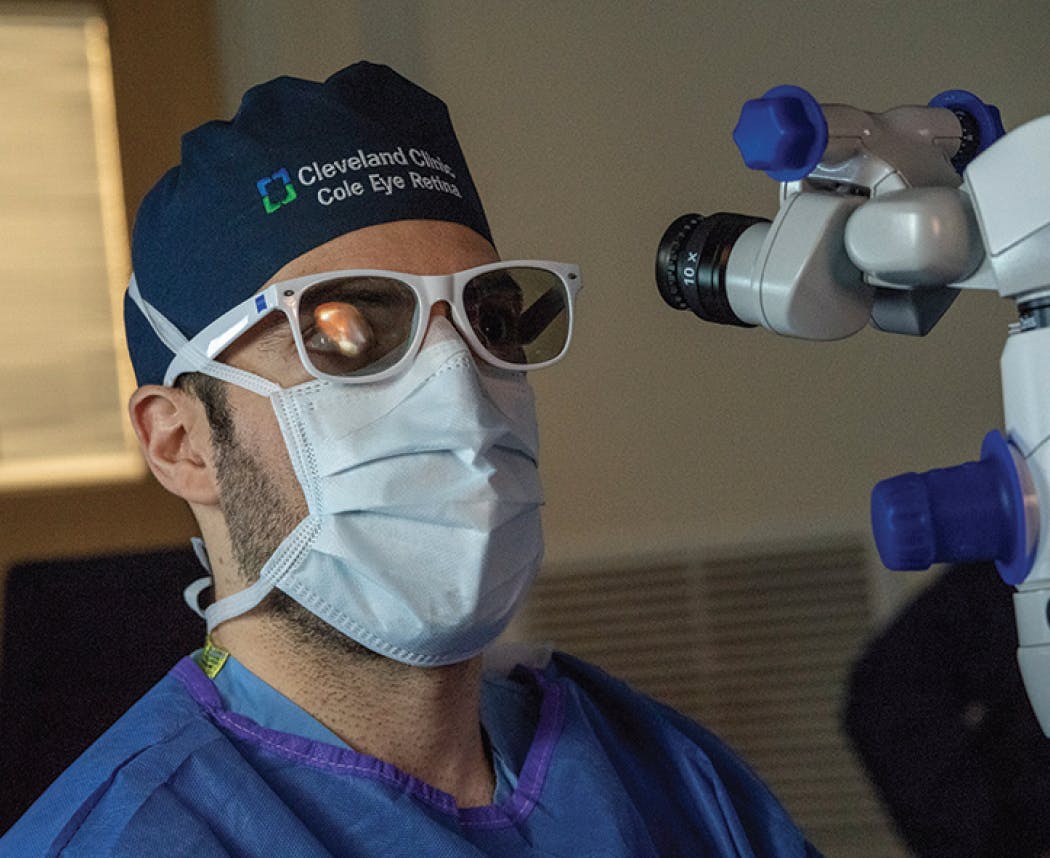
Dr. Mammo’s advice: Stay hungry and humble. Hunger is essential to continually learn and gain confidence in surgery and clinic. Humility is even more important, as it helps you respect your patients and staff and acknowledge how much more there is to learn.
AN EXPERIENCE TO REMEMBER
We are given the opportunity to restore or preserve sight for so many patients. While the successes are too many to count, the handful of setbacks are the cases I remember most—the redetachment, the patient with postoperative pain, etc. I learn the most from these cases, which benefits future patients.
French surgeon René Leriche said, “Every surgeon carries within himself a small cemetery, where from time to time he goes to pray […] for an explanation of his failures.” Analyzing atypical results is crucial to helping you become a better surgeon.
