


Finding the dream job as a retina specialist requires careful thought about what you want in a career, where you want to be, and who is on the road of life with you. For some, it’s a one-and-done decision. For others, including Laxmi Devisetty, MD, it’s more of a journey. Since completing her fellowship in vitreoretinal diseases and surgery at the Associates in Ophthalmology in Pittsburgh, she has gained first-hand experience in several different practice models: academic, private practice (both group and solo), and hospital-based.
AT A GLANCE
- When making a career move, consider if it will require new credentialing; if it does, get started on the process as early as possible.
- Don’t forget to keep your CV and resume updated with all your presentations and publications; you never know when you might need it.
- If you’re thinking about moving to industry or leaving medicine, consider consulting a professional resume writer to help you translate your skills.
- Evaluate whether your values align with those of the practice. If you get into a practice that’s not the right fit, don’t be afraid to make a change.
Her travels have taught her invaluable lessons about career choices, moving with a family, interviewing, and making the most of unforeseen situations. Here, Dr. Devisetty shares her story—and pearls for success—to help others journeying through their retina careers.
RETINA TODAY (RT): CAN YOU WALK US THROUGH YOUR CAREER MOVES AND THE MOTIVATIONS FOR THE CHANGE?
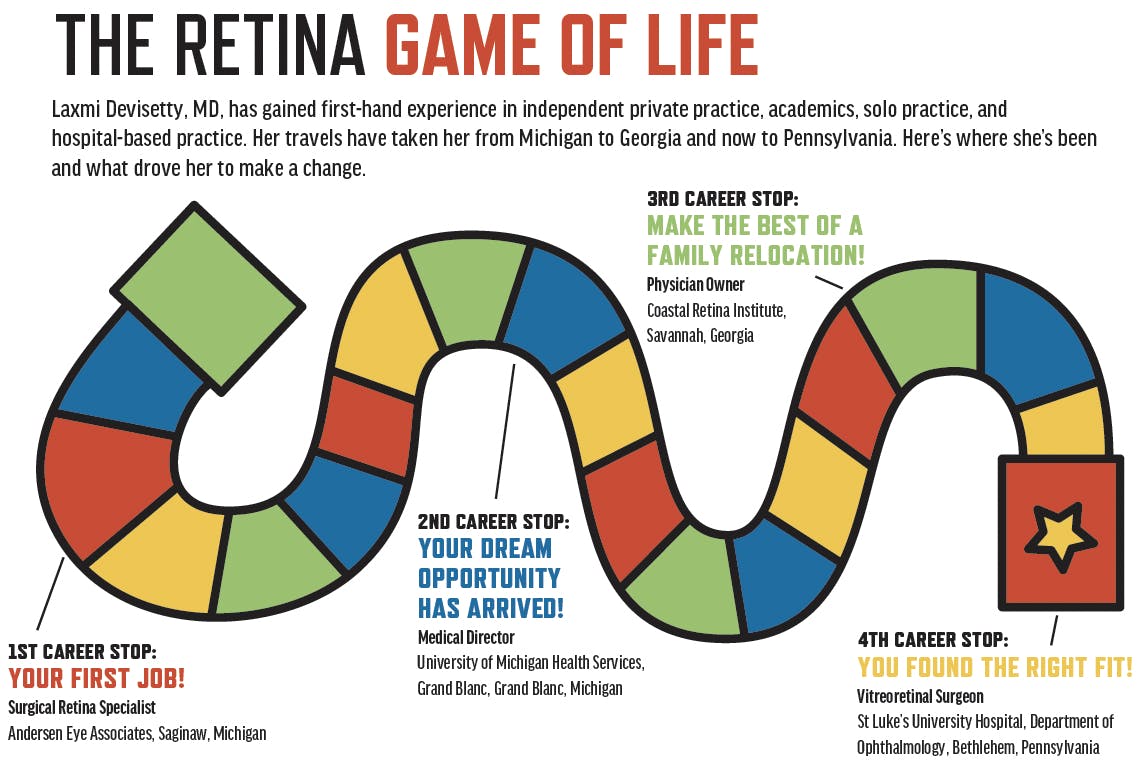
Dr. Devisetty: My first job out of fellowship was with Andersen Eye Associates, a multispecialty and group private practice in Saginaw, Michigan. This role proved to be a wonderful experience with multispecialty support.
I then made the transition to academia as a medical director at the University of Michigan Health Services, Grand Blanc, in Grand Blanc, Michigan, because it seemed like a fantastic opportunity to branch out into teaching along with managing a practice.
During the COVID-19 pandemic, my family decided to move to Savannah, Georgia, in search of a nice change in geography and climate. I decided to start my own solo practice, Coastal Retina Institute and, in doing so, learned the business of medicine and developed a unique skillset. This was such a rewarding experience.
Because of a unique opportunity for my husband, we decided to move to Pennsylvania. I didn’t have a lot of time with this transition, so I had to move before finding a job. Once my family was settled, I started working toward my Pennsylvania medical license and interviewing. Fortunately, there were a few practices that were recruiting surgical retina specialists, and I chose one that was the best fit for me.
RT: WHEN DECIDING TO MAKE A CAREER CHANGE, WHAT COMES FIRST, THE MOVE OR THE JOB SEARCH?
Dr. Devisetty: It depends on the reason for your move. If you’re moving because it’s an abrupt situation, such as family needs, you may not have time to look around and plan it out. If that’s the case, one of the most important lessons I have learned in my moves is the value of getting licensing done ahead of time. Licensing can take up to 3 months to complete, so getting that out of the way makes a huge difference by the time you get to the job. We don’t think about licensing and credentialing after training because most of us join a practice after fellowship that takes care of it for us. However, with midcareer changes, it’s on you to get the ball rolling. By being proactive, you can save a lot of time.
Ideally, you look for the right job prior to moving, but if you must move first, take the time to research the area and find a practice that’s the right fit. See where all the practices are located to understand the competitive landscape and figure out what each practice has to offer. The culture of the practice must align with your values. Sometimes we get caught up in the idea of a forever job, but our needs and mindset often change with time—and so does the forever job. You, your family, and your career will evolve and affect what the right practice looks like at different stages of life.
RT: HOW DO YOU PREPARE FOR A MIDCAREER INTERVIEW?
Dr. Devisetty: When we first graduate residency, we all use the same CV template, regardless of whether we are seeking a job in private practice or academia. Once I was in an academic position, I discovered my institution had its own preferred CV format. I have kept those same principles and have been adding to it as I go along, as it is easy to forget to keep it up to date. Always remember to add lectures, published papers, committee service, etc. You never know when something might happen. Also keep in mind that the format of a CV and resume are different, and having both can help, depending on the opportunity you want to pursue. You don’t want to be scrambling at the last minute; rather, it’s much easier to keep a working document—that’s one of the easiest ways to be efficient with time during a job search.
RT: WHAT SHOULD CLINICIANS KEEP IN MIND WHEN THINKING ABOUT CHANGING THEIR CAREER TRAJECTORY?
Dr. Devisetty: If you’re thinking about moving to industry or leaving medicine, consider consulting a professional resume writer to help you translate your skills. If you want to move to another practice or position, ask colleagues and friends what they think about the move. Having experienced colleagues look at your CV or resume and suggest ways to better highlight your skillset is invaluable.
These days, there are services that can help you with your marketability, such as headhunters and even your LinkedIn profile. LinkedIn has become a useful way to network and get a job, even in retina. Social media in general has become useful for supporting each other throughout our careers. I have also found the Ophthalmology Moms group and other similar women’s groups to be very supportive and helpful.
RT: HOW DO YOU APPROACH THE SUBJECT OF LEAVING WITH YOUR CURRENT EMPLOYER?
Dr. Devisetty: It’s vital to first decide that you are moving. Once you identify the reasons why you want to move, be truthful with your current practice. If you are leaving due to family reasons or because you really need different weather, be honest about it, and no one can fault you for that. If you are leaving the practice because you aren’t happy, that’s a little harder. But you should still be honest and let the practice know that it’s not the right fit for you. Regardless of the circumstances, you will do well to find a positive approach to discussing your decision. You are going to see your colleagues at the next retina conference, and if you left with a positive attitude and were truthful, running into them won’t be a problem. Most recently, I realized I needed to be more available at home for my family, so I needed to find an opportunity that would strike the right balance between professional and personal development. I felt my newest role would give me the best of both worlds.
RT: HOW CAN CLINICIANS NAVIGATE THE JOB SEARCH WHILE STILL WORKING FULL TIME?
Dr. Devisetty: We didn’t have many virtual options before the COVID-19 pandemic, but now we do, and virtual interviews are great. However, if you need to move, you also need to take the time to do it right. Be proactive about it. For example, if you are moving for family reasons and your practice knows, your colleagues might be more supportive. But if you aren’t comfortable announcing your decision just yet, take advantage of virtual options, schedule the time off to meet with your prospective employer, or network during conferences.
Most of us don’t stay at our first job anymore. As we grow into our careers, we often realize that we want something else; few people know for sure that the first job is what they want to do. Maybe something interests you more, such as research or the business side of the practice, that pushes you to move into academia or open a solo practice. Finally, a career path might present itself that you didn’t even anticipate. You must be flexible and adaptable because that’s what gives you a better, and longer, career in this field.
RT: HOW DOES THE INTERVIEW DIFFER BETWEEN YOUR FIRST JOB AND A MIDCAREER CONVERSATION?
Dr. Devisetty: For my first job, the questions were more technical and focused on the types of procedures I was comfortable with and the number I had performed. As I have matured in my career, the questions have shifted more toward my own career goals. Potential employers are worried less about my technical skillset and more about what I add to the practice. They also want to know why I am changing jobs. For me, it has always been for family reasons.
When you first graduate, you’re trying to figure everything out, such as whether you have enough training to succeed or what kind of laser or OCT you want to use in practice. Once you are midcareer, you already know all of that, and it’s a simpler discussion during the interview process. This is a stark difference from when I came out of fellowship because I didn’t have many preferences at that point.
Changing practices midcareer also presents an opportunity to create efficiencies that you might not have known you needed as a new attending. For example, you can use your past experiences with scribes or different clinic flows to suggest efficiencies in the new practice. However, you must be flexible in every new job because what worked somewhere else might not work there.
Before committing to a new practice, shadow the attendings to get a feel for how the office operates and get to know your colleagues.
RT: HOW HAVE YOUR PRIORITIES CHANGED WITH EACH CAREER CHOICE?
Dr. Devisetty: I have always been focused on high-volume private practices. I want to see as many patients as possible, and I want to provide high-quality care efficiently. I have always searched for that in the practices that I’ve been with, including my own solo practice.
Along the way, my family has grown, and dedicating time to them is important. Somewhere along my career journey, I realized that I’m also a mother and a member of my community, and I need to give back—and I can’t do all of that if I’m at my job 24/7. I have worked to find a balance, and we are all looking for ways to do the same efficient, high-volume work while also having a family.
When you are first starting out in the field of retina (or any job, really), you don’t know what to ask for to achieve a sustainable work-life balance. As is the case for most retina specialists, you think it’s all about the salary because of the debt you have. But when you are midcareer, you have a different set of priorities. It could be health, family, or even a charity. Whatever your second goal may be, you will likely prioritize time off a little more to focus on that. When you have kids, a family, and other things that you want to do, you realize that this is a marathon, not a sprint.
RT: ANY LAST PEARLS OF ADVICE?
Dr. Devisetty: With experience, my perspective has changed. When you are fresh out of training, you want to jump in because you’re worried about the salary, as you must pay your loans. Now, however, I am thinking more about where I want to be in 5 years, and if this job is where I see myself. I have learned to take the time to evaluate that carefully. For ophthalmologists, much of our career choice is about the practice culture/fit and professional growth.
Clinicians should closely evaluate whether their goals and values align with those of the practice they are considering. If they do, it’s a good match. If you get into the practice and realize that it’s not the right fit, don’t be afraid to make a change. It’s not helpful for you or your employer if you’re unhappy. Making a career move at the right time in the right place is the hardest decision for most people. Stepping out of your comfort zone never gets easy—but finding the right job that makes you and your family happy is worth the risk.


