


AT A GLANCE
- AI has been employed in disease risk stratification, diagnostic imaging, patient scheduling, and educational applications.
- Early applications of deep learning in OCT involved boundary detection of retinal layers, and recent advances have led to the use of deep learning for pathology identification in OCT.
- Despite its advantages, AI in clinical practice faces several challenges, including data integrity, medicolegal accountability, and potential shifts in the patient-physician relationship.
Health care is rapidly evolving due to technological advances and the accessibility of big data. In retina, the growing interest in AI is driven by the field’s reliance on routine imaging data that require daily review and interpretation for managing retinal pathologies.1-3 AI holds significant promise for revolutionizing ophthalmology by advancing diagnostic, predictive, and management processes. AI has evolved into sophisticated tools applicable across three primary research domains: prediction, causal inference, and description.2 Supervised AI excels in predictive tasks, such as classifying retinal pathologies using labeled data and training sets of images to identify the characteristics of normal versus abnormal conditions.1
Clinically, AI has been employed in disease risk stratification, diagnostic imaging, patient scheduling, and educational applications, with surveys indicating that ophthalmologists anticipate significant improvements in patient care and screening efficiency through AI integration.2
AI IN FUNDUS IMAGING
AI has emerged as a promising tool for enhancing screening capabilities in both acute and chronic clinical settings. The Retinopathy Online Challenge, established in 2010 by the University of Iowa, exemplifies efforts to advance AI in this domain by evaluating algorithms for microaneurysm detection on a standardized dataset of fundus images.4 Notable AI systems, such as those developed by Antal et al and Budak et al, have demonstrated significant accuracy in identifying microaneurysm lesions (Figure 1).5,6
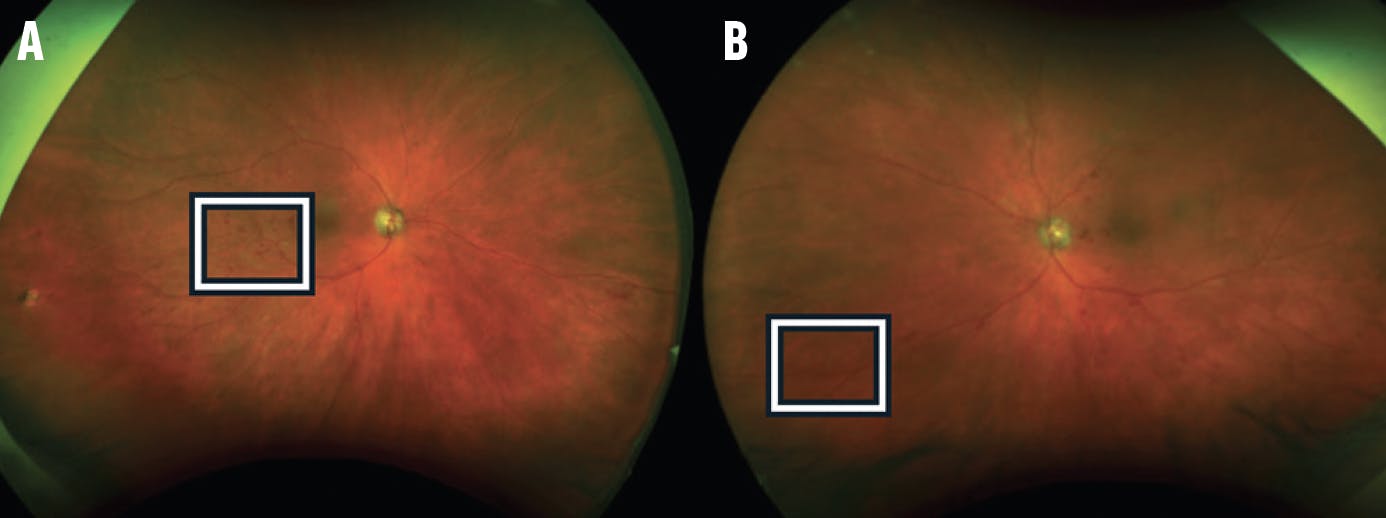
Figure 1. Widefield pseudocolor fundus photographs of the right (A) and left (B) eye show areas of microaneurysms, dot-and-blot hemorrhages, intraretinal microvascular abnormalities, and regions suspicious for neovascularization. The white rectangles show the labelling used by AI to detect DR.
Recent innovations have also targeted retinal vessel detection despite the variation in vascular morphology and crowded background. In addition, a deep convolutional neural network (CNN) model for retinal vessel extraction, which achieved high accuracy and area under the receiver operating characteristic curve (AUC) values, has been introduced.2 Despite these advances, challenges remain in detecting neovascular changes associated with diabetic retinopathy (DR). AI systems, such as those developed by Rajalakshmi et al, have shown high sensitivity and specificity for DR detection using fundus images, while models by Pawar et al have outperformed ophthalmologists in identifying sight-threatening DR.7,8
FDA-approved AI systems—VoxelCloud Retina, IDx-DR (Digital Diagnostics) and EyeArt (EyeNuk)—are currently used for the screening of more-than-mild cases of DR, with others like CLAiR, BioAge, and Theia (Toku Eyes) undergoing approval processes for the detection of systemic cardiovascular risk factors based on fundus imaging.9,10 AI’s application extends to detecting multiple retinal pathologies, including AMD and retinal vascular occlusion (RVO). For instance, algorithms developed by Stevenson et al and Bhuiyan et al have achieved high accuracy in diagnosing various retinal conditions.2
Moreover, novel approaches, such as those integrating style transfer networks with registration networks, have enhanced image alignment and accuracy. However, real-world validation of retinal imaging data remains imperative.3 A study by Lee et al revealed performance discrepancies between AI models in controlled studies compared with real-world clinical settings, highlighting the necessity for comprehensive validation before broader clinical implementation.11
AI IN OCT IMAGES
OCT is instrumental in detecting intra- and subretinal fluid accumulation and abnormalities in retinal layer thickness, which are critical biomarkers in the diagnosis and management of numerous retinal pathologies, such as diabetic macular edema, AMD, RVO, and central serous retinopathy (CSR).12-14 Early applications of deep learning (DL) in OCT involved boundary detection of retinal layers, a critical step for evaluating disease states. For example, Fabritius et al achieved 96.7% accuracy in retinal pigment epithelium segmentation using DL on 1,022 macular OCT images, marking a significant advancement in retinal imaging.12
Subsequent models have made improvements, with Hussain et al’s algorithm demonstrating superior performance in detecting retinal layer boundaries, such as the internal limiting membrane and retinal pigment epithelium.15 Their model outperformed earlier tools like OCTRIMA-3D and AURA, with improved root-mean-square error for key retinal layers.15,16 In addition to boundary detection, DL models have been applied to pathology identification in OCT.
Chakravathy et al developed a DL algorithm that detected intraretinal and subretinal fluid with an AUC of 0.97 and 91% accuracy, comparable with expert retina specialists.17 Zang et al created a model capable of screening for DR and staging disease severity using both OCT and OCT angiography, achieving an AUC of 0.96.18 Occlusion testing has also been employed to identify novel regions of interest in OCT images. For example, Lee et al used occlusion testing to identify fluid accumulation in AMD images, generating heat maps that highlighted areas potentially missed by human graders. These advances demonstrate the utility of DL in enhancing diagnostic accuracy and staging in retinal diseases, making it a valuable tool for clinical decision making.19
Taking this one step further, researchers have developed an AI algorithm (Deepeye) that uses OCT images to identify AMD disease activity and provide treatment recommendations to help clinicians optimize vision outcomes with anti-VEGF therapy.20
AI IN FLUORESCEIN ANGIOGRAPHY
Traditional clinical assessment of nonperfusion areas on fluorescein angiography (FA) is based on indirect markers of ischemia, such as the ischemic index, which typically manifest in advanced stages of disease. This limitation underscores the need for automated detection systems capable of identifying subtle ischemic changes at earlier stages, thereby providing timely and reliable guidance for clinical decision making.21,22
Recent advances in DL have shown promise in improving the detection of nonperfusion and other pathological features in FA images (Figure 2). Gao et al compared the performance of three CNNs—VGG16, ResNet50, and DenseNet—for identifying nonperfusion in DR.23 Using a dataset of 11,214 FA images from 705 patients, the VGG16 model demonstrated superior performance, with an accuracy of 94.17% and an AUC of 0.972, outperforming human graders. Similarly, Jin et al employed ResNet50 on 3,014 FA images from 221 patients with diabetic macular edema, achieving an AUC of 0.8855 for nonperfusion areas, further highlighting the potential of DL models for automated retinal analysis.24
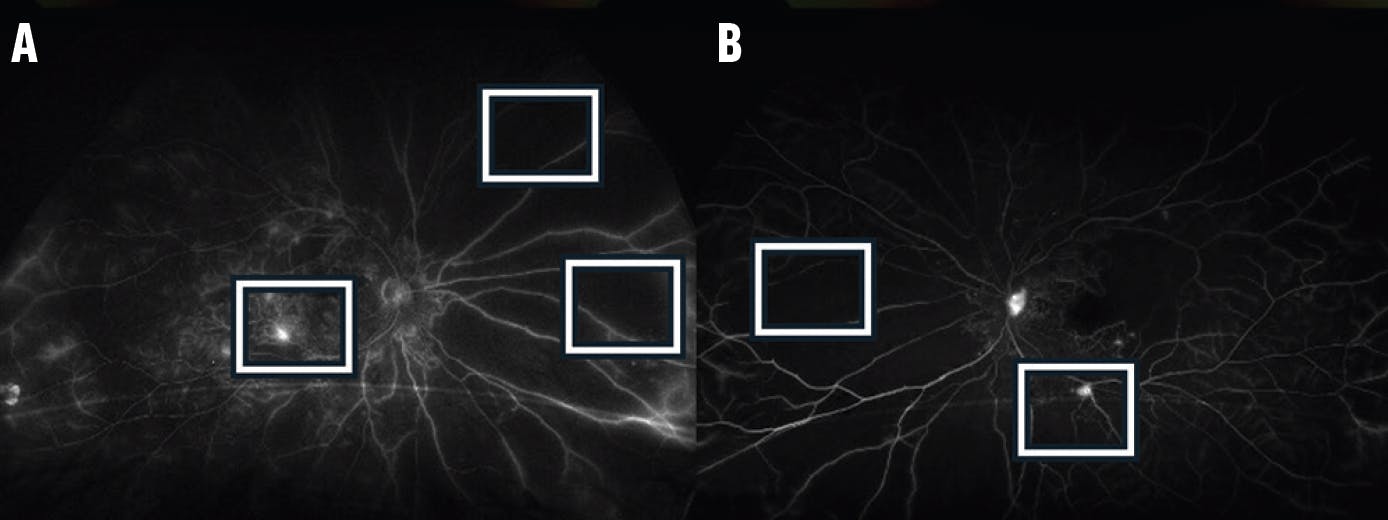
Figure 2. FA of the right (A) and left (B) eye reveals hyperfluorescent areas corresponding to leakage from neovascularization and hypofluorescent areas corresponding to severe ischemia indicating proliferative DR in each eye. The white rectangles show the labelling used by AI to detect DR.
In other retinal conditions, such as neovascular AMD and CSR, DL models have also been successfully applied to detect choroidal neovascularization and leakage. For instance, Chen et al used an attention-gated CNN to identify leakage points in CSR with an accuracy of 93.4%, surpassing the 89.7% accuracy achieved by ophthalmologists. These studies illustrate the growing utility of DL-based models in enhancing the diagnostic capabilities of FA in clinical practice.25
PROCEED WITH CAUTION
The integration of AI into ophthalmology presents significant potential to enhance diagnostic precision, optimize patient outcomes, and increase health care efficiency. However, the clinical application of AI faces several challenges, including data integrity, medicolegal accountability, and potential shifts in the patient-physician relationship. The garbage in, garbage out phenomenon highlights the critical need for high-quality input data to ensure the reliability and accuracy of AI-driven predictions. Furthermore, ethical and legal concerns, particularly related to data privacy and the delegation of decision making, require robust regulatory frameworks. Despite these challenges, ongoing prospective trials and advances in multimodal AI systems underscore the promise of AI in complementing ophthalmologists, improving retinal diagnostics, and enhancing clinical workflows. The successful integration of AI into ophthalmology could lead to more efficient, cost-effective, and accurate retinal care in the future.
1. Wang YL, Yang JY, Yang JY, Zhao XY, Chen YX, Yu WH. Progress of artificial intelligence in diabetic retinopathy screening. Diabetes Metab Res Rev. 2021;37(5):e3414.
2. Shahriari MH, Sabbaghi H, Asadi F, Hosseini A, Khorrami Z. Artificial intelligence in screening, diagnosis, and classification of diabetic macular edema: A systematic review. Surv Ophthalmol. 2023;68(1):42-53.
3. Niemeijer M, van Ginneken B, Cree MJ, et al. Retinopathy online challenge: automatic detection of microaneurysms in digital color fundus photographs. IEEE Trans Med Imaging. 2010;29(1):185-195.
4. Hwang DK, Hsu CC, Chang KJ, et al. Artificial intelligence-based decision-making for age-related macular degeneration. Theranostics. 2019;9(1):232-245.
5. Antal B, Hajdu A. An ensemble-based system for microaneurysm detection and diabetic retinopathy grading. IEEE Trans Biomed Eng. 2012;59(6):1720-1726.
6. Budak U, Şengür A, Guo Y, Akbulut Y. A novel microaneurysms detection approach based on convolutional neural networks with reinforcement sample learning algorithm. Health Inf Sci Syst. 2017;5(1):14.
7. Rajalakshmi R, Subashini R, Anjana RM, Mohan V. Automated diabetic retinopathy detection in smartphone-based fundus photography using artificial intelligence. Eye (Lond). 2018;32(6):1138-1144.
8. Pawar B, Lobo SN, Joseph M, Jegannathan S, Jayraj H. Validation of artificial intelligence algorithm in the detection and staging of diabetic retinopathy through fundus photography: an automated tool for detection and grading of diabetic retinopathy. Middle East Afr J Ophthalmol. 2021;28(2):81-86.
9. Hao Z, Xu R, Huang X, Ren X, Li H, Shao H. Application and observation of artificial intelligence in clinical practice of fundus screening for diabetic retinopathy with non-mydriatic fundus photography: a retrospective observational study of T2DM patients in Tianjin, China. Ther Adv Chronic Dis. 2022;13:20406223221097335.
10. Ipp E, Liljenquist D, Bode B, et al. Pivotal evaluation of an artificial intelligence system for autonomous detection of referrable and vision-threatening diabetic retinopathy. JAMA Netw Open. 2021;4(11):e2134254.
11. Lee AY, Yanagihara RT, Lee CS, et al. Multicenter, head-to-head, real-world validation study of seven automated artificial intelligence diabetic retinopathy screening systems. Diabetes Care. 2021;44(5):1168-1175.
12. Fabritius T, Makita S, Miura M, Myllylä R, Yasuno Y. Automated segmentation of the macula by optical coherence tomography. Opt Express. 2009;17(18):15659-15669.
13. Panozzo G, Gusson E, Parolini B, Mercanti A. Role of OCT in the diagnosis and follow up of diabetic macular edema. Semin Ophthalmol. 2003;18(2):74-81.
14. van Velthoven ME, Verbraak FD, Garcia PM, Schlingemann RO, Rosen RB, de Smet MD. Evaluation of central serous retinopathy with en face optical coherence tomography. Br J Ophthalmol. 2005;89(11):1483-1488.
15. Hussain MA, Bhuiyan A, Turpin A, et al. automatic identification of pathology-distorted retinal layer boundaries using SD-OCT Imaging. IEEE Trans Biomed Eng. 2017;64(7):1638-1649.
16. Tian J, Varga B, Somfai GM, Lee WH, Smiddy WE, DeBuc DC. Real-time automatic segmentation of optical coherence tomography volume data of the macular region. PLoS One. 2015;10(8):e0133908.
17. Chakravarthy U, Goldenberg D, Young G, et al. Automated identification of lesion activity in neovascular age-related macular degeneration. Ophthalmology. 2016;123(8):1731-1736.
18. Zang P, Hormel TT, Wang X, et al. A diabetic retinopathy classification framework based on deep-learning analysis of OCT angiography. Transl Vis Sci Technol. 2022;11(7):10.
19. Lee CS, Baughman DM, Lee AY. Deep learning is effective for the classification of OCT images of normal versus age-related macular degeneration. Ophthalmol Retina. 2017;1(4):322-327.
20. Gutfleisch M, Ester O, Aydin S, et al. Clinically applicable deep learning-based decision aids for treatment of neovascular AMD. Graefes Arch Clin Exp Ophthalmol. 2022;260(7):2217-2230
21. Patel RD, Messner LV, Teitelbaum B, Michel KA, Hariprasad SM. Characterization of ischemic index using ultra-widefield fluorescein angiography in patients with focal and diffuse recalcitrant diabetic macular edema. Am J Ophthalmol. 2013;155(6):1038-1044.e2.
22. Zheng Y, Kwong MT, Maccormick IJ, Beare NA, Harding SP. A comprehensive texture segmentation framework for segmentation of capillary non-perfusion regions in fundus fluorescein angiograms. PLoS One. 2014;9(4):e93624.
23. Gao Z, Jin K, Yan Y, et al. End-to-end diabetic retinopathy grading based on fundus fluorescein angiography images using deep learning. Graefes Arch Clin Exp Ophthalmol. 2022;260(5):1663-1673.
24. Jin K, Pan X, You K, et al. Automatic detection of non-perfusion areas in diabetic macular edema from fundus fluorescein angiography for decision making using deep learning. Sci Rep. 2020;10(1):15138.
25. Holomcik D, Seeböck P, Gerendas BS, et al. Segmentation of macular neovascularization and leakage in fluorescein angiography images in neovascular age-related macular degeneration using deep learning. Eye (Lond). 2023;37(7):1439-1444.


_1784132761.jpg?auto=compress,format&w=75)





