




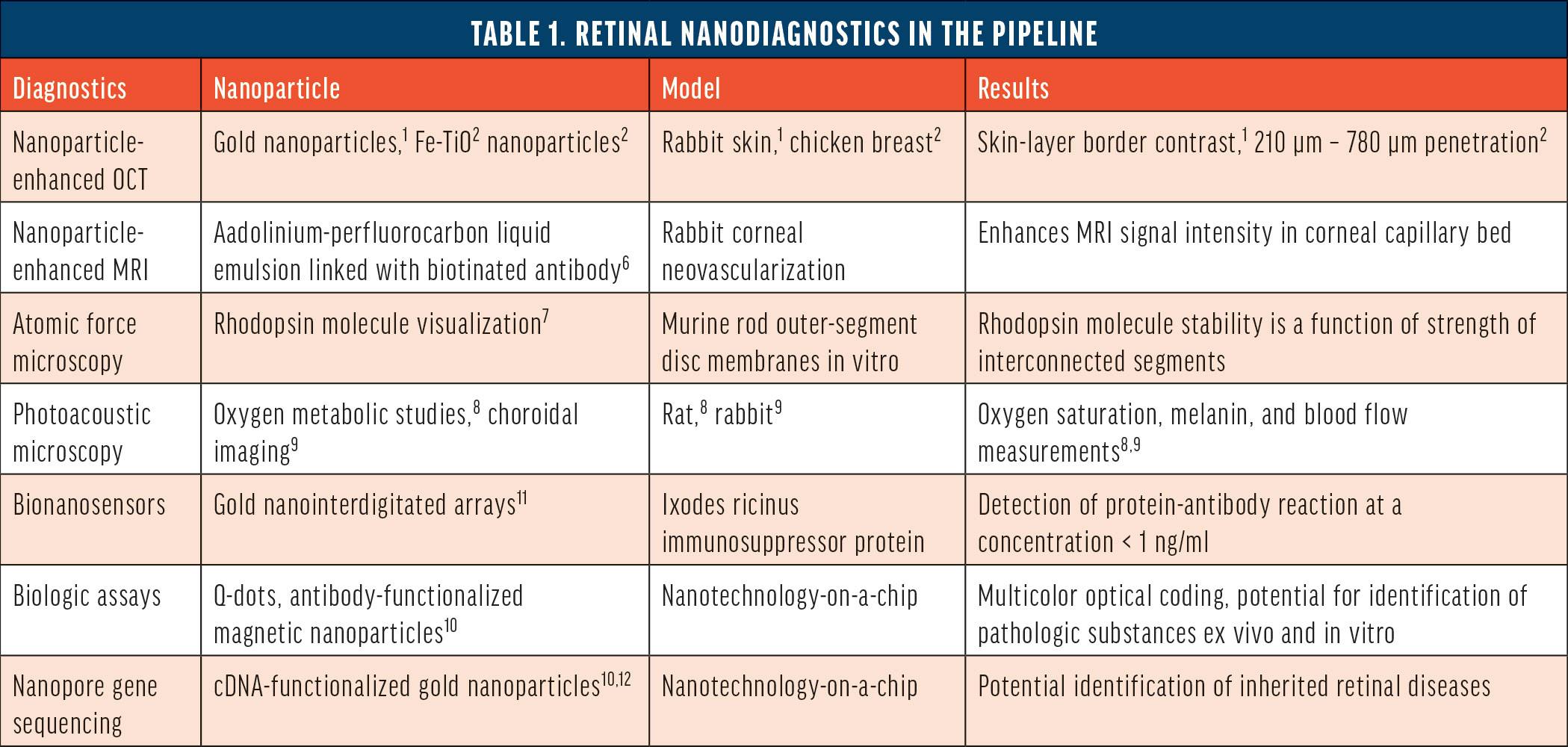
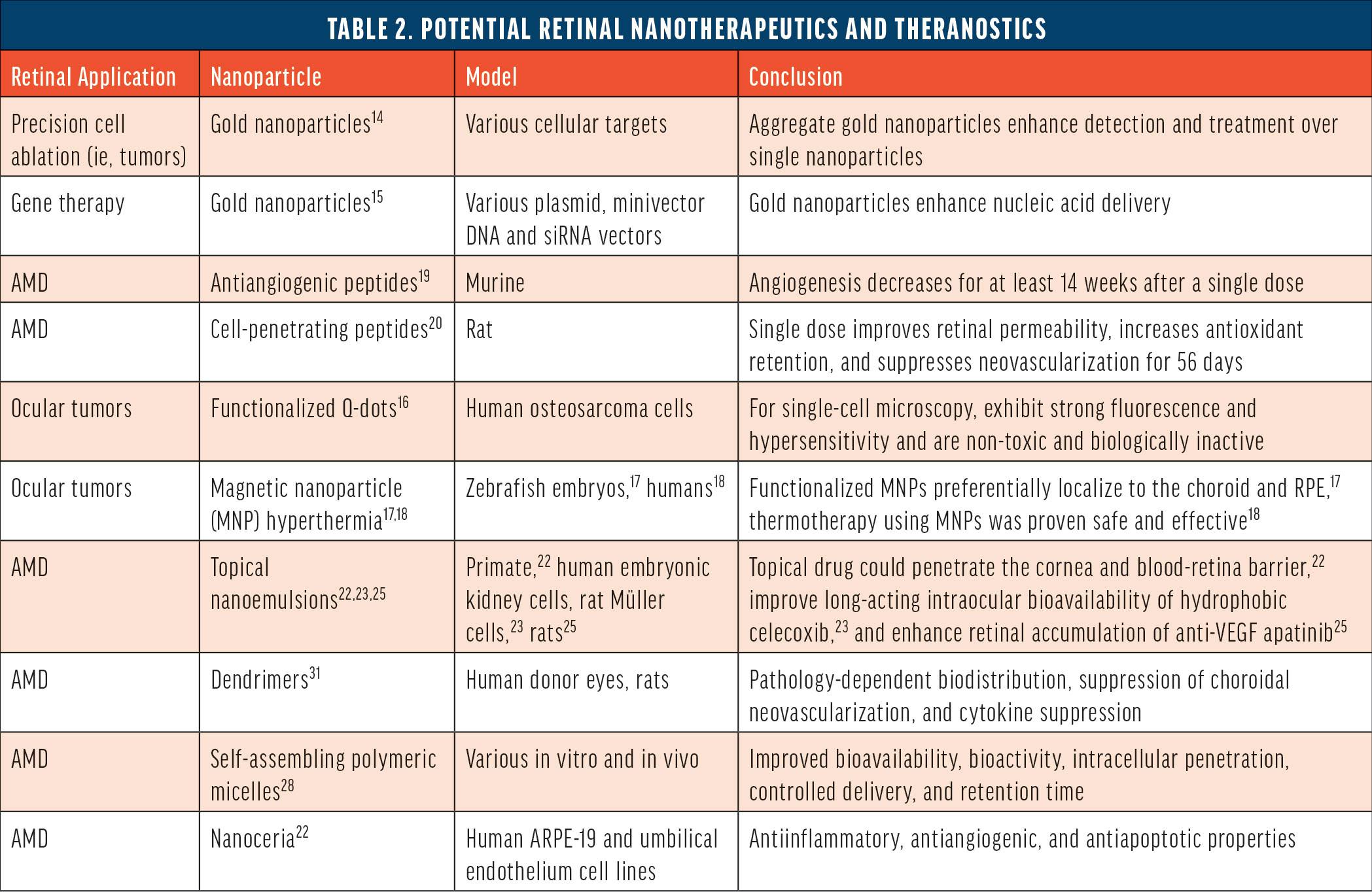
Nanobiotechnology can prove useful in retinal diagnostics, pharmacologic and surgical interventions, and drug delivery (Tables 1 and 2). Regenerative medicine also stands to benefit from nanoscience. The retina—for which therapeutics and surgery are in the range of micrograms and microns, respectively, combined with its relative immune privilege and accessibility—is ideally suited for nanobiotechnological innovations. Here, we review the state of nanotechnology in the field of retina.
DIAGNOSTICS
Today’s retinal imaging, although a far cry from the tools used decades ago, remains imperfect in several ways. For example, the specificity of neovascular structures on OCT can be limited by optical artifacts from adjacent vascular structures. Furthermore, OCT angiography is unable to directly demonstrate leakage. Nanotechnology may be a useful innovation to combat these limitations.
Researchers are exploring the utility of gold nanoparticles (AuNPs) as contrast agents for OCT because they are small enough (almost 3 µm in diameter) to pass through retinal and choroidal vessels, with wavelength absorption efficiencies higher than conventional angiographic dyes.1 For example, researchers used AuNPs to enhance boundary contrast and increase OCT signaling when examining rabbit skin.1 Iron-titanium dioxide NPs have also been investigated as a viable contrast agent in swept-source OCT.2
Atomic force microscopy can create 3D surface profiles of retinal cells, organelle membranes, and nanostructures such as rhodopsin molecules.3 Using this technology, researchers discovered that rhodopsin assembles in rows of dimers and paracrystals; they also realized that the rhodopsin dimer is the building block of higher-order structures.3
Another tool under investigation, photoacoustic microscopy, uses high-resolution identification of endogenous chromophores (such as hemoglobin and melanin) which, when integrated with OCT, can enhance chorioretinal localization of oxygen saturation measurements.4,5
Transistor-like circuitry incorporating functionalized carbon nanotubules and gold nanoarrays (with dimensions less than 10 nm) can detect single molecules of DNA and other biologic molecules by changing surface conductivity.6 Similarly, nanopore DNA sequencing takes advantage of changes in conductivity when DNA nucleotides are sequentially passed through 2 nm nanopores.7 By increasing diagnostic sensitivity at the molecular level, these next-generation sequencing technologies may one day replace time-consuming, off-site analyses with rapid point-of-service testing.
THERAPEUTICS: DRUGS, DELIVERY SYSTEMS, AND TARGETING
Nanoscale therapeutics allow for successful penetration of the blood-brain barrier via endocytosis without the inflammation noted with viral vectors. Self-assembled nanoparticles are coated to form poly(lactic-co-glycolic acid) nanoparticles with slow-release properties.8 One study found that the biodegradable biopolymer poly(E-caprolactone) embedded with resveratrol demonstrates antioxidant and antiinflammatory properties. The surface was coated with metformin (known to inhibit choroidal neovascularization) and cell-penetrating peptides that increased retinal permeability 15-fold after intravitreal injection.9
Topical nanoparticles deliver high potency because of their high surface area-to-volume ratio.10 In one AMD model, a nanoparticle formulation of aminocaproic acid-Diosgenin delivered antiangiogenic activity with low cellular toxicity.11 Similarly, research has shown that topical celecoxib-loaded poly(ortho ester) nanoparticles possess antiinflammatory and antiproliferative properties.12 Another study found that nanoparticles of apatinib—an anti-VEGFR2 tyrosine kinase inhibitor—can penetrate the cornea and target retinal cells.13
Dendrimers are highly branched molecules as small as 1.5 nm in diameter that can allow for delivery of multiple drugs, as well as effective sustained delivery. Systemic dendrimer-based molecules have demonstrated selective, passive retinal pigment epithelium (RPE) uptake of a steroid in damaged cells, which can suppress both inflammation and choroidal neovascularization.14
SURGICAL ADJUNCTS
Researchers have investigated the utility of coating surgical instruments with silver nanoparticles, which confer antiinfective and antioxidative properties.15 Other investigators have designed nanotube tweezers by fusing together two carbon nanotubes with a spacing of 10 nm.16 Others have proposed direct nerve fiber axon repairs using a knife edge with a 20 nm radius of curvature, with attachment of a transplanted axon segment performed by electrofusion.17
Hyaluronic acid-coated AuNPs have been found to cluster on vitreous opacities in vivo. Sauvage et al found that low-energy nanosecond laser pulses can create vitreous nanobubbles by heating the AuNPs and ablating vitreous opacities with lower energy levels, reducing the risk of complications compared with Nd:YAG vitreolysis.18
NANOPROSTHESES
The smallest nanoscale transistors are 1 nm long, and diodes are as small as one molecule in size—technology that could increase the resolution of current subretinal implants. For example, researchers are investigating poly(3-hexylthiophene) nanoparticles injected into the subretinal space, mimicking the spatial distribution of photoreceptors, to form a light-sensitive interface.19 Others are exploring carbon nanotubule prosthetics integrated with neural tissue to guide synaptic development during neuronal repair,20 which could help patients with trauma or retinal degeneration.
REGENERATIVE NANOBIOTECHNOLOGY
Future therapies will not only protect retinal tissues, but also repair and regenerate structure and function. AuNPs, for instance, are relatively inert and possess intrinsic antiinflammatory and antiangiogenic properties.21 Nanoceria is another powerful example of a reactive oxygen species scavenger that can help to promote and regulate healthy angiogenesis while demonstrating anti-VEGF properties.22 Dexamethasone-conjugated dendrimers demonstrate selective affinity for damaged retinal Müller glial cells, promoting regenerative stem cell-like properties in mammals while minimizing the potential for systemic toxicity.23
Carbon nanotubules are not only useful in diagnostics, but also can function as radical scavengers,24 potentially reducing oxidative stress thought to play a vital role in progression to wet AMD. Similarly, fullerenes are inherently antioxidative and antiinflammatory and are showing promise as a therapeutic approach to arthritis.25
Intravitreal oxygen nanobubbles have been used to deliver oxygen to the inner retina for rescue from ischemic damage.26 Furthermore, platinum nanozymes have been used to counteract light-induced photoreceptor degeneration and inflammation in a rodent AMD model.27
Magnetic nanoparticles are being used for targeted stem cell delivery within the eye. Yanai et al describe a technique of magnetizing rat mesenchymal stem cells and, after intravenous injection, inducing migration and localization to the inner and outer retina with a magnet placed in the orbit.28
Researchers are also exploring natural nanofiber scaffolds from gelatin, chitosan, collagen, and hyaluronic acid. These have been shown to promote RPE growth and release of regenerative factors, with superior cellular adhesion to that of synthetic scaffolds.29 Electrospinning, a technique whereby nanofibers are created by extrusion of a polymer solution, has recently been used to create a nanofiber scaffold upon which RPE cells can be cultured with the possibility of subsequent subretinal transplantation.30
FUTURE DIRECTIONS
Nanotechnology holds much promise for improving the success of various gene therapies. For example, carefully designed inorganic nanoparticles (eg, polymers, silicone, and organometallic composites) may overcome the challenges of crossing the blood-retina barrier, rapid degradation, and gene/cellular toxicity.31 Researchers have also harvested IPSC-derived RPE cells from fibroblasts or mononuclear blood cells by incubation with various protein-coding genes, such as LEFTY2.32 Müller glial cells, furthermore, have been shown to transdifferentiate to rod photoreceptors using the sonic hedgehog gene, SHH.33 Targeted delivery of mRNA to the RPE, Müller glia, and neural retina has been accomplished using lipid nanoparticles.34,35 Laser-enhanced delivery of genetic material to precise areas of retinal degeneration using optoporation is a novel technique that could be used to deliver gene-laden lipid nanoparticles or other non-viral nanoparticles.36,37
Exosomes, bilayered nanovesicles that can be as small as 30 nm in size, are showing promise as disease biomarkers, intercellular communication vehicles, and drug delivery vehicles.38 Exosomes have been shown to transport microRNA between RPE cells and retinal glial cells, which could prove useful in modulating senescence and apoptosis of the retina in conditions such as AMD and diabetic retinopathy.39
Scientists have successfully used external magnetic fields to guide magnetic nanoscale micropropellers to traverse the vitreous cavity with the potential to deliver therapeutics to the retina (Figure); such nanorobots could conceivably be engineered to diameters approaching 2 nm.40,41
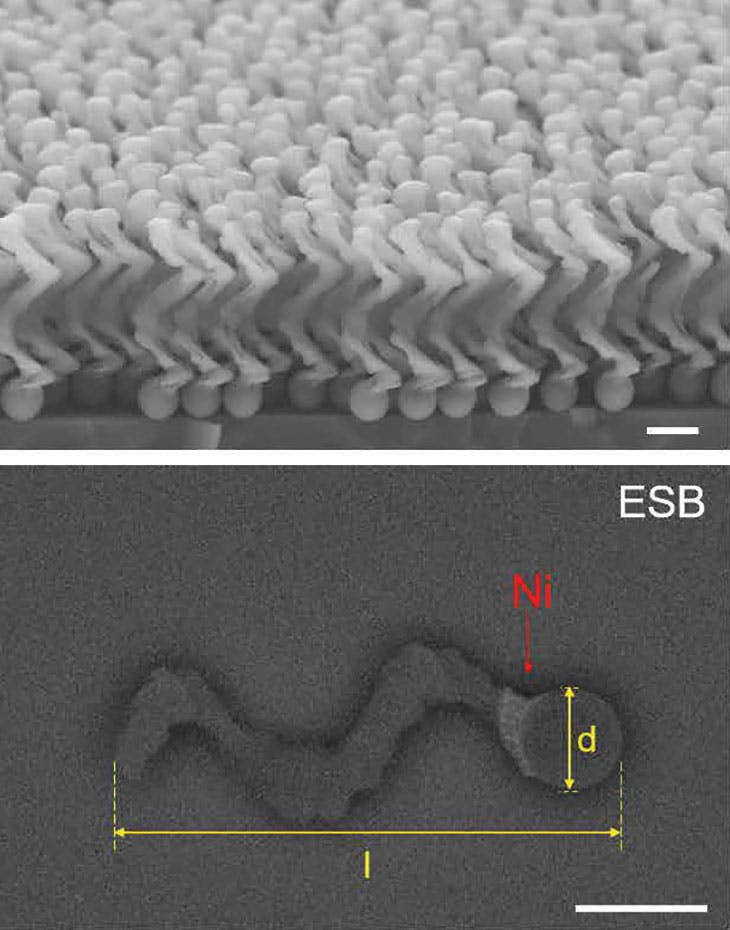
Figure. These scanning electron microscope (A) and energy-selective backscatter scanning electron microscope (B) images depict micropropellers that can cross the vitreous cavity. Scale bar = 500 nm. Reprinted with permission from Wu et al.40
Others have investigated a polyacrylamide nanoparticle integrated with neurotrophin nerve growth factor with an affinity for retinal rods and cones to prevent retinal cell apoptosis.42 Similarly, oligochitosan-coated nanoceria demonstrates antiangiogenic, antiinflammatory, and antiapoptotic characteristics in cellular AMD models.43
Researchers have found that lipid nanoparticles combined with targeting peptides and messenger RNA can bypass retinal barriers that have otherwise limited access to photoreceptors, a critical target in designing gene therapies for inherited retinal diseases.44
Simna et al recently engineered photoreceptors using a nanoparticle-mediated delivery of a full-length human rhodopsin gene to murine rod photoreceptors, which could be useful in future treatment of retinitis pigmentosa.45 Kwon et al synthesized melanin-like nanoparticles that could be used as an artificial melanin substitute in murine RPE cells.46
ONLY THE BEGINNING
We have only begun to scratch the surface of what is possible with therapeutic and regenerative applications of nanotechnology in the field of retina. We look forward to seeing where this field of investigation takes us.
1. Zagaynova E, Shirmanova M, Kirillin Y, et al. Contrasting properties of gold nanoparticles for optical coherence tomography: phantom in vivo studies and Monte Carlo simulation. Phys Med Biol. 2008;53:4995-5009.
2. Barkhade T, Indolaya A, Poddar R, et al. Iron content titanium dioxide nanoparticles as exogenous contrast agent for tissue imaging using swept-source optical coherence tomography. AIP Advances. 2021;11:015023.
3. Bosshart PD, Engel A, Fotiadis D. High-resolution atomic force microscopy imaging of rhodopsin in rod outer segment disk membranes. Methods Mol Biol. 2015;1271:189-203.
4. Song W, Wei Q, Liu W, et al. A combined method to quantify the retinal metabolic rate of oxygen using photoacoustic ophthalmoscopy and optical coherence tomography. Sci Rep. 2014;4(6525):1-7.
5. Nguyen VP, Paulus YM. Photoacoustic microscopy of the retina and choroid: Imaging by hearing the retina. Retina Physician. 2020;17:42-44, 46, 47.
6. Tang X, Jonas A, Nysten B, et al. Direct protein detection with a nano-interdigitated array gate MOSFET. Biosens Bioelectron. 2009;24(12):3531-3537.
7. Booker R, Boysen E. Nanotechnology for Dummies. Wiley-VCH Verlag GmbH & Co;2005;247.
8. Shmueli R, Ohnaka M, Miki A, et al. Long-term suppression of ocular neovascularization by intraocular injection of biodegradable polymeric particles containing a serpin-derived peptide. Biomaterials. 2013;34:7544-7551.
9. Nguyen D, Luo LJ, Yang CJ, et al. Highly retina-permeating and long-acting resveratrol/metformin nanotherapeutics for enhanced treatment of macular degeneration. ACS Nano. 2023;17:168-183.
10. Zhang J, Zhou T, Wang L, et al. Nanoemulsion as a vehicle to enhance the ocular absorption after topically applied cyclosporine a in the rabbit eye. Invest Ophthalmol Vis Sci. 2012;53(14):488.
11. Xin G, Zhang M, Zhong Z, et al. Ophthalmic drops with nanoparticles derived from a natural product for treating age-related macular degeneration. ACS Appl Mater Interfaces. 2020;12:57710-57720.
12. Palamoor M, Jablonski M. Synthesis, characterization and in vitro studies of celecoxib-loaded poly (orth ester) nanoparticles targeted for intraocular drug delivery. Colloids Surf B Biointerfaces. 2013;112:474-482.
13. Radwan S, El-Kamel A, Zaki E, et al. Hyaluronic-coated albumin nanoparticles for the non-invasive delivery of apatinib in diabetic retinopathy. Int J Nanomedicine. 2021;16:4481-4494.
14. Kambhampati S, Bhutto I, Wu T, et al. Systemic dendrimer nanotherapies for targeted suppression of choroidal inflammation and neovascularization in age-related macular degeneration. J Control Release. 2021;10:335:527-540.
15. Burgess R. Understanding Nanomedicine. Pan Stanford Publishing;2012:1-44.
16. Kim P, Lieber CM. Nanotube tweezers. Science. 1999;286(5447):2148-2150.
17. Sretavan D, Chang W, Hawkes E, et al. Microscale surgery on single axons. Neurosurgery. 2005;57(4):635-646.
18. Sauvage F, Nguyen V, Li Y, et al. Laser-induced nanobubbles safely ablate vitreous opacities in vivo. Nat Nanotechnol. 2022;17(5):552-559.
19. Maya-Vetencourt JF, Manfredi G, Mete M, et al. Subretinally injected semiconducting polymer nanoparticles rescue vision in a rat model of retinal dystrophy. Nat Nanotechnol. 2020;15:698-708.
20. Pampaloni N, Scaini D, Perissinotto F, et al. Sculpting neurotransmission during synaptic development by 2D nanostructured interfaces. Nanomedicine. 2018;14(7);2521-2532.
21. Mukherjee P, Bhattacharya R, Wang P, et al. Antiangiogenic properties of gold nanoparticles. Clin Canc Res. 205;11(9):3530-3534.
22. Das S, Chigurupati S, Dowding J, et al. Therapeutic potential of nanoceria in regenerative medicine. MRS Bulletin. 2014;39:976-983.
23. Emmerich K, White DT, Kambhampati SV, et al. Nanoparticle-based targeting of microglia improves the neural regeneration enhancing effects of immunosuppression in the zebrafish retina. Commun Biol. 2023;6(534):534.
24. Shimizu T, kishi R, Yamada T, Hata K. Radical scavenging activity of carbon nanotubes: toward appropriate selection of a radical initiator. RSC Adv. 2020;10:29419-29423.
25. Dellinger A, Cunun P, Lee D, et al. Inhibition of inflammatory arthritis using fullerene nanomaterials. Plos One. 2015;10(4):e0126290.
26. Fayyaz M, Musarrat J, Tsipursky M, Irudayaraj J. Dextran-based oxygen nanobubbles for treating inner retinal hypoxia. ACS Nano. 2021;4(10):6583-6593.
27. Cupini S, Di Marco S, Boselli L, et al. Platinum nanozymes counteract photoreceptor degeneration and retina inflammation in a light-damage model of age-related macular degeneration. ACS Nano. 2023;17(22):22800-22820.
28. Yanai A, Häfeli U, Metcalfe A, et al. Focused magnetic stem cell targeting to the retina using superparamagnetic iron oxide nanoparticles. Cell Transplant. 2012;21(6):1137-1148.
29. Sahle F, KimS, Niloy K, et al. Nanotechnology in regenerative ophthalmology. Adv Drug Deliv Rev. 2019;148:290-307.
30. Egbowon BF, Fornari E, Pally JM, et al. Retinal pigment epithelial cells can be cultured on fluocinolone acetonide treated nanofibrous scaffold. Materials and Design. 2023;232:1121522.
31. Salman A, Kantor A, McClements M, et al. Non-viral delivery of CRISPR/Cas cargo to the retina using nanoparticles: current possibilities, challenges, and limitations. Pharmaceutics. 2022;14(9):1842.
32. Bharti K, Miller S, Arnheiter H, et al. The new paradigm: retinal pigment epithelium cells generated from embryonic or induced pluripotent stem cells. Pigment Cell Melanoma Res. 2011;24(1):21-34.
33. Gu D, Wang S, Zhang S, et al. Direct transdifferentiation of Müller glial cells to photoreceptors using sonic hedgehog signaling pathway agonist purmorphamine. Mol Med Rep. 2017;16(6):7993-8002.
34. Herrera-Barrera M, Ryals R, Gautam M, et al. Peptide-guided lipid nanoparticles deliver mRNA to the neural retina of rodents and nonhuman primates. Sci Adv. 2023;9(2):1-16.
35. Patel S, Ryals R, Weler K, et al. Lipid nanoparticles for delivery of messenger RNA to the back of the eye. J Control Release. 2019;303:91-100.
36. Batabyal S, Gajjeraman S, Bhattacharya S, et al. Nano-enhanced optical gene delivery to retinal degenerated mice. Curr Gene Ther. 2019;19(5):318-329.
37. Batabyal S, Kim S, Wright W, et al. Laser-assisted targeted gene delivery to degenerated retina improves retinal function. J Biophotonics. 2021;14(1):e202000234.
38. Zhang Z, Mugisha A, Fransisca S, et al. Emerging role of exosomes in retinal diseases. Front Cell Dev Biol. 2021;9:64360.
39. Morris D, Bounds S, Liu H, et al. Exosomal miRNA transfer between retinal microglia and RPE. Int J Mol Sci. 2020;21(10):3541.
40. Wu Z, Troll J, Jeong HH, et al. A swarm of slippery micropropellers penetrates the vitreous body of the eye. Sci Adv. 2018;4(11):eaat4388.
41. Shaikh S, Younis M, Yuan L. Functionalized DNA nanostructures for bioimaging. Coordination Chem Rev. 2022;469:214648.
42. Colucci P, Giannaccini M, Baggiani M, et al. Neuroprotective nanoparticles targeting the retina: a polymeric platform for ocular drug delivery applications. Pharmaceutics. 2023;15(4):1096.
43. Wang K, Mitra RN, Zheng M, Han Z. Nanoceria-loaded injectable hydrogels for potential age-related macular degeneration treatment. J Biomed Mater Res A. 2018;106(11):2795-2804.
44. Herrera-Barberral M, Rylas RC, Galitam M, et al. Peptide-guided lipid nanoparticles deliver mRNA to the neural retina of rodents and nonhuman primates. Sci Adv. 2023;9(2):eadd4623.
45. Sp S, Mitra RN, Zheng M, et al. Gene augmentation for autosomal dominant retinitis pigmentosa using rhodopsin genomic loci nanoparticles in the P23H+/- knock-in murine model. Gene Ther. 2023;30(7-8):628-640.
46. Kwon YS, Zheng M, Zhang AY, Han Z. Melanin-like nanoparticles as an alternative to natural melanin in retinal pigment epithelium cells and their therapeutic effects against age-related macular degeneration. ACS Nano. 2022;16(11):19412-19422.


_1784132761.jpg?auto=compress,format&w=75)





