



AT A GLANCE
- Many hopeful advances are under investigation for the treatment of diabetic eye disease in terms of therapy, delivery, and targeting pathways other than anti-VEGF.
- At least five therapies are in phase 3, one of which is an oral formulation.
- Seven therapies have completed phase 2, three of which are oral therapies, and one is suprachoroidal.
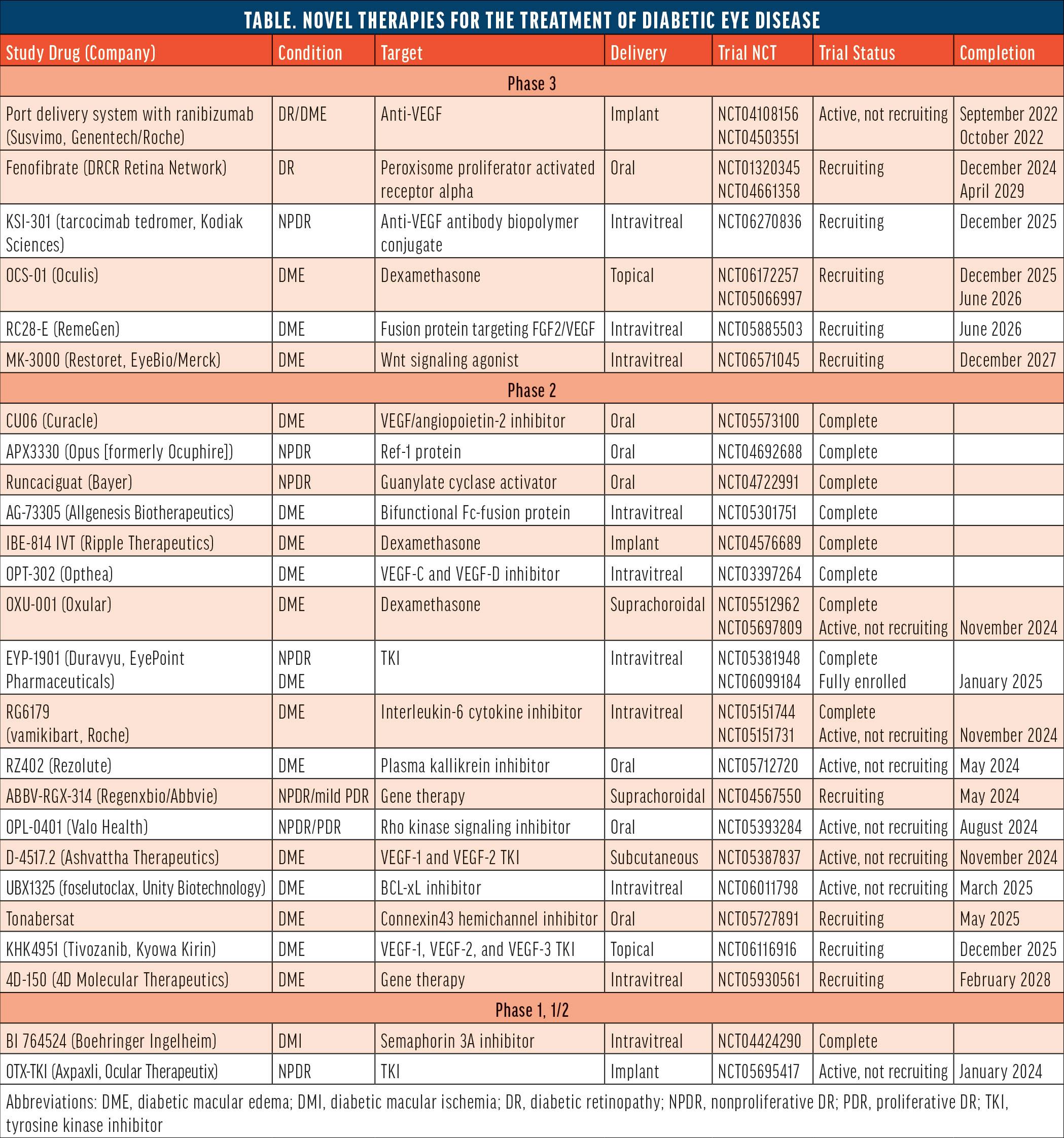
The treatment of diabetic retinopathy (DR) currently includes panretinal photocoagulation to prevent severe vision loss due to proliferative DR (PDR) and intravitreal anti-VEGF agents. Although these treatments have reduced the rate of vision loss from DR and its sequelae,1,2 many patients have treatment-resistant disease or struggle with treatment burden. Thus, many advances are under investigation, not only in terms of treatment delivery but also for targeting pathways other than anti-VEGF. In this article, we highlight some of the latest therapeutic developments (Table).
INTRAVITREAL DELIVERY
Tarcocimab tedromer (KSI-301, Kodiak Sciences) is an anti-VEGF antibody biopolymer conjugate that blocks all VEGF-A isoforms. The phase 3 GLOW trial (NCT05066230) compared tarcocimab with sham in moderately severe to severe nonproliferative DR (NPDR). After receiving four injections of the study drug, a significantly higher proportion of patients had a 2-step or more DRSS improvement from baseline (41.1%) compared with sham (1.4%) at week 48.3 The similarly designed phase 3 GLOW2 clinical trial (NCT06270836) is recruiting.
RC28-E (RemeGen), a fusion protein targeting FGF2 and VEGF, is in a phase 3 trial (NCT05885503) for the treatment of diabetic macular edema (DME). The trial is comparing 2 mg RC28-E with 2 mg aflibercept (Eylea, Regeneron) with the primary outcome being change in BCVA at week 52.
MK-3000 (restoret, EyeBio/Merck) is a tetravalent, trispecific antibody that acts as an agonist of the Wnt signaling pathway.4 The phase 2b/3 BRUNELLO trial (NCT06571045) is investigating the safety and efficacy of two dosages of MK-3000 compared with ranibizumab (Lucentis, Genentech/Roche) in patients with DME.4 Primary endpoints are safety and mean change in BCVA from baseline to week 52.
UBX1325 (foselutoclax, Unity Biotechnology) is a senolytic small-molecule inhibitor of antiapoptotic protein BCL-xL. In the phase 2 BEHOLD study (NCT04857996), one injection of UBX1325 led to an improvement of 6.2 letters from baseline, 5.6 more than sham, at 48 weeks.5 Of UBX1325-treated patients, 53% did not require rescue injections before 48 weeks.5 The phase 2b ASPIRE study (NCT06011798) is comparing the safety and efficacy of UBX1325 with 2 mg aflibercept for patients with NPDR and DME.6
AG-73305 (Allgenesis Biotherapeutics), a bispecific Fc-fusion protein designed to block VEGF and integrin pathways, showed positive preliminary results from the phase 2a trial (NCT05301751) for DME. The data for 22 patients treated with a single intravitreal injection showed a mean BCVA improvement of +6.4 ETDRS letters and central subfield thickness (CST) reduction of 100 µm at 4 weeks, which lasted between 12 and 24 weeks.7
RG6179 (vamikibart, Roche) is a monoclonal antibody that binds interleukin-6 cytokines. The phase 2 trial (NCT05151731) is evaluating the safety and efficacy of two dosages of RG6179 compared with ranibizumab for DME. A second phase 2 trial (NCT05151744), now complete, is evaluating the therapy in combination with ranibizumab.
OPT-302 (Opthea), an intravitreal anti-VEGF therapy that blocks VEGF-C and VEGF-D, is designed as a combination therapy with current anti-VEGF agents. In the completed phase 2 trial (NCT03397264), 52.8% of patients with DME treated with OPT-302 in combination with aflibercept achieved a visual gain of ≥ 5 ETDRS letters at 12 weeks compared with baseline.8 The company has not announced plans to pursue further trials for DME.
BI 764524 (Boehringer Ingelheim) is a humanized monoclonal anti-semaphorin 3A antibody.9 The tolerability of BI 764524 in patients with diabetic macular ischemia was evaluated in a phase 1/2 trial (NCT04424290), which met its primary safety endpoints. The study also showed early efficacy of foveal avascular zone area stabilization at week 16.10
SUPRACHOROIDAL INJECTION
OXU-001 (Oxular) consists of dexamethasone-containing microspheres that are delivered suprachoroidally for the treatment of DME. The phase 2 OXEYE study (NCT05697809) is comparing the safety, tolerability, efficacy, and durability of two dose levels of OXU-001 with the intravitreal dexamethasone implant (Ozurdex, Abbvie). Another phase 2 study (NCT05512962) evaluated the same delivery approach with triamcinolone acetonide suspension in patients with DME; the trial is complete with data pending.
IMPLANTS IN THE WORKS
The port delivery system (PDS) with ranibizumab (Susvimo, Genentech/Roche) remains in the pipeline for DR/DME as the company awaits an FDA decision.11 The supplemental biologics license application is based on the 1-year results of the phase 3 Pagoda (NCT04108156) and Pavilion (NCT04503551) trials, both of which met their primary endpoints. The 2-year data show that 95% and 98% of patients treated with the PDS in Pagoda and Pavilion, respectively, did not need supplemental injections at 2 years.11
IBE-814 IVT (Ripple Therapeutics) is an intravitreal dexamethasone implant that showed efficacy and safety in the phase 2 RIPPLE-1 trial (NCT04576689). At 6 months, patients treated with the high dose had a mean BCVA improvement of 8.7 ETDRS letters; at 9 months, treatment with the high dose led to an 82% reduction in treatment burden. Future studies will focus on the high dose.12
EYP-1901 (Duravyu, EyePoint Pharmaceuticals) delivers vorolanib, a selective tyrosine kinase inhibitor (TKI), in a bioerodible insert.13 It is a pan-VEGF receptor inhibitor. The phase 2 VERONA clinical trial (NCT06099184) is comparing low and high doses of EYP-1901 with aflibercept for the treatment of DME. Interim 16-week data show improvements in BCVA and CST compared with baseline, and 82% of eyes in the 2.7 mg arm were supplement-free compared with 50% in the aflibercept control arm at 16 weeks.14
The phase 2 PAVIA trial (NCT05381948) for moderately severe to severe NPDR did not meet its primary endpoint.15
OTX-TKI (Axpaxli, Ocular Therapeutix) is an intravitreal implant containing the TKI axitinib. Interim phase 1 data (NCT05695417) showed that 23.1% of treated patients had a 2-step DRSS improvement at week 48; no patients in the treatment arm developed PDR or center-involving DME at week 48 compared with 37.5% in the sham arm.16
TOPICAL/SUBCUTANEOUS APPROACHES
OCS-01 (Oculis) is a topical dexamethasone suspension for the treatment of DME. There was a VA improvement of 2.6 ETDRS letters with OCS-01 drops three times daily for 12 weeks in the phase 2 study, which was not statistically significant.17 Preliminary results from the first stage of the phase 3 DIAMOND-1 trial (NCT05066997) showed statistically significant improvement in mean BCVA at 12 weeks.18 There was also a significant decrease in CST at 6 and 12 weeks. The second stage of the trial is ongoing, and the phase 3 DIAMOND-2 trial (NCT06172257) is recruiting.
KHK4951 (tivozanib, Kyowa Kirin) is a VEGF-1, -2, and -3 TKI eye drop in a phase 2 trial (NCT06116916) for the treatment of DME. The topical medication is delivered in either high, medium, or low doses in conjunction with intravitreal aflibercept. The primary outcome is BCVA at 36 weeks.
D-4517.2 (Ashvattha Therapeutics) is a subcutaneous therapy consisting of a nanoparticle that inhibits VEGF receptors 1 and 2 tyrosine kinases. The phase 2 study (NCT05387837) is evaluating the safety, tolerability, pharmacokinetics, and efficacy of various dosages of D-4517.2 in patients with wet AMD or DME.
ORAL OPTIONS
Fenofibrate activates peroxisome proliferator activated receptor alpha, altering systemic lipid synthesis. The phase 3 FAME 1 EYE trial (NCT01320345) is evaluating 145 mg of fenofibrate versus placebo in adults with type 1 diabetes. Patients are followed for 36 months to assess DR progression. Patient recruitment is occurring in Australia, New Zealand, Hong Kong, and the United Kingdom. In the United States, Diabetic Retinopathy Clinical Research (DRCR) Retina Network Protocol AF (NCT04661358) is evaluating the effect of 160 mg fenofibrate compared with placebo in eyes with mild to moderately severe NPDR and no center-involving DME at baseline with a follow-up of 6 years.
APX3330 (Opus [formerly Ocuphire]) is an oral drug that targets the Ref-1 protein. Although the phase 2 trial (NCT04692688) failed to meet its primary endpoint, the company is planning a phase 2/3 trial in patients with NPDR.19 The company recently acquired Opus Genetics and has discontinued internal development of APX3330.20
Tonabersat is an oral Connexin43 hemichannel inhibitor, which is a gap-junction modulator used in migraine treatment. It is being investigated in a phase 2 clinical trial (NCT05727891), DRCR Retina Network Protocol AN, comparing the efficacy of tonabersat versus placebo to reduce CST in eyes with center-involving DME and good visual acuity after 6 months.
Runcaciguat (Bayer) is a soluble guanylate cyclase activator under investigation as an oral therapy for the treatment of NPDR. The phase 2 NEON-NPDR trial (NCT04722991), now complete, evaluated the safety and efficacy of runcaciguat versus placebo in 104 patients, with a primary endpoint of a ≥ 2-step DRSS improvement at 24 weeks.
RZ402 (Rezolute) is an orally administered selective plasma kallikrein inhibitor designed to treat DME. The phase 2 trial (NCT05712720) met its primary endpoint of safety and a clinically significant reduction in CST from baseline.21
OPL-0401 (Valo Health) is an oral Rho kinase signaling inhibitor in phase 2 (NCT05393284) for NPDR and mild PDR. The trial is evaluating twice-daily dosing of OPL-0401 versus placebo in 114 patients for 24 weeks.22 The primary endpoint is the proportion of patients with a ≥ 2-step DRSS improvement from baseline at 24 weeks.
CU06 (Curacle) is an oral anti-VEGF and angiopoietin-2 inhibitor. The phase 2a study (NCT05573100) evaluated once-daily 100 mg, 200 mg, or 300 mg CU06 versus placebo in patients with DME; the primary outcomes are change in CST at 12 weeks and determination of the optimal dose.23
GENE THERAPIES IN THE PIPELINE
ABBV-RGX-314 (Regenxbio/Abbvie) is a single-dose subretinal or suprachoroidal injection of an AAV gene vector that expresses an anti-VEGF-A antigen-binding fragment leading to sustained VEGF suppression. The phase 2 dose-escalation ALTITUDE study (NCT04567550) is assessing the efficacy, safety, and tolerability of suprachoroidal delivery of ABBV-RGX-314 in patients with NPDR or mild PDR. Preliminary 1-year data show that dosage levels 1 and 2 were well tolerated. At 1 year, dose level 2 in NPDR patients prevented disease progression and reduced the risk of developing vision-threatening events by 89%.24
4D-150 (4D Molecular Therapeutics) is a single-dose intravitreal retinotropic AAV vector that delivers two transgenes. These encode aflibercept and an miRNA sequence that inhibits VEGF-C.25 4D-150 is being investigated in the phase 2 SPECTRA study (NCT05930561) for the treatment of DME. This study is assessing the need for aflibercept rescue injections over 52 weeks, as well as BCVA and CST.
1. Wong WL, Su X, Li X, et al. Global prevalence of age-related macular degeneration and disease burden projection for 2020 and 2040: a systematic review and meta-analysis. Lancet Glob Health. 2014;2(2):e106-116.
2. Sabanayagam C, Yip W, Ting DSW, Tan G, Wong TY. Ten emerging trends in the epidemiology of diabetic retinopathy. Ophthalmic Epidemiol. 2016;23(4):209-222.
3. Wykoff C. Tarcocimab tedromer for diabetic retinopathy: primary endpoint efficacy and safety outcomes of the GLOW phase 3 pivotal study. Presented at AAO; November 3, 2023; San Francisco.
4. Merck and EyeBio announce initiation of phase 2b/3 clinical trial for REstoret for the treatment of diabetic macular edema [press release]. Merck. September 4, 2024. Accessed October 10, 2024. tinyurl.com/2v3pak8k
5. UNITY Biotechnology announces positive 48-week results from Phase 2 BEHOLD study of UBX1325 in patients with diabetic macular edema [press release]. UNITY Biotechnology. April 24, 2023. Accessed October 10, 2024. tinyurl.com/mpwyer3e
6. UNITY Biotechnology doses first patients in phase 2 ASPIRE study of UBX1325 in DME [press release]. UNITY Biotechnology. December 12, 2023. Accessed October 10, 2024. tinyurl.com/ypj3y5vf
7. Allgenesis announces encouraging preliminary safety and efficacy data from the AG-73305 phase 2a trial for the treatment of diabetic macular edema at American Academy of Ophthalmology [press release]. Allgenesis Biotherapeutics. November 8, 2023. Accessed October 7, 2024. tinyurl.com/2j9vzher
8. Jackson TL, Slakter J, Buyse M, et al. A randomized controlled trial of OPT-302, a VEGF-C/D inhibitor for neovascular age-related macular degeneration. Ophthalmology. 2023;130(6):588-597.
9. Nakamura S, Nishinaka A, Hidaka Y, et al. Efficacy of an anti-semaphorin 3A neutralizing antibody in a male experimental retinal vein occlusion mouse model. Invest Ophthalmol Vis Sci. 2022;63(8):14.
10. Boehringer Ingelheim shares positive results from the first study worldwide in diabetic macular ischemia [press release]. Boehringer Ingelheim. May 6, 2024. Accessed October 10, 2024. tinyurl.com/y3k5dt22
11. New data for Roche’s Susvimo demonstrates sustained efficacy in two serious diabetic eye conditions [press release]. Roche. July 18, 2024. Accessed October 7, 2024. tinyurl.com/ppsuumm4
12. Mehta H. Efficacy and safety of the low dose dexamethasone IBE-814 IVT Implant for diabetic macular edema and retinal vein occlusion: Results of a first-in-human Phase 2 trial. Presented at Euretina; Barcelona, Spain; September 19-22, 2024.
13. Eyepoint Pharmaceuticals. Eyepoint Investor Presentation September 2024. Accessed October 10, 2024. tinyurl.com/mu6j4xzx
14. EyePoint Pharmaceuticals announces positive interim 16-week data for ongoing phase 2 VERONA clinical trial of Duravyu for diabetic macular edema [press release]. EyePoint Pharmaceuticals. October 28, 2024. Accessed October 28, 2024. tinyurl.com/mr8pu42m
15. EyePoint Pharmaceuticals announces topline data from the phase 2 PAVIA trial of DURAVYU in non-proliferative diabetic retinopathy [press release]. EyePoint Pharmaceuticals. May 6, 2024. Accessed October 1, 2024. tinyurl.com/4a7y2y32
16. 2024 Investor Day Presentation. Ocular Therapeutix. Accessed October 24, 2024. tinyurl.com/4ctnjnmb
17. Stefansson E, Loftsson T, Larsen M, et al. Topical treatment of diabetic macular edema using dexamethasone ophthalmic suspension: A randomized, double‐masked, vehicle‐controlled study. Acta Ophthalmol (Copenh). 2023;101(1):22-33.
18. Oculis announces positive top line results from DIAMOND stage 1 phase 3 trial in diabetic macular edema with OCS-01 eye drops [press release]. Oculis. May 22, 2023. Accessed October 10, 2024. tinyurl.com/427c5jf7
19. Ocuphire Corporate Presentation. July 2024. Accessed October 8, 2024. tinyurl.com/4hmuzaz2
20. Ocuphire Pharma Announces Acquisition of Opus Genetics [press release]. Opus Genetics. October 22, 2024. Accessed October 24, 2024. tinyurl.com/8rfdxzpc
21. Pearlman JA. Results from a phase 2a study of a novel orally administered RZ402 a plasma kallikrein inhibitor in patients with diabetic macular edema. Presented at AAO; October 18, 2024; Chicago.
22. Valo Health completes enrollment of OPL-0401 phase 2 study for the treatment of diabetic retinopathy [press release]. Valo Health. May 4, 2024. Accessed October 8, 2024. tinyurl.com/3r4tht6x
23. CU06 completes contract with global CRO company for FDA pre-meeting [press release]. Curacle. September 24, 2024. Accessed October 8, 2024. tinyurl.com/5539csr3
24. Regenxbio presents positive one year data from phase II ALTITUDE trial of ABBV-RGX-314 for treatment of diabetic retinopathy using suprachoroidal delivery [press release]. Regenxbio. November 3, 2023. Accessed October 10, 2024. tinyurl.com/mpeyyydh
25. Khanani AM, Hershberger VS, Kay CN, et al. Interim results for the phase 1/2 PRISM trial evaluating 4D-150, a dual-transgene intravitreal genetic medicine in individuals with neovascular (wet) age-related macular degeneration. Invest Ophthalmol Vis Sci. 2023;64(8):5055-5055.


_1773249222.png?auto=compress,format&w=75)





