


With more than 225,000 performed each year in the United States, pars plana vitrectomy (PPV) is an essential part of any surgical vitreoretinal practice—and its revenue stream.1 However, coding and reimbursement can be a challenge, and success depends on several factors. Recognizing and mastering these key principles will streamline coding, billing, and reimbursement.
CONFIRM THE DIAGNOSIS
The first step to coding retinal surgical and laser procedures is to confirm the diagnosis, as this will help guide you to the correct CPT code. PPV is performed for a range of diagnoses, and coding can differ based on the indication for surgery. For example, if PPV is performed to repair a retinal detachment, the CPT code selection will be limited to CPT codes 67108 and 67113.
Access the AAO’s retina coding guide at aao.org/retinapm for more information.
READ THE CPT CODE DESCRIPTOR
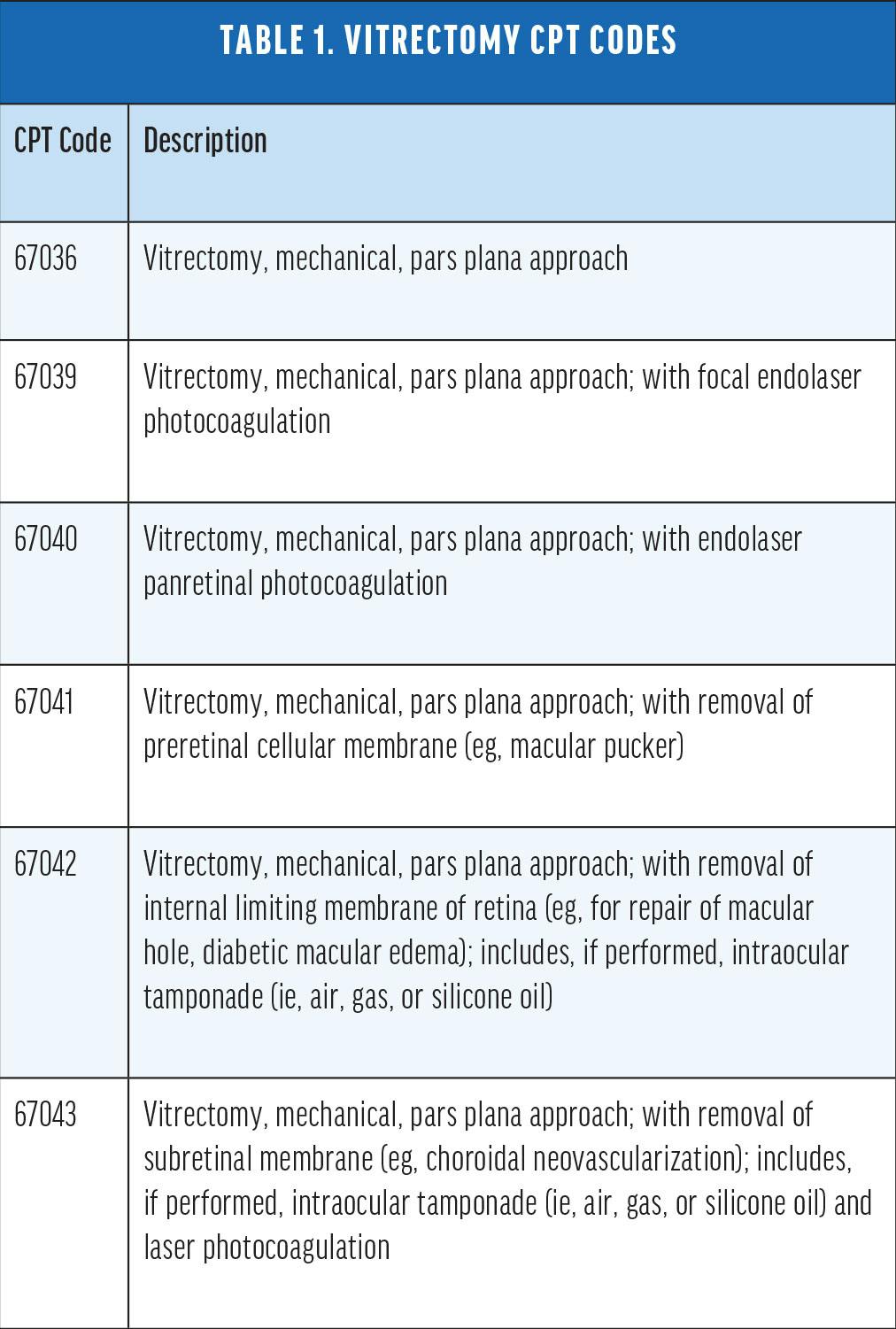
The family of codes for PPV, CPT codes 67036-67043, represents a range of treatments. Along with PPV, additional procedures are included in the descriptors when performed, including laser, membrane removal (preretinal, internal limiting, and subretinal cellular membrane), and injection of air, gas, or silicone oil.
For correct code selection, review the descriptors carefully and select the codes that represent the procedures performed based on the operative report (Table 1). For example, PPV with focal laser would be coded with CPT 67039, while PPV including endolaser panretinal photocoagulation would be coded using CPT 67040.

KNOW THE BUNDLES
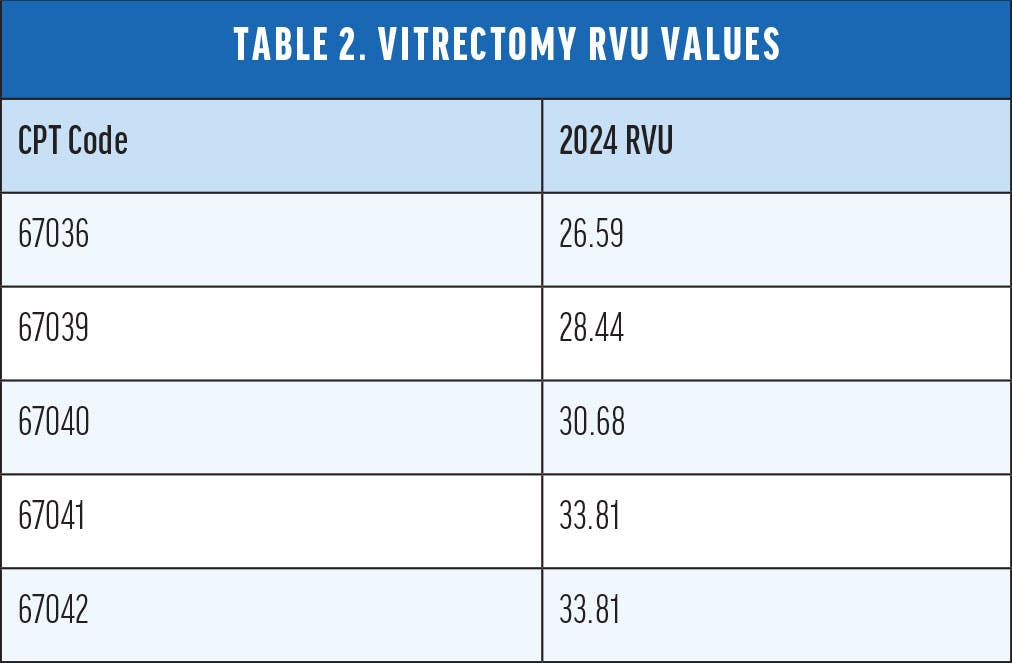
Next, review the National Correct Coding Initiative edits and eliminate bundled CPT codes. Report the CPT code with the highest relative value unit (RVU) value (Table 2).
All PPV codes are bundled with an indicator of 1, which means there are limited circumstances when it’s appropriate to unbundle with modifier -59, distinct procedural service. It is appropriate when performed in separate structures or the fellow eye. When two PPV codes are performed in the same eye during the same session, it is inappropriate to unbundle.
For example, PPV, endolaser panretinal photocoagulation, and membrane peel were all performed during the same surgical session. This surgical case would be represented by CPT codes 67040 and 67041. However, these two codes are bundled. Based on RVU value, CPT code 67041 should be billed.
Surgeons should remember that CPT code 67121—removal of implanted material, posterior segment, extraocular—is bundled with all PPV codes and should not be unbundled, unless performed in the fellow eye.
RECOGNIZE PAYER POLICIES
Local Medicare Administrative Contractors don't have a published local coverage determination or policy for PPV. However, the CMS has a national coverage determination (NCD) that applies to all jurisdictions, NCD 80.11. This policy has undergone multiple revisions to outline the ICD-10 diagnosis codes. The most recent version (TN 2202) can be accessed at aao.org/lcds.
Most notable is that a dislocated IOL (ICD-10 T85.22XA) and removal of silicone oil (ICD-10 T85.39XA) are not covered diagnosis codes. When either is an indication for surgery, consider reporting an appropriate primary (and covered) diagnosis supporting medical necessity.
For other payers, do not apply Medicare’s policies, but do consider the unique guidelines, as they frequently vary in terms of medical necessity, documentation requirements, and covered diagnoses.
SUBMIT THE CORRECT ORDER
When multiple procedures can be submitted for a retina surgery, it is imperative that the CPT codes are reported on the claim form in the correct order, from highest to lowest RVU value, because this will appropriately maximize reimbursement due to the multiple surgery rules. Per the CMS, when multiple surgical CPT codes are submitted for the same surgical session, the first procedure listed will be paid at 100% and subsequent procedures at 50% of the Medicare Physician Fee Schedule. Other payers follow this same rule.
For example, if a surgoen bills both PPV (CPT code 67036) and IOL exchange (CPT code 66986), 66986 should be reported as the primary procedure because it has the higher RVU value.
Alternatively, if CPT code 67036 is reported with CPT code 66850, phacoemulsification, 67036 should be reported first, as it has a higher RVU value than 66850.
1. Lalezary M, Shah RJ, Reddy RK, et al. Prospective retinal and optic nerve vitrectomy evaluation (PROVE) study: twelve-month findings. Ophthalmology. 2014;121(10):1983-1989.


