



SAVE THE DATE: The 53rd Annual Aspen Retinal Detachment Society is set for March 1-5, 2025, at The Viceroy in Snowmass, Colorado. Click here to learn more.
Ongoing research and innovations have led to significant progress in our imaging and understanding of many retinal diseases. During the 52nd Annual Aspen Retinal Detachment Society (ARDS) Meeting, held from March 2-6, 2024, in Snowmass Village, Colorado, the esteemed named lectures focused on new findings in pseudoxanthoma elasticum (PXE; presented by K. Bailey Freund, MD), high-resolution OCT imaging (presented by Giovanni Staurenghi, MD), and central serous retinopathy (CSR; presented by David S. Boyer, MD). Here are some key pearls from their talks (Figure).
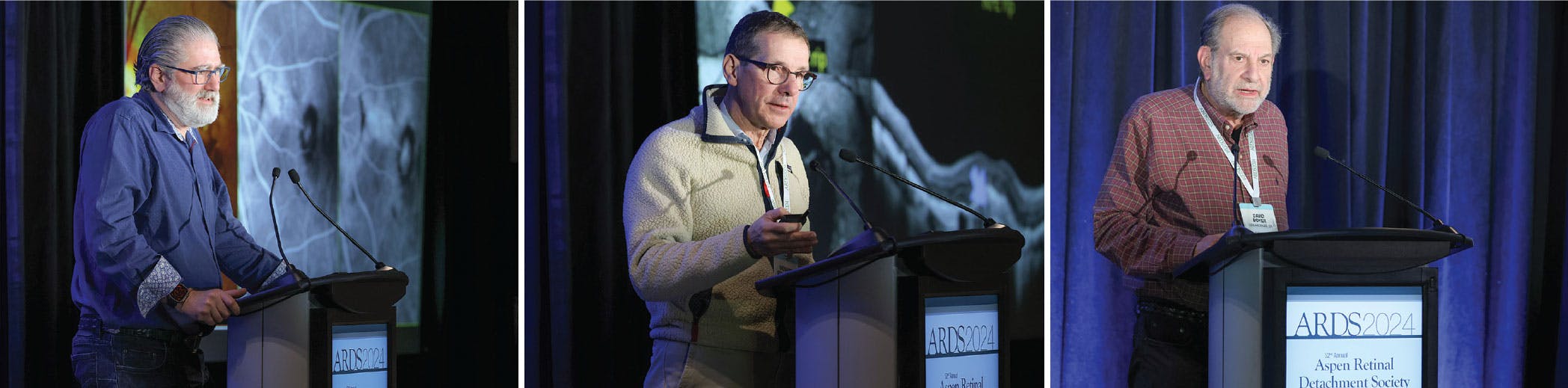
Figure. The 52nd Annual Aspen Retinal Detachment Society Meeting boasted three named lectures, led by (from left to right) Drs. Freund, Staurenghi, and Boyer. Images courtesy of Kevin Caldwell Photography.
FOUNDERS LECTURE: PSEUDOXANTHOMA ELASTICUM
PXE is a rare genetic disorder, caused by mutations in the ABCC6 gene, that affects multiple systems, including the cardiovascular, gastrointestinal, and skin systems. The 13th Annual Founders Lecture by Dr. Freund highlighted the extensive retinal manifestations of PXE, which he noted go beyond the classic angioid streaks to include optic disc drusen, comet lesions, pattern dystrophy, and macular neovascularization. Dr. Freund shared several cases of PXE to highlight the varied presentations on fundus photography, fundus autofluorescence images, high-resolution OCT, and ICG angiography (particularly if hemorrhage is impeding the view). While detailing imaging findings in angioid streaks, he commented that, because of the fragility of the Bruch membrane, eyes with PXE are very susceptible to blunt trauma and can present with significant hemorrhages—something clinicians should discuss with the patient.
Dr. Freund also emphasized the significant effect anti-VEGF therapy has had on managing neovascularization in PXE patients, although many still experience vision loss due to macular atrophy. Fortunately, most patients with neovascularization secondary to PXE respond well to anti-VEGF therapy, he said.
A notable new finding discussed was the occurrence of acute inflammatory retinopathy in PXE patients, resembling conditions such as punctate inner choroidopathy and multiple evanescent white-dot syndrome. This inflammatory retinopathy can lead to vision loss if not properly identified and treated, according to Dr. Freund.
Eyetube Video Coverage: Aspen Retinal Detachment Society 2024
TAYLOR SMITH & VICTOR CURTIN LECTURE: HIGH-RESOLUTION OCT
During the 41st Taylor Smith & Victor Curtin Lecture, Dr. Staurenghi discussed the potential clinical utility of high-resolution OCT. He first summarized the evolution of OCT technology, highlighting the improvements in axial resolution from 10 µm to nearly 2 µm. These advancements allow for better visualization of retinal layers and structures. For example, high-resolution OCT provides an excellent view of the choriocapillaris, and clinicians can differentiate the outer deep capillary plexus, inner deep capillary plexus, and superficial capillary plexus, he explained.
Dr. Staurenghi provided examples of high-resolution OCT images, which reveal details not visible with standard commercial devices. He pointed out various retinal layers, as seen on high-resolution OCT, which allow for the identification of early signs of geographic atrophy, reticular drusen, and basal laminar deposits, to name a few. He showed several cases to highlight the value of these new OCT images in the setting of wet AMD, geographic atrophy, CSR, choroidal folds, and even PXE. Dr. Staurenghi also emphasized the importance of combining fundus autofluorescence imaging with OCT to identify areas of photoreceptor loss.
To conclude, Dr. Staurenghi discussed the future of OCT technology, including its application in visualizing retinal vessels and its role in early disease detection and clinical trials. The lecture emphasized the importance of combining scientific rigor with practical application in clinical settings and ended with a look at the future directions of OCT technology in retinal imaging and disease management.
TAYLOR SMITH & VICTOR CURTIN LECTURE: CENTRAL SEROUS RETINOPATHY
For the 42nd Taylor Smith & Victor Curtin Lecture, Dr. Boyer focused on CSR, a condition first described in 1866 by Von Graefe as “relapsing central luetic retinitis.”1 It primarily affects men from 40 to 50 years of age, with a higher incidence in Asian populations.2
According to Dr. Boyer, CSR manifests in acute and chronic forms, with acute CSR often resolving spontaneously and chronic CSR potentially leading to severe vision loss. Risk factors include hypertension, helicobacter pylori infection, steroid use, erectile dysfunction medication, and sleep apnea. Multimodal imaging with OCT and ICG is crucial for early and accurate diagnosis, Dr. Boyer emphasized, although differentiating CSR from other retinal conditions can be challenging.
Dr. Boyer noted that treatment options for CSR have expanded over the years to include observation, micropulse laser, photodynamic therapy (PDT), and mineralocorticoid receptor antagonists. PDT is considered the standard, while other treatments such as anti-VEGF medications, mifepristone, propranolol, and rifampicin show varying degrees of efficacy. He pointed out that research on scleral thickness, mitochondrial DNA levels, and genetic factors is providing new insights into CSR. He also mentioned that the use of AI in the diagnosis and prediction of therapeutic outcomes is an emerging area of research.
ABOUT THE SPEAKERS
K. Bailey Freund, MD
• Clinical Professor of Ophthalmology, New York University Grossman School of Medicine, New York
• Senior Partner, Vitreous Retina Macula Consultants of New York, New York

Giovanni Staurenghi, MD
• Professor of Ophthalmology; Chairman, University Eye Clinic; Director, University Eye Clinic Department of Biomedical and Clinical Science, all at the Luigi Sacco Hospital, Milan, Italy
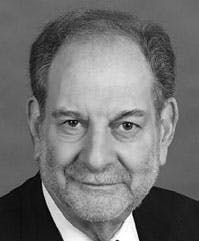
David S. Boyer, MD
• Senior Partner, Retina-Vitreous Associates Medical Group, Los Angeles
• Adjunct Clinical Professor of Ophthalmology, University of Southern California Keck School of Medicine, Los Angeles
APPLYING WHAT YOU LEARNED
ARDS attendees walked away from these three named lectures with a number of clinically relevant pearls, including the following:
- Retinal manifestations of PXE extend beyond angioid streaks to include optic disc drusen, comet lesions, and macular neovascularization. Acute inflammatory retinopathy, which can resemble conditions like punctate inner choroidopathy and multiple evanescent white-dot syndrome, is a significant finding in patients with PXE and requires proper identification and treatment.
- Advancements in high-resolution OCT technology have improved our visualization of retinal layers and may aid in early disease detection. Although widespread use of this technology is currently limited, clinicians must remember to combine scientific rigor with practical application.
- Diagnostic techniques such as OCT and ICG help in the early and accurate diagnosis of CSR, although differentiation from other retinal conditions can be challenging. Treatment options include observation, micropulse laser, PDT, and mineralocorticoid receptor antagonists, with ongoing research exploring personalized strategies and emerging therapies.
1. Yannuzzi LA. Type A behavior and central serous chorioretinopathy. Trans Am Ophthalmol Soc. 1986;84:799-845.
2. Gäckle HC, Lang GE, Freissler KA, et al. Central serous chorioretinopathy. Clinical, fluorescein angiography and demographic aspects. Ophthalmologe. 1998;95:529-533.


_1784132761.jpg?auto=compress,format&w=75)





