
When physically exerting ourselves, how do we measure work? Is it the weight of the object we are lifting or the distance through which we are lifting it? Can we decide based on weight alone or distance alone? The most accurate method of measuring work is to measure the energy exerted. Simply speaking, energy can be measured by multiplying the applied force in the direction of movement times the distance moved resulting from the force applied. This energy measurement applies to situations ranging from lifting heavy objects to closing the handles of a pair of internal limiting membrane (ILM) forceps.
Why is this important? Aren’t the forces applied to the handles of ILM forceps so small that it doesn’t take much energy effort at all to close them? This may appear to be the case on the surface, but it can actually make a difference.
For an Olympic marksman, the accuracy of hitting the target is affected by how much the end of the barrel moves when engaging the trigger. If the trigger pull is too long (distance), any small lateral movement while engaging the trigger will magnify the movement at end of the barrel. In a similar manner, if the force required to engage the trigger is excessive, any small lateral movement engaging the trigger will also magnify movement at end of the barrel excessively. Thus, the energy applied while applying the trigger can have a substantial effect on accuracy.1 When it comes to microsurgery, specifically ophthalmic microsurgery, any movement is measured in microns, and tactile and proprioceptive feedback plays a minimal role—visual perception becomes the key feedback parameter.
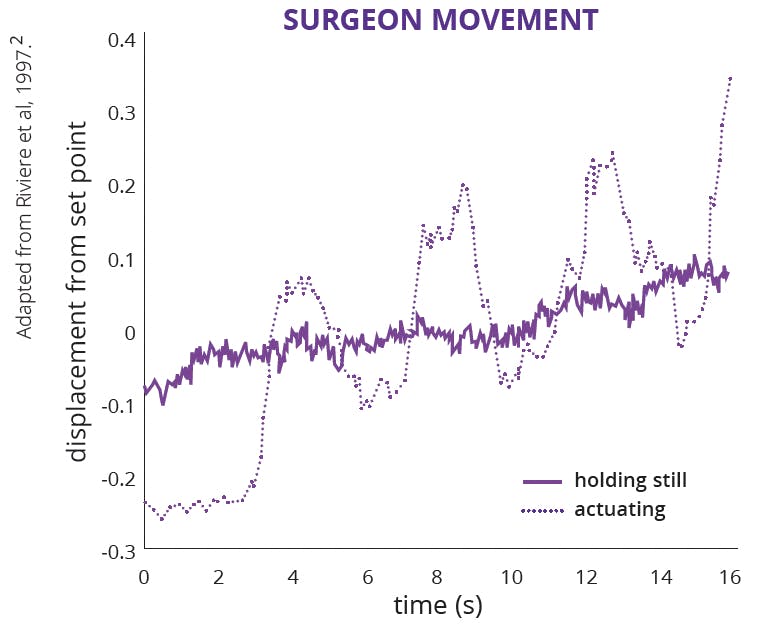
Inherent in the environment of microscopic movements are the following qualities of human hand movement to include the involuntary components of physiological tremor, jerk, and low frequency drift.2 In an experiment evaluating the baseline tremor of surgeons attempting to point a measuring probe with no entry-point constraint, constrained by an artificial eye model or constrained by an in-vivo rabbit eye, the 3-dimensional root-mean-square (RMS) positioning error was 144 μm, 258 μm, and 285 μm, with a maximum 3-dimensional error of 349 μm, 647 μm, and 696 μm, respectively, for the three conditions. The frequency of this tremor was centered around the 6 to 12 Hz range for all three test conditions.3 In another experiment in which eye surgeons were tested in the two tasks of attempting to hold an instrument still, as well as repeated instrument actuation, the average range of motion while trying to hold still was 202 µm, while the average RMS error was 49 µm and 133 µm, respectively, for the two test conditions. This actuation artifact is undesirable in surgery, and is a type of positioning error (Figure 1).2 The typical thickness of the ILM is around 5 to 10 μm, and ILM peeling requires micrometer positioning accuracy that must be within this range, preferably better, to successfully avoid damaging nearby tissue within the eye.3 One can see that this actuation error can have a potentially detrimental effect when performing delicate procedures, such as an ILM peel. Dogramaci and Steel were able to show that such low frequency unintentional movements predominate during the actuation of vitreoretinal forceps and that their amplitude is directly related to both the extent (ie, distance) and force of actuation.4 As a result, work, or the product of distance x force (ie, energy) is an important factor in determining the amplitude of these unintentional movements, and thus, can have an effect on the safety of using a particular type of ILM forceps.
To better evaluate this, an experiment was designed in which several 25G forceps were evaluated:
1. Grieshaber Finesse® Reflex™ handle with DSP ILM Forceps (Alcon);
2. Synergetics Microserrated Eckardt Forceps (Bausch + Lomb);
3. DEX Super Grip Forceps (Katalyst Surgical);
4. Vitreq ILM Endgripping Forceps (BVI Medical);
5. DORC Eckardt Endgripping Microforceps (DORC).
The distance and applied force to the handle during compression was measured. A typical force-distance curve during compression is shown in Figure 2. There are two portions of the curve: the upper portion denotes the compression phase of the experiment; the lower portion denotes the relaxation phase. The force difference is due to friction upon actuation. Point A denotes the point at which the forceps tips just touch, and point B denotes the beginning of deformation, or the point at which the maximum range of handle movement has been met.5 The force-distance curve from five forceps of each type were obtained, and the mean area under the curve (AUC) for each forceps type for both the work to closure and the actuation work were determined. Referring to the image in Figure 2, the AUC from the origin to point A on the upper part of the curve is defined as the work to closure. The AUC from the origin to point B on the curve is defined as the actuation work. The results are shown on the graph in Figure 3.5 It becomes clear that the Finesse® Reflex™ Handle demonstrates the lowest work to closure.
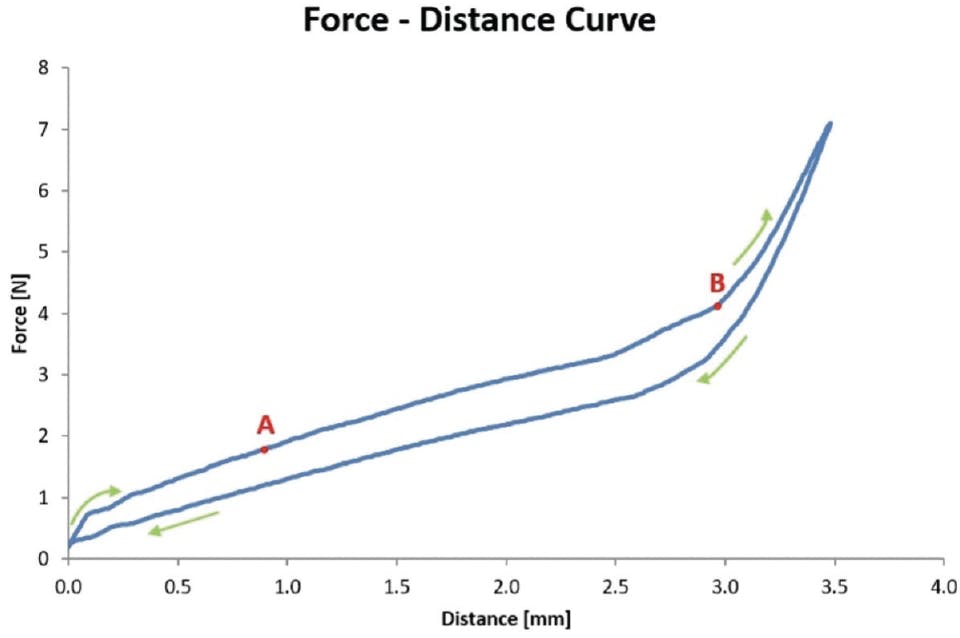
Figure 2. A typical force-distance curve. Point A denotes the handle position where the forceps tips just touch, and Point B denotes the point where the maximum handle movement has been reached. Green arrows designate the direction of movement.
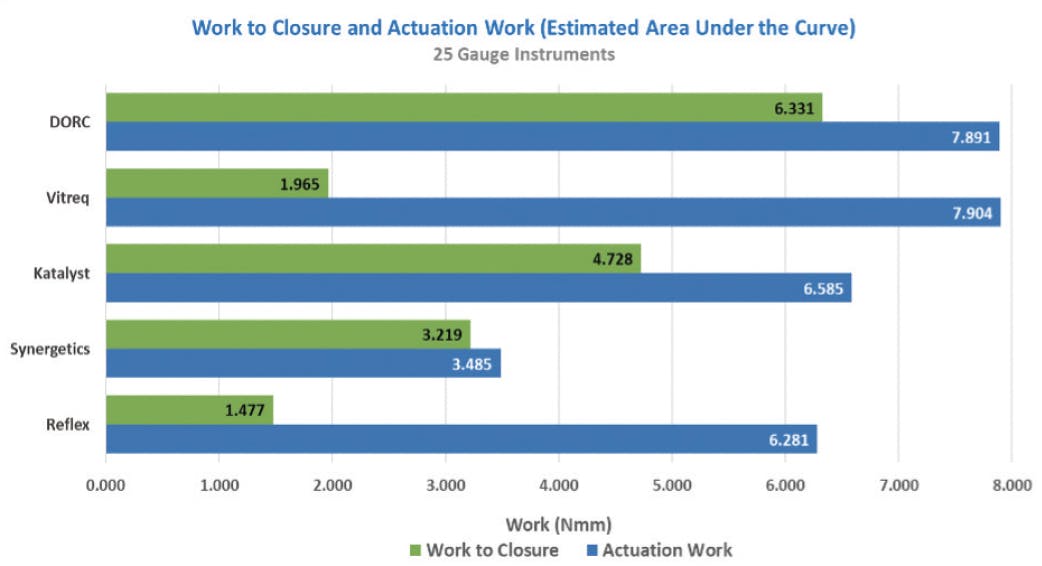
As stated previously, work, or the product of distance x force (ie, energy) is an important factor in determining the amplitude of unintentional movements. Looking at the work to closure (green bars in Figure 3), the lower the work to closure, the greater the likelihood of reducing involuntary movements experienced by the surgeon just to close the forceps.4 This is a critical part of the operation, as the forceps are directly overlying the retina when grasping the ILM (or epiretinal membrane)—involuntary movements at this point could be disastrous. Figure 4 shows the actuating distance relationship using a stacked bar graph of the total actuation travel (full bar length), to include the distance to closure (green bars), the point at which the forceps tips just close, and the grasping pressure control, which is the proportion of the total actuation travel used to vary the grasping pressure on the membrane (blue bars).5 Forceps handles that utilize a large proportion of movement just to appose the forceps tips may be particularly vulnerable to unintentional movements; this appears to coincide with the work to closure. These types of forceps also leave little room to control the grasping pressure on a membrane. The Finesse® Reflex™ handle has the lowest amount of travel to close the forceps while leaving a substantial amount of controlability to grasp the membrane.
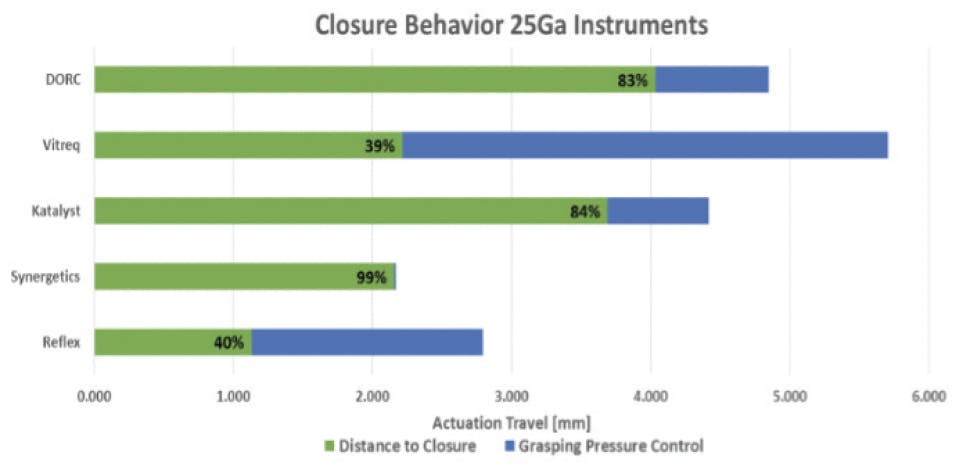
Just as an Olympic marksman’s accuracy is affected by the work applied to the trigger,1 a forceps’ accuracy is also affected by the work of handle actuation.4 By optimizing the force-distance relationship, or work, of forceps handle actuation, the unintentional movements that typically predominate during vitreoretinal forceps handle actuation can be minimized, favorably affecting the precision and predictability during membrane peeling or macular surgery. The Alcon Grieshaber Finesse® Reflex™ Handle provides this optimized performance by minimizing the work to closure and limiting the distance to closure within the range of the actuation travel.
1. What to Consider about your Firearms Trigger. August 30, 2018. National Shooting Sports Foundation website. Accessed March 28, 2025. https://www.letsgoshooting.org/resources/articles/firearms/trigger-pull-weight/
2. Riviere CN, Rader RS, Khosla PK. Characteristics of Hand Motion of Eye Surgeons. Proceedings of the 19th Annual Conference of the IEEE Engineering in Medicine and Biology Society. Chicago, IL USA; 30 Oct - 2 Nov, 1997.
3. Wells TS, Yang S, Maclachlan RA, et al. Comparison of Baseline Tremor Under Various Microsurgical Conditions. Conf Proc IEEE Int Conf Syst Man Cybern. 2013:1482-1487.
4. Dogramaci M, Steel DH. Unintentional movements during the use of vitreoretinal forceps. Transl Vis Sci Technol. 2018;7(6):28.
5. Alcon data on file; 2024.
The views and opinions expressed here may not reflect those of Bryn Mawr Communications or Retina Today.
Alcon medical devices comply with the current legislation for Medical Devices. Exclusive use by healthcare professionals. Please refer to relevant product Directions For Use or Operator’s Manuals for complete list of indications, contraindications and warnings.
IMPORTANT SAFETY INFORMATION
CAUTION: Federal (USA) law restricts this device to sale by, or on the order of, a physician. Indications for Use: GRIESHABER® DSP instruments are a line of single-use vitreoretinal microinstruments which are used in ophthalmic surgery, for cases either in the anterior or the posterior segment. The GRIESHABER® Advanced Backflush Handles DSP are a family of instruments for fluid and gas handling in vitreoretinal surgery.
WARNINGS AND PRECAUTIONS:
• Potential risk from reuse or reprocessing GRIESHABER® DSP instruments include: foreign particle introduction to the eye; reduced cutting or grasping performance; path leaks or obstruction resulting in reduced fluidics performance.
• Verify correct tip attachment, function and tip actuation before placing it into the eye for surgery.
• For light fiber instruments: Minimize light intensity and duration of exposure to the retina to reduce risk of retinal photic injury. The light fiber instruments are designed for use with an ALCON® illumination source.
• Good clinical practice dictates the testing for adequate irrigation and aspiration flow prior to entering the eye. If stream of fluid is weak or absent, good fluidics response will be jeopardized.
• Use appropriate pressure supply to ensure a stable IOP.
• If unwanted tissue gets engaged to the aspiration port, it should be released by interrupting aspiration before moving the instrument.
ATTENTION: Please refer to the product labeling for a complete listing of indications, warnings, and precautions.
© 2025 Alcon Inc. 07/25 US-FFH-2500002
