

C5 Complement Inhibition
The complement system is strongly implicated in the progression of GA, with substantial evidence demonstrating that C5 inhibition can effectively slow inflammation and cell death, which are key drivers of disease progression. Avacincaptad pegol (ACP), a targeted C5 inhibitor, has emerged as a therapeutic option for GA and is currently available in the United States.
GATHER Clinical Trials
Evidence supporting complement inhibition at the C5 level primarily stems from the GATHER1 and GATHER2 trials. GATHER2, a two-year phase III international trial with 488 participants, evaluated the efficacy of monthly 2mg ACP injections versus sham injections. In the second year, treatment arm patients were re-randomized to receive either monthly or every other month injections, while the sham group continued with sham injections.
Patient Selection
Eligible participants were aged 50 years or older with macular atrophy secondary to AMD. Key inclusion criteria for lesions included: (1) non-center point involving GA, (2) GA lesions within 1500µm from the foveal center, (3) total lesion area ranging from 2.5 to 17.5mm2 (equivalent to 1-7-disc areas), (4) for multifocal lesions, at least one lesion of ≥1.25mm2. Exclusion criteria ruled out patients with GA secondary to conditions other than AMD, evidence of CNV in either eye, signs of diabetic neuropathy in either eye, prior AMD treatment or intravitreal injections for any indication, or any ocular condition in the study eye that could progress and impact central vision.
Results
Both the GATHER1 and GATHER2 trials met their primary endpoints, demonstrating a significant slowdown in the growth of GA with ACP treatment.1,2 A post-hoc analysis across both trials at 12 months revealed a 56% reduction in the risk of persistent vision loss with ACP (2mg) compared to the sham group.*
To account for patient dropouts during the second year of re-randomization, a nonlinear model was applied, assuming a piecewise linear growth slope for each 6-month segment instead of a constant slope over 24 months. This model identified an early treatment effect at 6 months that progressively increased over 2 years.# Remarkably, the treatment effect more than doubled by the end of the second year compared to the one-year mark.
Safety
The combined safety data from the GATHER1 and GATHER2 trials showed that the most common adverse event was conjunctival hemorrhage. Temporary increases in intraocular pressure were also observed in some patients, but all cases resolved to normal levels on the same day. An increased incidence of CNV was also noted.
Regarding serious ocular adverse effects, no cases of retinal vasculitis or ischemic optic neuropathy were reported. Notably, there were no cases of intraocular inflammation during the first year of the GATHER2 trial. In the second year, only one non-serious case of intraocular inflammation, described as trace vitreous cells, was documented. Additionally, a single case of culture-positive endophthalmitis was reported.
Effective real-world management of GA patients requires awareness of these rare but possible safety concerns, along with diligent monitoring for symptoms (Figure 1).
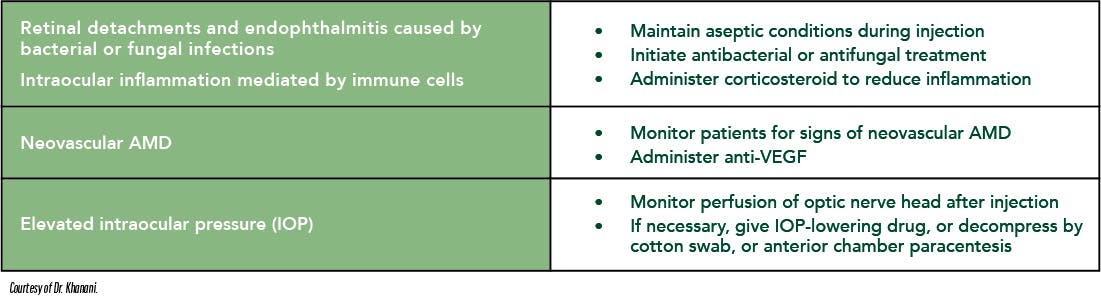
Real-world challenges with GA treatments
Managing GA in real-world settings introduces numerous challenges. Doctors face a diverse patient population, including those with foveal and non-foveal GA, as well as patients with bilateral GA. In bilateral GA, key questions arise, such as: Should treatment prioritize the better-seeing or worse-seeing eye, or is same-day bilateral treatment viable?
Additional complexities arise in patients with wet AMD treated with anti-VEGF therapies who later develop macular atrophy. While clinical trials excluded patients with active CNV, patients who developed CNV in the study eye received anti-VEGF treatment, but data is lacking for those with pre-existing wet AMD who subsequently develop GA or macular atrophy. Similarly, uncertainties persist around patients with prior vitrectomy, glaucoma surgery, or concurrent use of port delivery systems.
Although many of these questions remain unanswered, the current ACP label in the US permits treatment for any patient diagnosed with GA. Doctors must navigate these complexities while real-world data accumulates to guide future best practices.

Conclusions
One consistent takeaway is that early treatment produces better outcomes. Treating non-foveal GA may be particularly beneficial, as functional vision is still preserved. In contrast, managing advanced cases with large central lesions and significant functional loss presents greater challenges. A crucial strategy involves treating the better-seeing eye to prevent foveal invasion.
Determining the optimal treatment interval, whether six weeks, eight weeks, or another duration, is equally important, as monthly treatments may impose a significant burden on patients. Setting realistic expectations from the beginning is essential. Unlike anti-VEGF injections, which often result in noticeable improvements, GA treatments aim to slow disease progression rather than reverse or halt it entirely.
*Danzig, C, et al. Presented at The Association for Research in Ophthalmology and Vision (ARVO) Annual Meeting 2023, April 23, 2023, New Orleans, USA
#Khanani AM, et al. Presented at: AAO 2023
1. Patel, S. S. et al. Avacincaptad pegol for geographic atrophy secondary to age-related macular degeneration: 18-month findings from the GATHER1 trial. Eye (Lond) 37, 3551–3557 (2023).
2. Khanani, A. M. et al. Efficacy and safety of avacincaptad pegol in patients with geographic atrophy (GATHER2): 12-month results from a randomised, double-masked, phase 3 trial. Lancet 402, 1449–1458 (2023).
