

Incidence and prevalence of AMD and GA
Age-related macular degeneration (AMD) currently affects approximately 196 million people worldwide, making it a leading cause of severe vision impairment in older adults. This number is projected to increase to around 288 million by 2040.1 Geographic atrophy (GA), the advanced atrophic stage of AMD, becomes increasingly common with age, affecting nearly one in five individuals aged 85 and older in at least one eye. GA rates vary by region, with the highest prevalence among Europeans and lower rates in other ethnicities, such as those of Asian origin.2 Variability in reported rates is also influenced by the imaging modalities used across studies.
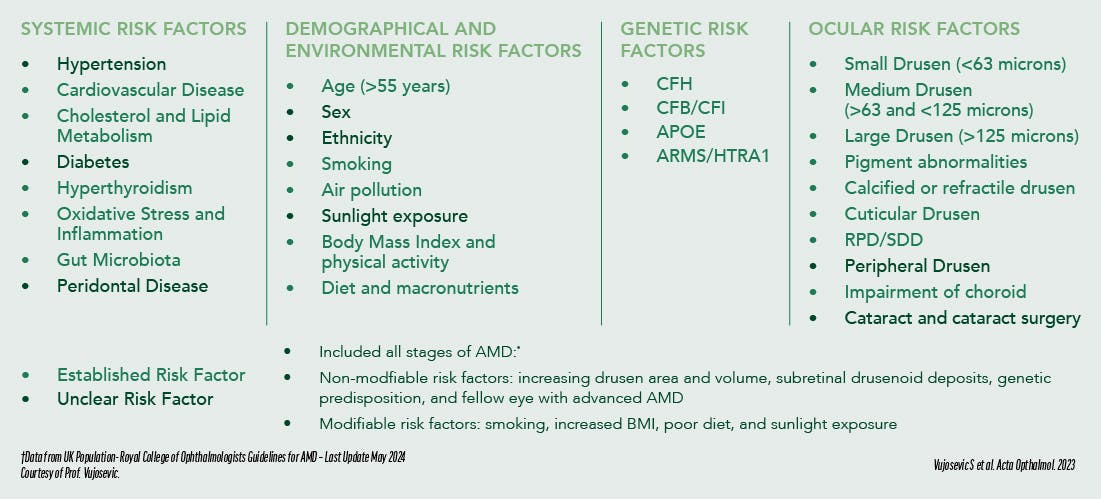
Primary risk factors for AMD include advancing age, white ethnicity, and smoking,† along with other established or unclear risk factors,# which can be categorized as systemic, demographical and environmental, genetic, or ocular (Figure 1).
Imaging modalities
The current diagnostic toolkit for dry AMD and GA incorporates a variety of imaging modalities.3-5 Key recommended techniques for early diagnosis and disease monitoring include color fundus photography (CFP), optical coherence tomography (OCT), fundus autofluorescence (FAF; blue/green), and near infrared reflectance (NIR). Optional examinations include fluorescein angiography (FA)/indocyanine green angiography (ICG-A), optical coherence tomography angiography (OCT-A), ultra-wide field (UWF), multicolor imaging, and other types of FAF.
Each imaging modality has its own pros and cons. CFP, the historical standard, remains the preferred modality for evaluating hemorrhages and focal retinal pigment epithelium (RPE) changes. FAF, used as a primary endpoint in numerous clinical trials, is particularly useful for assessing the junctional zone surrounding GA, where a diffuse trickling pattern is often prognostic of rapid disease progression. However, blue-FAF can be challenging for evaluating foveal autofluorescence.
OCT has become broadly accessible, providing high-resolution volumetric maps that are particularly valuable for identifying pre-atrophic features and biomarkers. Current guidelines recommend using 6x6 millimeter volume scans with closed spaced B-scans to ensure detection of disease progression. NIR is advantageous as it is unaffected by macular pigment.
Among optional imaging modalities, OCT-A stands out as a noninvasive tool that facilitates early detection of neovascular membranes. Additionally, ICG-A is valuable for detecting neovascular membranes and for differential diagnosis from other diseases that can mimic GA.
Integrity loss ratio of photoreceptors (PR) and RPE has been emerging as one of the most reliable prognostic indicators for disease progression. The FDA has recognized AI-based determination of ellipsoid zone attenuation as a primary outcome measure in GA clinical trials.6
Functional impairment
GA often develops in the parafoveal area, resulting in severe reading difficulties due to parafoveal absolute scotoma. Therefore, alternative assessments are being explored to better capture the relationship between anatomic changes observed in multimodal imaging and the decline in visual function. These include low-luminance visual acuity, reading speed assessments, patient-reported outcomes, and microperimetry.7
Microperimetry in particular is emerging as a promising alternative for assessing visual function loss in GA patients. It allows pointwise sensitivity evaluation, the creation of local defect maps and interpolation maps, as well as the assessment of fixation stability. However, there remains an unmet need for precise and sensitive functional endpoints that correlate with anatomic features.3
Guidelines for monitoring
Monitoring recommendations are highly dependent on the stage of the disease (Figure 2).
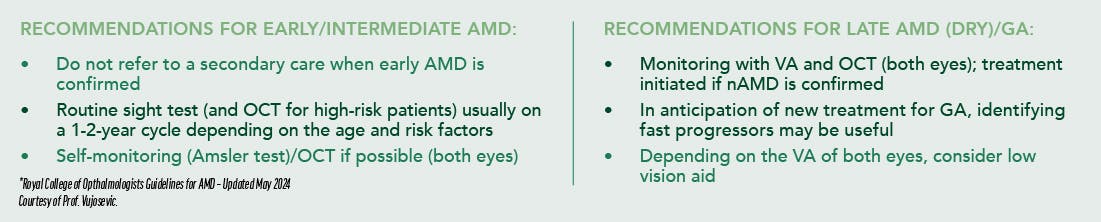
Home OCT telemedicine systems offer an alternative approach to disease monitoring. These systems can be particularly beneficial for patients with intermediate AMD by detecting early conversion to neovascular AMD before central visual acuity is significantly affected.8 Additionally, mobile apps can assist patients by tracking symptoms, providing educational resources, and enhancing communication with healthcare providers.9

Conclusions
Multimodal imaging is essential for the diagnosis and monitoring of dry AMD and GA. By combining functional assessments with multimodal structural imaging techniques, clinicians achieve a more thorough understanding of disease progression. The integration of AI and imaging is crucial for tracking changes over time and evaluating treatment efficacy. Moreover, self-monitoring systems can help minimize the need for frequent visits and help facilitate early intervention.
†Data from UK Population- Royal College of Ophthalmologists Guidelines for AMD – Last Update May 2024
#Including all stages of AMD; Royal College of Ophthalmologists Guidelines for AMD – Updated May 2024
1. Fleckenstein, M., Schmitz-Valckenberg, S. & Chakravarthy, U. Age-Related Macular Degeneration: A Review. JAMA 331, 147–157 (2024).
2. Vujosevic, S., Alovisi, C. & Chakravarthy, U. Epidemiology of geographic atrophy and its precursor features of intermediate age-related macular degeneration. Acta Ophthalmol 101, 839–856 (2023).
3. Vujosevic, S. et al. Imaging geographic atrophy: integrating structure and function to better understand the effects of new treatments. British Journal of Ophthalmology 108, 773–778 (2024).
4. Holz, F. G. et al. Imaging Protocols in Clinical Studies in Advanced Age-Related Macular Degeneration: Recommendations from Classification of Atrophy Consensus Meetings. Ophthalmology 124, 464–478 (2017).
5. Pfau, M. et al. Multimodal imaging and deep learning in geographic atrophy secondary to age-related macular degeneration. Acta Ophthalmol 101, 881–890 (2023).
6. Schmidt-Erfurth, U. et al. Disease activity and therapeutic response to pegcetacoplan for geographic atrophy identified by deep learning-based analysis of OCT. Ophthalmology 0, (2024).
7. Fleckenstein, M. et al. The Progression of Geographic Atrophy Secondary to Age-Related Macular Degeneration. Ophthalmology 125, 369–390 (2018).
8. Kim, J. E. et al. Evaluation of a self-imaging SD-OCT system designed for remote home monitoring. BMC Ophthalmol 22, 261 (2022).
9. Reeves, B. C. et al. Descriptive study of the challenges when implementing an app for patients with neovascular age-related macular degeneration to monitor their vision at home. BMJ Open 14, e077196 (2024).
