

AI is transforming retinal care by moving beyond traditional 2D imaging to more sophisticated 3D analysis, which accurately localizes fluid within different retinal layers, such as intraretinal, subretinal, or subretinal pigment epithelium. Machine learning tools can quantify fluid volumes, providing data-driven insights that enhance diagnostic precision. Since fluid accumulation is a critical biomarker in conditions such as neovascular age-related macular degeneration (nAMD) and diabetic macular edema (DME), AI significantly enhances both diagnostic accuracy and disease management.1
AI’s Impact on Diagnosing and Managing Retinal Diseases
Early intervention is crucial for improving patient outcomes, particularly in AMD, where monitoring the fellow eye plays a vital role. Many patients with unilateral disease will eventually develop exudative changes in the other eye, and early detection of these changes can significantly enhance visual prognosis. AI-driven algorithms identify subtle, presymptomatic changes, enabling timely intervention and better long-term outcomes.
Beyond clinical decision-making, AI enhances workflow efficiency by triaging patients and distinguishing those without diabetic retinopathy (DR) from those needing specialist care. This ensures that retina specialists can focus on high-risk patients, improving care and patient education.
The 2023 EURETINA Clinical Trends Survey reflects clinicians’ confidence in AI, with 86% of respondents believing in AI’s potential to improve clinical outcome predictions in retinal diseases (Figure 1). This sentiment underscores AI’s expanding role in clinical care.
In managing GA, AI has already demonstrated its value. AI platforms with FDA and CE approval analyze OCT scans to detect early photoreceptor degeneration, which typically precedes RPE atrophy. By analyzing disease progression, AI helps clinicians distinguish between fast and slow progressors, facilitating timely intervention or continued monitoring.2
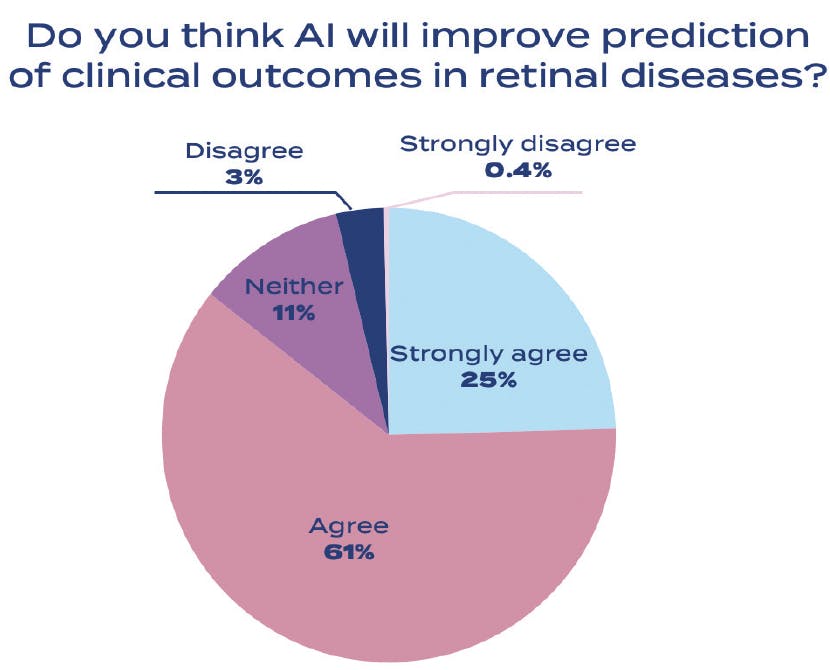
Figure 1. The 2023 EURETINA Clinical Trends Survey shows a strong consensus among respondents that AI will improve clinical outcome predictions in retinal diseases.
Balancing AI with Clinical Expertise
While AI has an immense impact on clinical decision-making, it is crucial that it complements, rather than replaces, human expertise in patient care. Patients still need meaningful discussions with their doctors. AI provides data-driven insights that support decision-making, but it does not replace human empathy and clinical judgment. By integrating and analyzing patient data, AI helps doctors personalize treatments for optimal outcomes.
Transparency is also paramount. Patients should understand AI’s role in their care and give informed consent. Ultimately, the decision-making process remains in the hands of the patient.
How Retina Specialists Can Begin With AI
Retina specialists new to AI can begin with FDA- or CE-approved platforms, which require no prior expertise. Simply uploading patient imaging data generates a detailed, quantitative report. These tools enhance diagnostic accuracy, streamline workflows, and support clinical decision-making with minimal effort. The adoption of AI speeds up diagnoses, improves patient outcomes, and optimizes retina specialists’ time, benefiting both patients and providers.
Conclusion
AI is revolutionizing retinal disease diagnosis and management. While it enhances accuracy and efficiency, the human connection remains irreplaceable. As AI continues to integrate into clinical practice, it will empower clinicians, improve patient outcomes, and shape the future of retinal care.
1. Kodjikian, L. et al. Fluid as a critical biomarker in neovascular age-related macular degeneration management: literature review and consensus recommendations. Eye (Lond) 35, 2119–2135 (2021).
2. Yoshida, K. et al. Deep Learning Approaches to Predict Geographic Atrophy Progression Using Three-Dimensional OCT Imaging. Transl Vis Sci Technol 14, 11 (2025).
The views and opinions expressed in this content may not necessarily represent those of Bryn Mawr Communications or Retina Today.
