

At-home OCT provides real-time disease monitoring, facilitating timely intervention. Studies confirm its efficacy, with patients using the device an average of 5.7 times per week.1 AI-driven fluid detection is as reliable as that by expert retina specialists, making at-home OCT a valuable tool for monitoring fluid recurrence in neovascular age-related macular degeneration (nAMD).
A retrospective study by Holekamp et al. found that clinicians using at-home OCT data extended treatment intervals from 8 to 15 weeks, reducing unnecessary injections while maintaining effective disease management.2 This resulted in higher patient satisfaction, as fewer injections were needed while maintaining the quality of care.
Identifying Ideal Candidates
Patients with longer treatment intervals, particularly those on newer drugs that extend treatment intervals up to six months, benefit the most from at-home OCT. This technology aids in determining the optimal time for retreatment. In contrast, patients who require more frequent injections may have less need for home monitoring.
The Role of a Monitoring Center
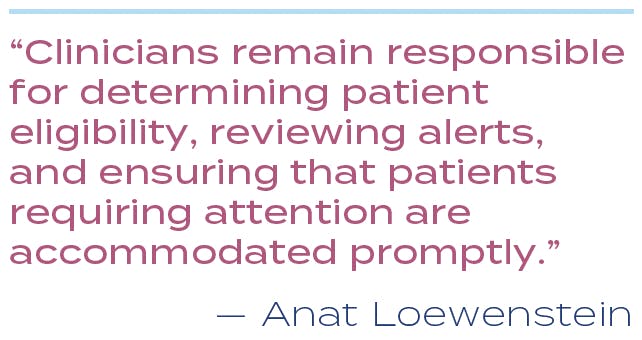
A dedicated monitoring center is essential for the success of at-home OCT, managing device distribution, setup, and patient adherence while securely storing AI-driven images. Alerts are sent directly to clinicians, who determine patient eligibility and necessary interventions.
By handling logistics, the monitoring center reduces clinicians’ workload, enabling them to focus on medical decision-making. Flexible scheduling is crucial to accommodate patients requiring in-office evaluations following alerts of disease activity.

Challenges in Adoption
Despite its advantages, at-home OCT remains underutilized. The 2023 EURETINA Clinical Trends Survey revealed that nearly 70% of respondents rarely or never use it for monitoring nAMD and diabetic macular edema (DME) (Figure 1).
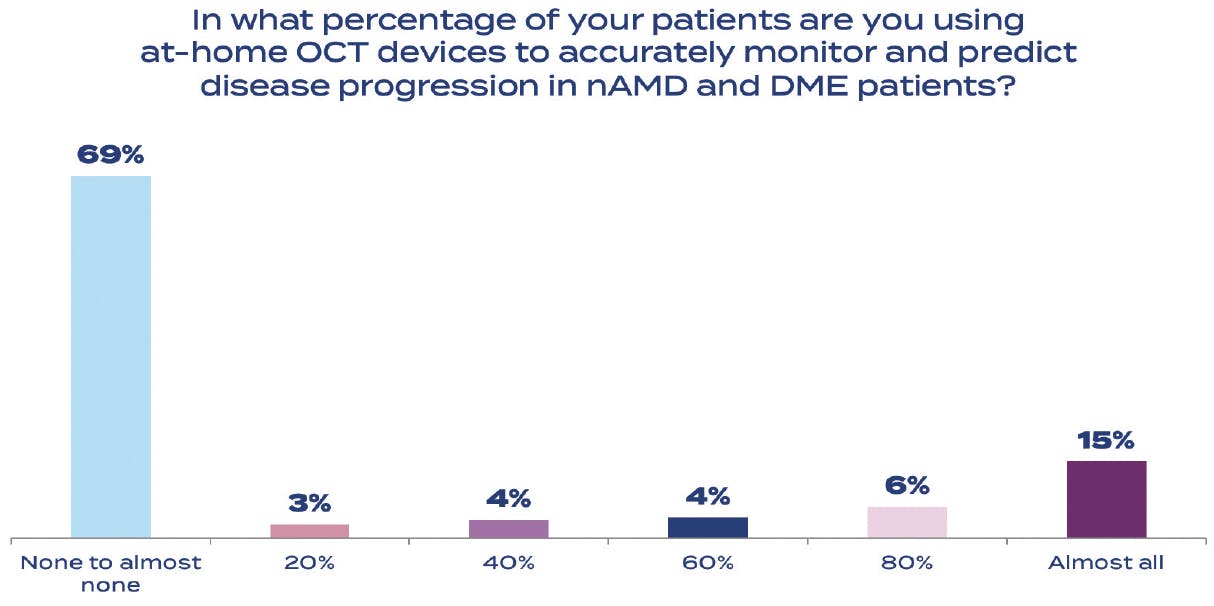
Figure 1. The 2023 EURETINA Clinical Trends Survey indicates that 69% of respondents use few or no at-home OCT devices to monitor and predict disease progression in nAMD and DME patients.
A major barrier is the lack of EMA approval. However, with FDA approval gained in April 2024, adoption is expected to accelerate in the US. As reimbursement frameworks develop, at-home OCT is poised to transform treatment decisions and patient outcomes.
Future Advancements in At-Home OCT Technology
At-home OCT is expected to expand to diabetic retinopathy and DME, though monitoring may differ, as the urgency to treat fluid accumulation is not as immediate as in nAMD. Future advancements may include additional biomarkers and AI-driven analysis for more personalized care.
Conclusion
At-home OCT represents a major advancement in retinal care, enabling real-time monitoring and more personalized treatment. As adoption grows, it will optimize disease management, reduce unnecessary interventions, and improve patient satisfaction.
1. Liu, Y., Holekamp, N. M. & Heier, J. S. Prospective, longitudinal feasibility study: daily self-imaging with home OCT in neovascular age-related macular degeneration. Invest Ophthalmol Vis Sci 63, 2320–2320 (2022).
2. Holekamp, N. M., de Beus, A. M., Clark, W. L. & Heier, J. S. Prospective trial of home optical coherence tomography-guided management of treatment experienced neovascular age-related macular degeneration patients. Retina 44, (2024).
The views and opinions expressed in this content may not necessarily represent those of Bryn Mawr Communications or Retina Today.
