
WHERE IT ALL BEGAN
I grew up in Chesterfield, Missouri, and attended Princeton University, where I majored in chemical engineering with a minor in materials science. At the time, I was interested in developing materials for drug delivery. After Princeton, I completed an MD/PhD program at Washington University in St. Louis, where I got my PhD in biophysics. My research focused on the development of nanoparticles for siRNA delivery. In addition to my clinical practice, I am working to start a research lab using this technology to treat macular degeneration. I had incredible mentors during my training who helped me develop a passion for patient care and translational research. Most importantly, my wife, who is a practicing cornea specialist, has always supported me along my journey to becoming a clinician scientist.
MY PATH TO RETINA
As a resident at the University of Califoria Los Angeles (UCLA), I had great exposure to retina from the very first days of my residency. I realized that I wanted to do retina while I was scrubbed in for my first after-hours intraocular foreign body surgery alongside two of our retina fellows, who made a complex case look easy. In addition to working closely with talented fellows, UCLA residents also participate in multimodal imaging rounds with David Sarraf, MD. Learning from him is like drinking from a firehose. As a resident, I did not have time to do any bench work, but he mentored me through a variety of projects that allowed me to present at national conferences. Having the freedom to pursue different areas of research and learn from world-class researchers confirmed my interest in the field of vitreoretinal surgery.
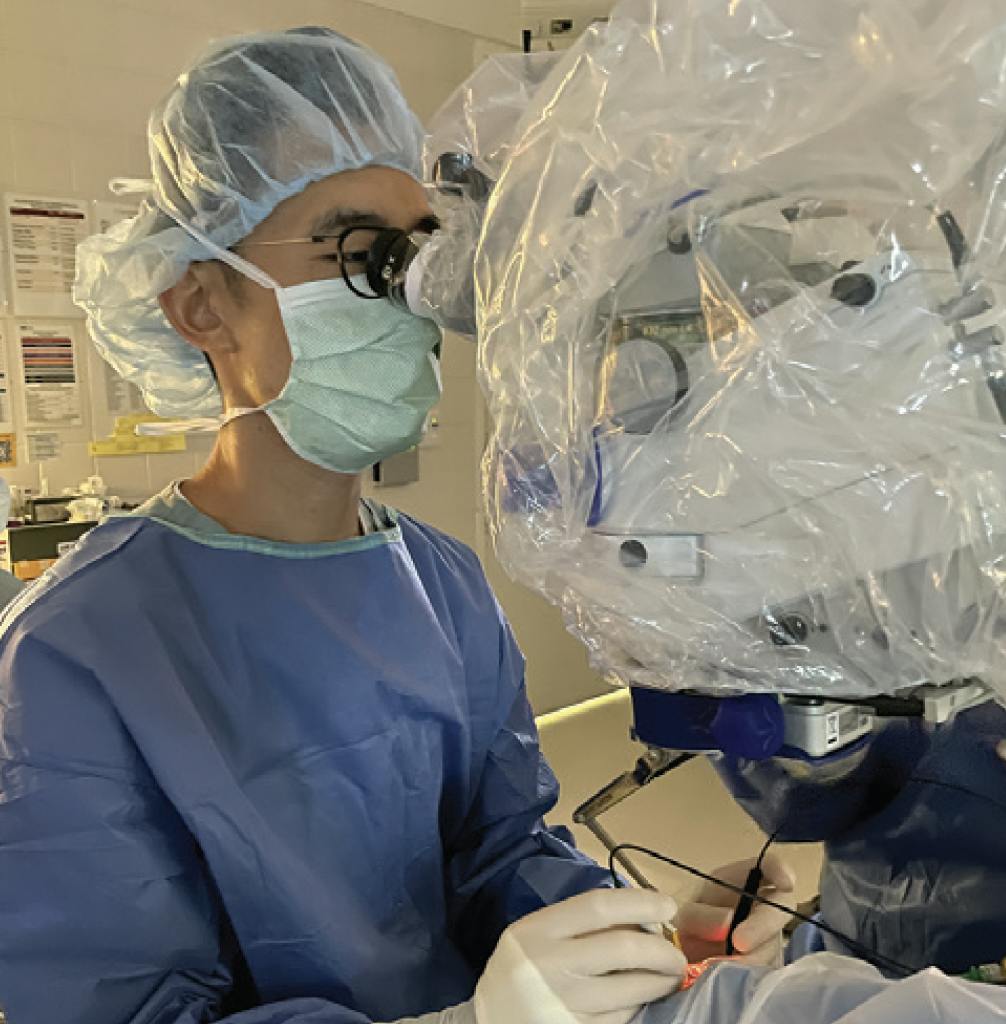
Dr. Hou’s advice: It is important to follow your passions within your chosen career path. If you have a passion for teaching or research, there are many opportunities to incorporate those activities into your career.
SUPPORT ALONG THE WAY
I was lucky to join the faculty at UCLA Stein Eye Institute, where I get to work with my mentors on a daily basis. It is an honor to continue working with surgical mentors such as Pradeep Prasad, MD, and Hamid Hosseini, MD. I am lucky that I still get to share complex cases with my medical retina mentors Dr. Sarraf and Edmund Tsui, MD. The career of an early clinician scientist can be quite challenging when balancing a busy clinical and surgical practice with teaching responsibilities and research.
It is incredibly important to build a strong network of mentors to guide you through these challenges. Irena Tsui, MD, has been a shining example of how to navigate these challenges, and she has guided me through each step along the way. With the support of the UCLA vitreoretinal faculty, I have started my own research lab investigating new treatments for early macular degeneration.
AN EXPERIENCE TO REMEMBER
Just this past year, a former fellow called me for advice on a complex patient he was taking care of. This experience helped me realize that the relationships I have fostered along the way are a rewarding part of my career as a physician in an academic setting. I look forward to training many fellows over the course of my career.
