




In the midst of the fall conference schedule, many of us have been jet-setting, hob-knobbing, and slide deck-checking all over the United States and abroad. A number of hot topics have been buzzing around the conference halls, including the loss of Good Days funding,1 the integration of new dry AMD therapies (such as complement inhibitors for geographic atrophy and LumiThera’s Valeda Light Delivery System for intermediate dry AMD) into the clinic, the launch of Alcon’s Unity vitreoretinal cataract system, and the novel implant to treat macular telangiectasia type 2, revakinagene taroretcel-lwey (Encelto, Neurotech).
One topic of particular interest, especially for this issue, has been the massive shift in diabetes care, including new systemic drugs, advanced disease management tools, and novel treatments for diabetic retinopathy (DR) and diabetic macular edema (DME). We were happy to see several lectures focused on systemic care at the annual American Society of Retina Specialists meeting in Long Beach, California. For example, Amer Alsoudi, MD, an ophthalmology resident at Baylor, shared his team’s data showing a reduced risk of vision-threatening complications for patients with nonproliferative DR who used a continuous glucose monitor for 1 year compared with those who did not use the device.2
Stemming from these talks, a few colleagues anecdotally noted that while diabetes is on the rise, the risk of vision-threatening complications isn’t necessarily keeping pace. And they were right. A new study in Ophthalmology found that, although the prevalence of diabetic retinal disease increased steadily between 2001 and 2021, vision-threatening complications rose until 2016 but have since decreased each year through 2021 (Table).3
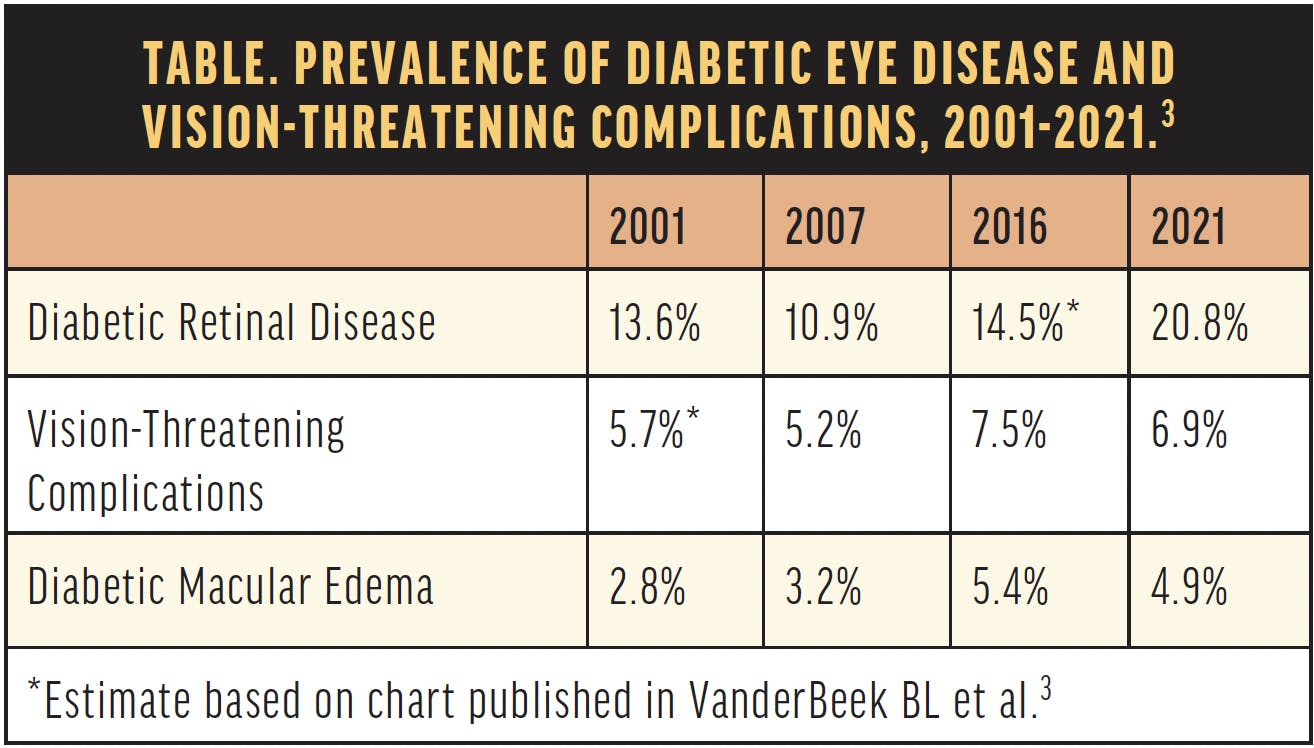
While the decrease in the rate of complications is small (the incidence of vision-threatening complications was 7.5% in 2016 and 6.9% in 2021),3 it’s statistically significant and, more importantly, a sign of improvement in our field. Retina specialists are getting better at screening patients, diagnosing early, and treating properly. On top of that, today’s systemic care now includes continuous glucose monitors, digital diabetes management platforms, and next-generation therapies such as glucagon-like peptide-1 receptor agonists (GLP-1 RAs).
Our patients with diabetes are some of our most complicated patients to care for, and they are requiring more chair time, closer monitoring, and more patient education. Because we can always do better—and we must do better—this issue is designed to help you understand the holistic treatment landscape for diabetes.
Ehsan Rahimy, MD, and his team at Byers Eye Institute discuss the effect of new systemic care options on the eye, while Aleksandra V. Rachitskaya, MD, and her team at Cole Eye dive deeper into GLP-1 RAs.
In addition, Jorge C. P. Rocha, MD, PhD, and Majda Hadziahmetovic, MD, touch on the use of AI to boost our screening programs. For more on diabetic eye disease screening, head online to retinatoday.com to read about a large-scale screening initiative, Diabetes Day, that first launched at Wills Eye Hospital in 2022. This year’s program ran statewide in Pennsylvania, and the organizers hope Diabetes Day continues to grow and help more patients connect with specialty care.
We also have articles on imaging DME with fluorescein angiography and OCT angiography, managing patients with DR and good vision, and a very detailed article on teaching (not just performing) fibrovascular membrane dissection.
So, if you see a patient this week struggling to maintain control of their hemoglobin A1c (we all have them in our clinics), maybe now is the time to suggest a new medication or mention the value of a digital monitoring platform—these systemic changes might be the difference between long-term visual health and blinding disease.
1. Lai M. The impact of Good Days’ underfunding on retinal disease management: Insights from a national survey of American Society of Retina Specialists members. Presented at ASRS. August 2, 2025; Long Beach, California.
2. Alsoudi A, Wai KM, Koo E, Koo, E, Mruthyunjaya P, Rahimy E. Reduced rates of diabetic retinopathy complications with use of continuous glucose monitoring. Nature Sci Rep. 2025;15:25215.
3. VanderBeek BL, Yu Y, Cardillo S, Hubbard R. Twenty-Year Trends in Prevalence and Incidence of Diabetic Retinal Disease. Ophthalmology. 2025;132(7):767-774.


_1784132761.jpg?auto=compress,format&w=75)





