


AT A GLANCE
- Diabetes Day is designed as a screen-to-care event, with same-day imaging and counseling, one-on-one patient navigation, social work support, and follow-up scheduling.
- Coordinating a statewide event required virtual meetings to exchange ideas, a “Diabetes Day Playbook”, and live events to build momentum around the event.
- In April 2025, the Pennsylvania House of Representatives passed a state resolution recognizing April 26 as Diabetic Eye Screening Day across the state with a goal to add more states around the country.
Recent data estimate 9.6 million people in the United States live with DR, 1.84 million of whom have vision-threatening disease, yet many adults with diabetes are not receiving recommended dilated examinations at timely intervals.1,2 This is largely due to barriers related to insurance, transportation, language, and care navigation.3-5 Current guidelines continue to endorse annual screening, with shorter intervals for advanced disease.6 This persistent under-screening, paired with the clear benefits of early intervention, demand a redesign of the pathways that connect patients to specialty eye care.
Diabetes Day was built to close that gap by turning screening into screen-to-care: same-day imaging and counseling paired with 1:1 navigation, embedded social work support, and follow-up scheduling before discharge. Launched at Wills Eye Hospital in 2022, the event offers free, comprehensive diabetic eye examinations and patient education aimed at empowering participants, educating families and caregivers, and reducing preventable vision loss.7
From that single-site pilot, the initiative expanded across Philadelphia and, by 2025, matured into a multi-institution, multi-retina practice, statewide model. In addition to Wills Eye Hospital, this year’s event included the Scheie Eye Institute at the University of Pennsylvania, Temple Eye Institute, Geisinger, Nazareth Hospital, and UPMC/University of Pittsburgh. The sites aligned on shared workflows such as arrival-window scheduling, 1:1 patient navigation, interpreter coverage, and donor-supported care for the uninsured to standardize the patient experience and facilitate rapid follow-up. Early evidence and prior trials show that navigator-led pathways improve post-screening adherence.8,9 Here, we summarize what scaled, what changed, and where the statewide effort is headed next.
CITY AND STATEWIDE PLANNING
Coordinating a statewide Diabetes Day required timely and efficient coordination of resources. In the months leading up to Diabetes Day, we hosted statewide virtual meetings to exchange ideas for logistical changes to improve participation and outcomes and build excitement and momentum around the event.
Patient recruitment was achieved through a multimodal approach, paying special attention to communities that face the greatest barriers to health care. We contacted local shelters and community centers and used local print, social media, and television news broadcasting. Online patient sign-ups occurred through a QR code linked to a HIPAA-compliant platform with flexible arrival-window scheduling and clear scope/limitations. In the weeks prior to the event, patients received email reminders with the date, time, and instructions.
Volunteers registered through SignUpGenius, with roles spanning specialist physicians, optometrists, opticians, medical technicians, medical students, and community members (Figure 1). Patient navigators are crucial to success of this screening process, as they guide patients in a 1:1 manner through the entire day, ensuring they stay on track with event flow and do not leave without their results.
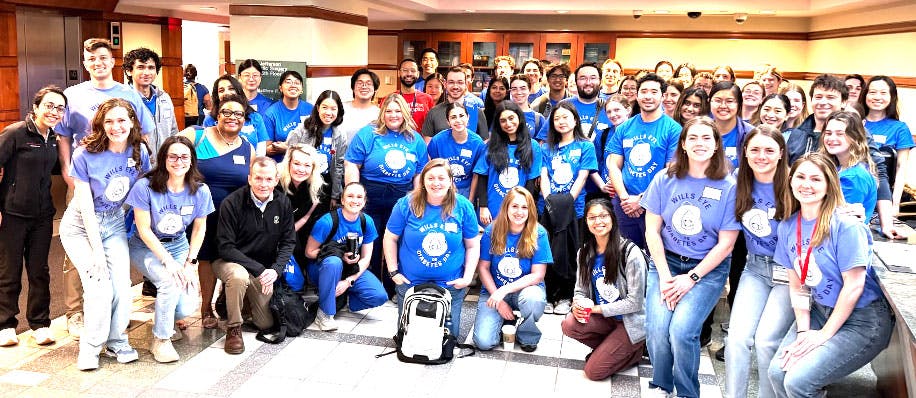
Figure 1. The multidisciplinary Wills Eye team gathered for a morning huddle prior to the start of Diabetes Day screenings.
EVENT PLAYBOOK
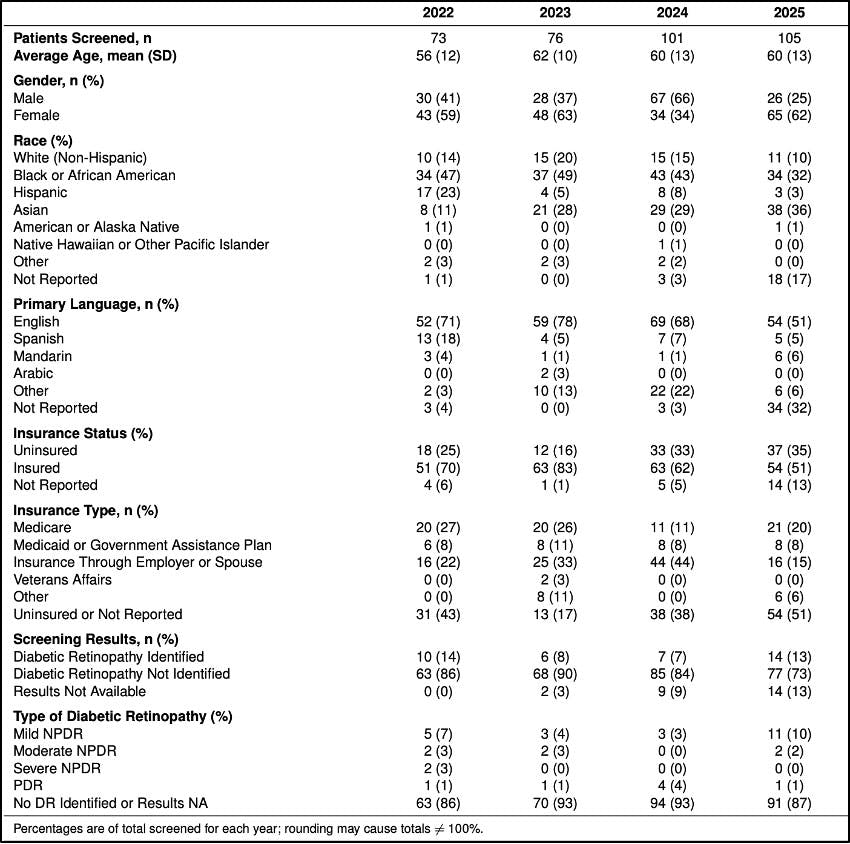
Resources and workflow varied by institution, but core elements are always consistent (Figure 2). At Wills Eye Hospital, patients arrive during an assigned time slot and are paired with a navigator (and interpreter if needed). The typical flow includes intake, visual acuity testing, and diabetic wide angle retinal imaging (Table). Patients with VA < 20/40 are routed to on-site optometry/optician services for a free pair of glasses. Results are reviewed chairside with an ophthalmologist, and any indicated follow-up is scheduled before discharge to reduce loss to follow-up. This year, we emphasized holistic diabetes care by partnering with Jefferson Health and Temple Podiatry to provide diabetic foot examinations, dermatologic skin checks, and connections to family medicine and endocrinology. While awaiting physician discussion, patients were encouraged to access educational resources and participate in a healthy, diabetic-friendly “lunch and learn.” On-site social workers addressed transportation, insurance, and other barriers, tailoring care plans to individual needs.
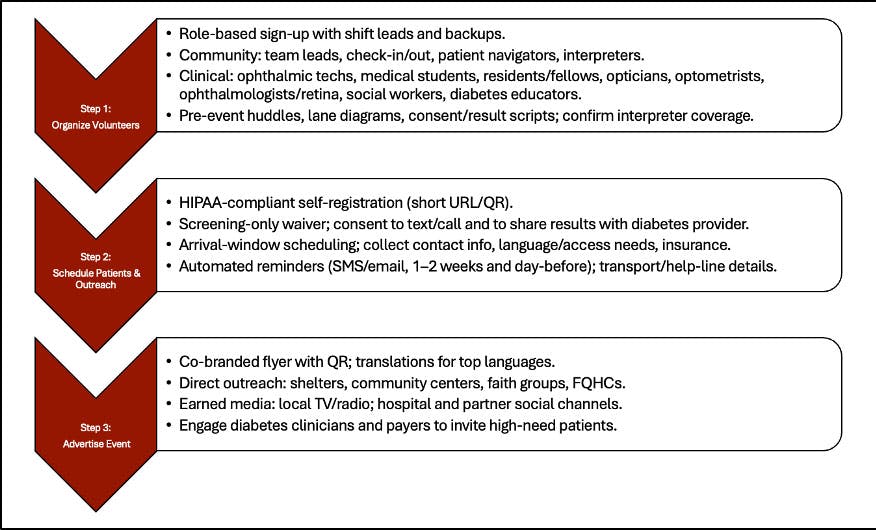
Figure 2. Our three-step coordination playbook for Diabetes Day includes: 1) organize volunteers, including patient navigators; 2) schedule patients using a HIPAA-compliant self-registration system with arrival-window scheduling; and 3) recruit through targeted community outreach and media. The checklist shown here standardizes tasks and helps teams reliably scale the event.
WHAT’S IN STORE FOR NEXT YEAR
The reach of Diabetes Day has grown markedly since its inception, and the goal is expansion nationwide. In alliance with our goals to decrease preventable blindness in the Philadelphia community and beyond, we are thrilled to continue to expand Diabetes Day every year. In April 2025, the Pennsylvania House of Representatives passed a state resolution recognizing April 26 as Diabetic Eye Screening Day across the state.10 This is a wonderful milestone for Diabetes Day efforts and speaks to the dedication and hard work put forth by those involved in this mission.
The entire event, led in part by our Jefferson Medical School, Wills Eye Hospital and Mid Atlantic Retina volunteers, fosters tremendous goodwill, team building, and positive energy. Our grass-roots mission is to expand the reach of Diabetes Days to other sites to reduce preventable diabetic vision loss, and we welcome the opportunity to communicate on a playbook for your site.
Acknowledgements: The authors would like to thank the following volunteers and clinicians for their help with this program: Jay Pendyala, BS; Saif Hamdan, MD; Bita Momenaei, MD; Luis Acaba Berrocal, MD; Martin Calotti, MD; Jack Williamson, MD; Flavius Beca, MD; Collin Richards, MD; Richard Kaiser, MD; David Xu, MD; Anton Orlin, MD; Marc Spirn, MD; Yoshihiro Yonekawa, MD; Ajay Kuriyan, MD, MS; Meera Sivalingam, MD; James Vander, MD; Carl Park, MD; Julia A. Haller, MD; and Leslie Hyman, PhD.
1. Lundeen EA, Burke-Conte Z, Rein DB, et al. Prevalence of diabetic retinopathy in the US in 2021. JAMA Ophthalmol. 2023;141(8):747-754.
2. VEHSS modeled estimates: prevalence of diabetic retinopathy (DR). Vision and Eye Health Surveillance System. Centers for Disease Control and Prevention. Accessed August 18, 2025. www.cdc.gov/vision-health-data/prevalence-estimates/dr-prevalence.html
3. Ravindranath R, Bernstein IA, Fernandez KS, Ludwig CA, Wang SY. Social determinants of health and perceived barriers to care in diabetic retinopathy screening. JAMA Ophthalmol. 2023;141(12):1161-1171.
4. Hudson SM, Modjtahedi BS, Altman D, Jimenez JJ, Luong TQ, Fong DS. Factors affecting compliance with diabetic retinopathy screening: a qualitative study comparing english and spanish speakers. Clin Ophthalmol. 2022;16:1009-1018.
5. Eppley SE, Mansberger SL, Ramanathan S, Lowry EA. Characteristics associated with adherence to annual dilated eye examinations among US patients with diagnosed diabetes. Ophthalmology. 2019;126(11):1492-1499.
6. American Diabetes Association Professional Practice Committee. 12. Retinopathy, neuropathy, and foot care: standards of care in diabetes-2025. Diabetes Care. 2025;48(Suppl 1):S252-S265.
7. Diabetes Day: improving access to DR care. Retina Today. 2024;19(6):18-20.
8. Leiby BE, Hegarty SE, Zhan T, et al. A randomized trial to improve adherence to follow-up eye examinations among people with glaucoma. Prev Chronic Dis. 2021;18:E52.
9. Hark LA, Gorroochurn P, Pizzi LT, et al. Patient navigators improve in-office eye exam adherence after community eye screenings in a randomized clinical trial: NYC-SIGHT study. Am J Ophthalmol. 2025;274:54-66.
10. Pennsylvania General Assembly. House Resolution 113 (2025): Recognizing April 26, 2025, as Diabetic Eye Screening Day. Adopted April 7, 2025. www.palegis.us/legislation/bills/text/HTM/2025/0/HR0113/PN0924


_1784132761.jpg?auto=compress,format&w=75)





