




MTM IN THREE PARTS

Myopic traction maculopathy (MTM) is a complex condition that includes macular schisis with or without submacular fluid, as well as the more advanced stage of macular hole retinal detachment (MHRD). To help clinicians tackle the various complications of high myopia, I have organized a three-part series breaking down the timing and surgical options for MTM, macular buckling for MTM, and vitrectomy pearls for complex MHRD. Together, these articles are designed to provide you with a comprehensive perspective on the surgical management of this challenging condition.
Below is part three, and you can find parts one and two here:
Myopic Traction Maculopathy: Surgical Timing and Techniques
Macular Buckling for Myopic Traction Maculopathy
Macular hole retinal detachments (MHRD) are a significant challenge in vitreoretinal surgery, with high myopia and the presence of a posterior staphyloma the predominant causes. In RDs originating from the posterior pole, retinal breaks other than the MH may be responsible, such as full-thickness tears along the vascular arcades or within areas of chorioretinal atrophy—particularly around the optic disc—which can be difficult to identify.
In addition to the macular buckling technique, several alternative surgical strategies have proven highly effective for achieving both MH closure and retinal reattachment.
ILM DISSECTION AND INVERTED FLAP TECHNIQUE
First described in 2016 by Michalewska et al for large MHs, the inverted internal limiting membrane (ILM) flap technique has demonstrated a clear superiority over complete ILM removal in terms of MH closure rates and retinal reattachment in various series published in 2016 and 2017.1-5 Creating an inverted flap when the retina is detached can be cumbersome due to two main challenges:
During staining, the dye tends to enter the subretinal space, impairing ILM visualization and increasing the risk of retinal pigment epithelium (RPE) toxicity.
Performing the initial “pinch” maneuver to start the ILM peel on a detached, mobile retina can be technically difficult and traumatic.
To address these issues, a modified technique was described in 2023: Following pars plana vitrectomy (PPV), perfluorocarbon liquid (PFCL) is injected to displace the subretinal fluid peripherally. Using high magnification and a 41-gauge cannula, a partial drainage of subretinal fluid can be performed through the MH. Staining is then achieved by injecting dye with a soft-tip cannula between the retina and the PFCL, which allows almost instantaneous staining without subretinal dye migration. The inverted flap can then be prepared and positioned over the MH. This approach avoids the need for additional posterior retinotomies.6
The inverted ILM flap technique has become the first-line surgical approach for MHRD associated with high myopia.
AUTOLOGOUS RETINAL TRANSPLANTATION
In 2016, Grewal and Mahmoud introduced the concept of autologous retinal transplantation (ART) for the treatment of large refractory MHs (Figure 1).7 Subsequently, 15% of the patients included in the ART Global Consortium Study had a MHRD that had failed to close after surgery. After ART, 95% of these patients achieved MH closure (complete closure in 68.4% and a small eccentric defect in 26.3%).7 Reported complications included graft dislocation, redetachment in four eyes, and the presence of subretinal PFCL in two eyes.8
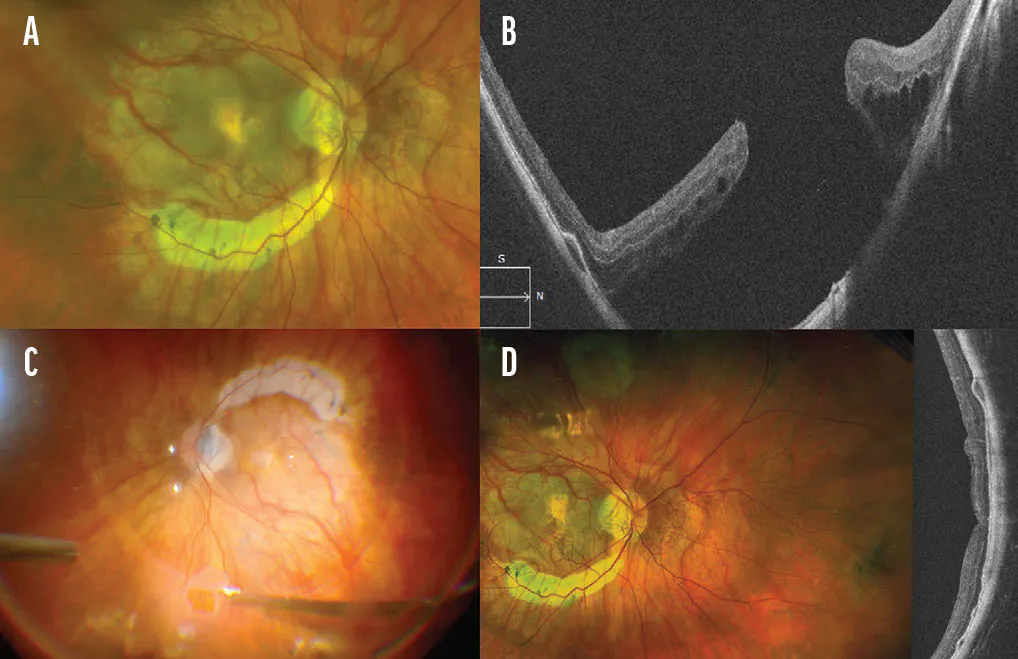
Figure 1. This eye with high myopia has a large MHRD confined to the macular area (A). Structural OCT shows the central size of the MH (B). Intraoperative imaging with PFCL after creating a peripheral localized RD and cutting the ART that will then be moved to the MH under PFCL (C). Postoperatively, the retina is reattached, and the MH is closed on OCT (D).
A controversial aspect of ART has been whether the graft becomes reperfused. Tabandeh reported two cases that demonstrated vascular reperfusion of large ART grafts,9 and Kitahata et al documented vascularization in 34.6% of 26 eyes.10 Conversely, Takeuchi et al observed no changes in fixation points using microperimetry or in absolute scotoma size in cases of very large MHs.11
During the initial surgical steps, it is important to estimate the MH size to harvest a graft approximately 25% larger, compensating for postoperative graft contraction. This can be facilitated by placing a Finesse Flex Loop (Alcon) over the MH to estimate its diameter and then transferring the measurement to the peripheral retina (ART is typically harvested from the superior peripheral retina).
Some surgeons prefer to apply diathermy around the donor site to minimize bleeding, although excessive coagulation may devitalize the edges. Maintaining the graft’s orientation is crucial. While some surgeons deliver the graft under PFCL to facilitate a correct placement, others prefer to lift the graft and place it directly over the MH, use forceps to position the graft, and stabilize it over the MH using PFCL. (The latter option could avoid potential photoreceptor trauma because the graft is not being dragged into position.) The final exchange with the chosen tamponade agent—either gas or silicone oil—is critical to prevent graft displacement.
KEY TAKEAWAYS
- First described in 2010, the inverted internal limiting membrane (ILM) flap technique has demonstrated a clear superiority over complete ILM removal regarding macular hole (MH) closure rates and retinal reattachment.
- During the initial surgical steps for autologous retinal transplantation, it is important to estimate the size of the MH to harvest a graft approximately 25% larger, compensating for postoperative graft contraction.
- The use of subretinal human amniotic membrane involves preparing an amniotic membrane disc (1 to 2 mm in diameter, depending on MH size) and positioning it beneath the MH edges.
HUMAN AMNIOTIC MEMBRANE
In 2011, Kiilgaard et al used subretinal human amniotic membrane (HAM) in animal studies as a substitute for damaged RPE and Bruch membrane.12 Later, Rizzo et al applied small, cryopreserved HAM implants subretinally without specific orientation to promote MH closure.13 In 2019, Caporossi et al reported a 94% closure rate in highly myopic eyes (mean axial length 30.89 mm) using subretinal HAM placed with chorion-RPE orientation. Importantly, 69% of eyes demonstrated visual improvement, with BCVA better than 20/63 in 56% of eyes.14
The technique involves preparing a HAM disc (1 to 2 mm in diameter, depending on MH size) and positioning it beneath the MH edges (Figure 2). Mechanical elevation of the edges is often necessary to insert the implant and prevent its loss during fluid-air exchange. In cases of MHRD, once the HAM is placed subretinally (preferably with the chorion facing the RPE), it should be stabilized with PFCL to prevent subretinal displacement. Subretinal fluid should then be drained either through a peripheral retinal break or a small, intentionally created peripheral retinotomy.15
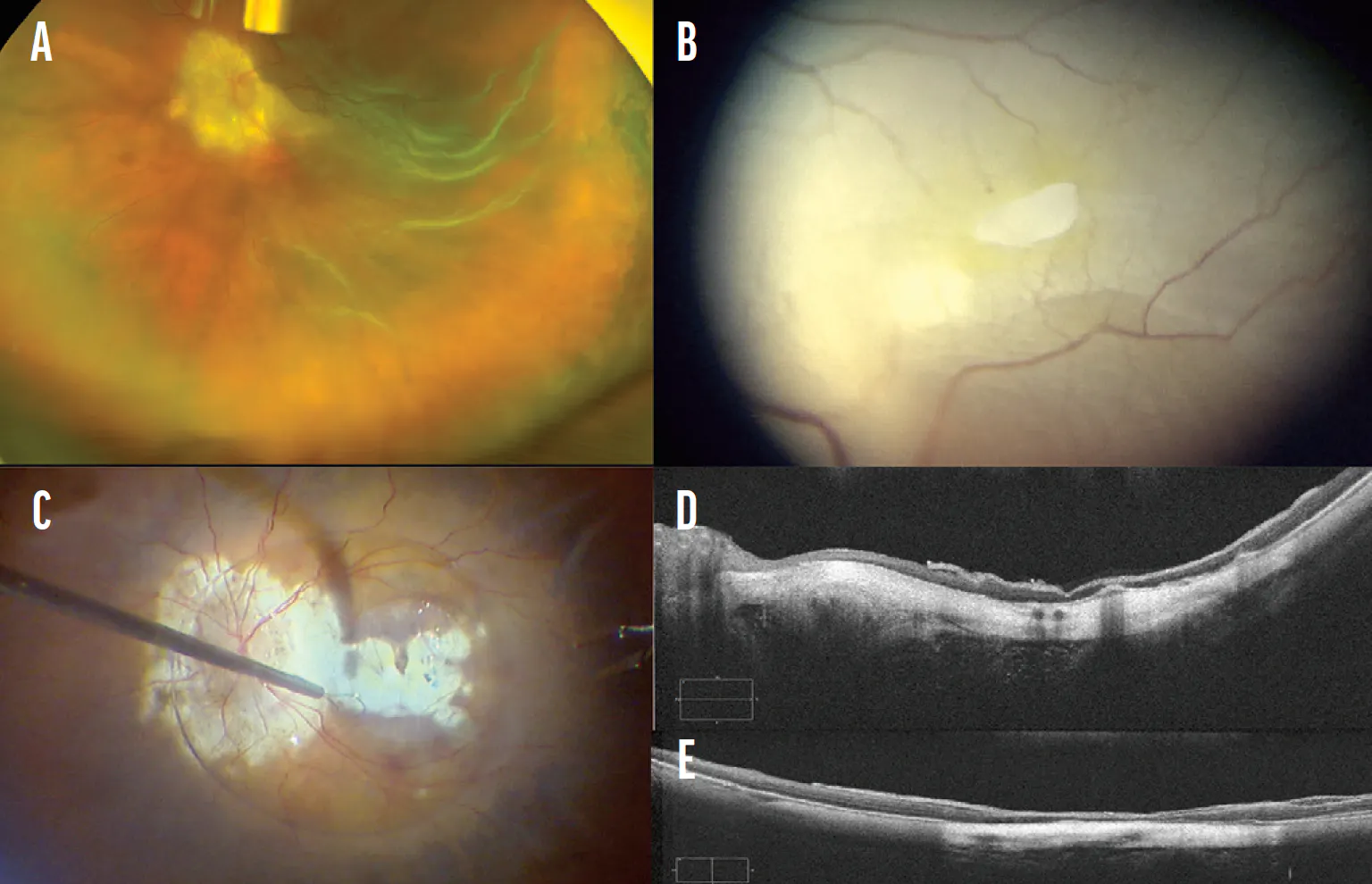
Figure 2. A total RD is caused by a large MH (A). Intraoperatively, the hole has atrophic areas seen through the translucent detached retina (B). The HAM is stabilized under PFCL, and the surgeon centers and unrolls the HAM (C). Horizontal (D) and vertical (E) OCT scans crossing the foveal center show the centered HAM.
In 2020, Moharram et al reported the use of a large epiretinal HAM patch in 14 eyes with MHRD, achieving MH closure and retinal reattachment in 93% of cases.16 In 2021, Garcin et al applied the same technique in two groups—those with large MHs and those with MHRD—achieving 80% hole closure and 100% retinal reattachment, respectively.17
Whether the optimal form of HAM is cryopreserved or lyophilized remains unclear. Cryopreserved HAM is stored at very low temperatures (-80°C to -196°C), preserving histological integrity but showing some basal lamina and stromal protein degradation after 3 months. Conversely, lyophilized HAM is thinner, can be stored at room temperature, and is immediately available. Regarding growth factors, Allen et al demonstrated that dried HAM retained higher concentrations of growth factors compared with cryopreserved HAM when a modified preservation process was used.18 Orientation also remains controversial—whether the chorionic side should face upward or toward the RPE. Cryopreserved HAM shows greater adherence on its chorionic surface, so many surgeons prefer placing this surface toward the RPE to enhance adherence and reduce the risk of implant displacement during the final fluid-air exchange.
THE BENEFITS OF MH COVERAGE
MHRD remains one of the most complex scenarios in vitreoretinal surgery, particularly in highly myopic eyes with posterior staphyloma. Recent advances such as the inverted ILM flap technique, ART, and HAM implantation provide effective alternatives for achieving both MH closure and retinal reattachment in challenging cases. However, we still have barriers to overcome, including the need to achieve not only closure and retinal reattachment, but also complete restoration of the retinal layers.
Careful patient selection, meticulous surgical technique, and awareness of potential complications are essential to optimize outcomes. As instrumentation and adjuncts evolve, these strategies may further improve both anatomic success and functional recovery in eyes with MHRD.
1. Michalewska Z, Michalewski J, Adelman RA, Nawrocki J. Inverted internal limiting membrane flap technique for large macular holes. Ophthalmology. 2010;117(10):2018-2025.
2. Chen SN, Yang CM. Inverted internal limiting membrane insertion for macular hole-associated retinal detachment in high myopia. Am J Ophthalmol. 2016;162:99-106.e1
3. Matsumura T, Takamura Y, Tomomatsu T, et al. Comparison of the inverted internal limiting membrane flap technique and the internal limiting membrane peeling for macular hole with retinal detachment. PloS One. 2016;11(10):e0165068.
4. Baba R, Wakabayashi Y, Umazume K, et al. Efficacy of the inverted internal limiting membrane flap technique with vitrectomy for retinal detachment associated with myopic macular holes. Retina. 2017;37(3):466-471.
5. Yuan J, Zhang LL, Lu YJ, Han MY, Yu AH, Cai XJ. Vitrectomy with internal limiting membrane peeling versus inverted internal limiting membrane flap technique for macular hole-induced retinal detachment: a systematic review of literature and meta-analysis. BMC Ophthalmol. 2017;17(1):219.
6. La Mantia A, Mateo C. Modified perfluorocarbon liquid/internal limiting membrane interface staining in myopic macular hole retinal detachment. Eur J Ophthalmol. 2023;33:602-606.
7. Grewal DS, Mahmoud TH. Autologous neurosensory retinal free flap for closure of refractory myopic macular holes. JAMA Ophthalmol. 2016;134(2):229-230.
8. Moysidis SN. Autologous retinal transplantation for primary and refractory macular holes and macular hole retinal detachments: the Global Consortium. Ophthalmology. 2021;128(5):672-685.
9. Tabandeh H. Vascularization and reperfusion of autologous retinal transplant for giant macular holes. JAMA Ophthalmol. 2020;138(3):305-305.
10. Kitahata S, Inoue M, Yanagi Y, et al. Angiogenesis and anastomosis on graft retina after autologous retinal transplantation. Ophthalmol Retina. 2022;6(10):972-974.
11. Takeuchi J, Kataoka K, Shimizu H, et al. Intraoperative and postoperative monitoring of autologous neurosensory retinal flap transplantation for a refractory macular hole associated with high myopia. Retina. 2021;41(5):921-930.
12. Kiilgaard JF, Scherfig E, Prause JU, la Cour M. Transplantation of amniotic membrane to the subretinal space in pigs. Stem Cells International. 2012;2012:716968.
13. Rizzo S, Caporossi T, Tartaro R, et al. A human amniotic membrane plug to promote retinal breaks repair and recurrent macular hole closure. Retina. 2019:39(Suppl 1):S95-S103.
14. Caporossi T, Tartaro R, De Angelis L, Pacini B, Rizzo S. A human amniotic membrane plug to repair retinal detachment associated with large macular tear. Acta Ophthalmol. 2019;97(8):821-823.
15. Abouhussein MA, Elbaha SM, Aboushousha M. Human amniotic membrane plug for macular holes coexisting with rhegmatogenous retinal detachment. Clin Ophthalmol. 2020;14:2411-2416.
16. Moharram HM, Moustafa MT, Mortada HA, Abdelkader MF. Use of epimacular amniotic membrane graft in cases of recurrent retinal detachment due to failure of myopic macular hole closure. Ophthalmic Surg Lasers Imaging Retina. 2020;51(2):101-108.
17. Garcin T, Gain P, Thuret G. Epiretinal large disc of blue-stained lyophilized amniotic membrane to treat complex macular holes: a 1-year follow-up. Acta Ophthalmol. 2022;100(2):e598-e608.
18. Allen CL, Clare G, Stewart EA, et al. Augmented dried versus cryopreserved amniotic membrane as an ocular surface dressing. PLoS One. 2013;8(10):e78441.


_1784132761.jpg?auto=compress,format&w=75)





