


Proliferative vitreoretinopathy (PVR) remains the leading cause of redetachment after rhegmatogenous retinal detachment (RD) repair and the most formidable nemesis of retina surgeons.1,2 In particular, grade C PVR, characterized by preretinal and subretinal fibrotic proliferation, star folds, intraretinal contraction, and retinal foreshortening, often requires complex surgical techniques, including membrane dissection, encircling scleral buckle, relaxing retinectomy, lensectomy, and silicone oil tamponade.2 However, these techniques have changed little over the past decades, and eyes with PVR still pose a high risk of recurrence and suboptimal visual outcomes. Techniques to improve PVR outcomes continue to represent an enduring challenge in vitreoretinal surgery.
To address these limitations, we propose extended internal limiting membrane (ILM) peeling as an additional strategy to reduce PVR recurrence, thereby improving outcomes.3
ILM PEELING IN PVR
There are three rationales for ILM peeling in PVR surgery:
- By removing the ILM, the surgeon is certain that the overlying PVR membranes have been completely removed. The wider the peel, the more PVR is removed.
- By removing the scaffold on which it grows, PVR does not reproliferate in that area. The portions of the retina without ILM are known as the nonproliferation zone; therefore, the wider the peel, the better.
- Peeling ILM, and consequently any overlying subclinical PVR, disconnects any peripheral traction from the posterior pole, thereby interrupting the tractional forces exerted by the PVR.
The potential benefits include the prevention of membrane reproliferation and consequent recurrent RD. Broader ILM peeling—extending to or beyond the vascular arcades—may further attenuate the transmission of peripheral traction toward the posterior pole.4 Extending the ILM peeling up to the margin of a planned retinectomy is ideal. This will reduce reproliferation along the retinectomy edge, a common site of recurrent detachment. Peeling all the way to the retinectomy edge is technically challenging, however, and not always possible.
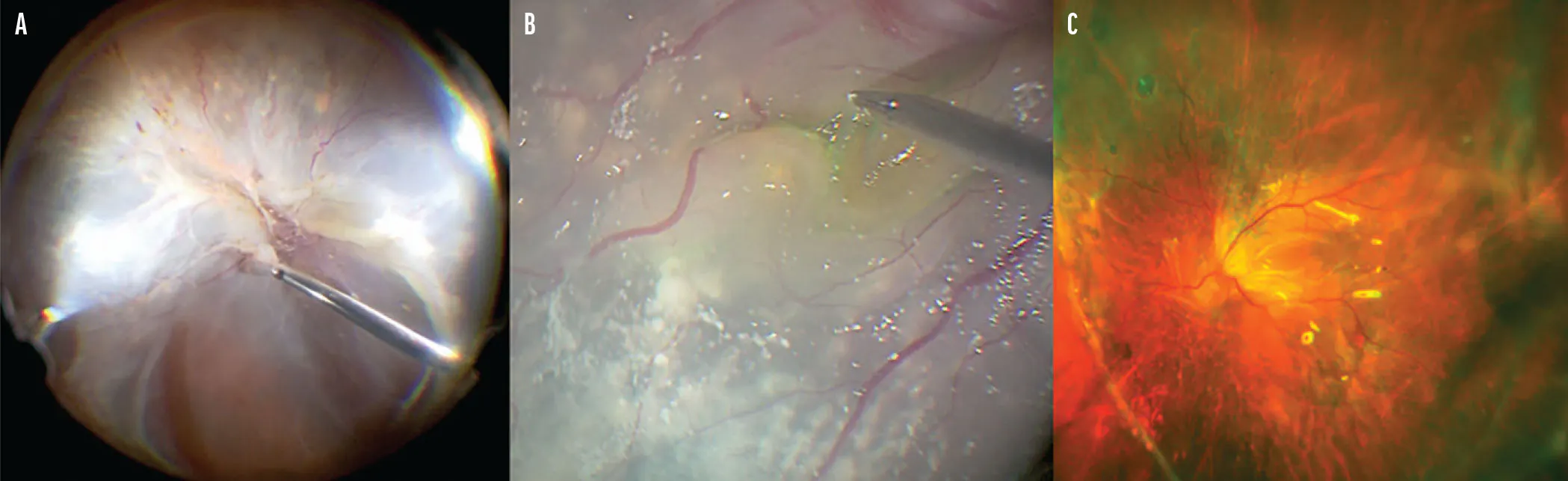
Figure 1. Intraoperative fundus imaging showed a total rhegmatogenous RD with grade C PVR (A). After inferior retinectomy and extended ILM peeling under PFO (B), the retina was successfully reattached postoperatively (C).
Case Report
A 52-year-old man presented with a 3-year history of progressive vision loss and a recent mature cataract in his left eye. His VA was hand motion OS, and his IOP was 5 mm Hg OS. B-scan ultrasonography revealed a total RD in the left eye, and the patient underwent phacovitrectomy. After cataract extraction, intraoperative findings confirmed a chronic total RD and grade C PVR (Figure 1A).
During vitrectomy, dense preretinal membranes were removed from the posterior pole to the periphery. Subretinal bands were removed bimanually through an inferior retinectomy. The retina was flattened under PFO, followed by extended ILM peeling from within the vascular arcade and beyond the arcade toward the retinectomy site to relieve residual traction (Figure 1B). Endolaser photocoagulation was applied to the inferior retinectomy margin, followed by silicone oil tamponade.
After surgery, the patient’s retina remained reattached; his VA improved to 20/400 OS and IOP was 20 mm Hg OS (Figure 1C).
Results of Our Multicenter Study
We conducted a multicenter study including six institutions in the United States and Japan (Wills Eye Hospital, Mayo Clinic, Osaka University, Aichi Medical University, Oshima Eye Clinic, and Hyogo Medical University) to evaluate the potential efficacy of ILM peeling on anatomic and visual outcomes in grade C PVR.3 The primary outcome was single-surgery anatomic success at 3 and 6 months. The study included 370 eyes from 370 patients: 157 eyes (42%) with ILM peeling and 213 (58%) eyes without ILM peeling. The mean follow-up was 23 months, and baseline characteristics were similar between groups. Among ILM-peeled eyes, 20% underwent macular peeling, 46% arcade-to-arcade peeling, and 24% extended peeling beyond the arcades.
The single-surgery anatomic success was significantly higher in the ILM peeling group (86.6% vs 73.2% at 3 months and 75.2% vs 64.8% at 6 months). The retinal reattachment rate under fluid without any tamponade was significantly higher in the ILM peeling group at 6 months (68.8% vs 51.6%). Both groups showed significant visual improvement after surgery; however, the ILM peeling group showed significantly better visual acuity and visual improvement (1.11 ± 0.70 LogMAR vs 1.29 ± 0.80 LogMAR and 0.48 ± 0.77 LogMAR vs 0.24 ± 0.90 LogMAR, respectively). The ILM peeling group had significantly fewer reoperations, including epiretinal membrane surgeries (8.9% vs 17.8%).3
In eyes without ILM peeling, 38% developed recurrent RD during follow-up, caused by posterior, mid-peripheral, or peripheral breaks, including macular holes and stretch breaks near the retinectomy margin. In contrast, 28% of eyes with ILM peeling experienced redetachment; however, none showed new breaks within the posterior pole. No ILM peeling was significantly associated with new posterior retinal breaks, suggesting ILM peeling significantly reduced the traction responsible for posterior retinal breaks. Multivariable regression analysis showed that extended ILM peeling was significantly associated with a higher likelihood of retinal reattachment at 6 months and better final visual acuity.3
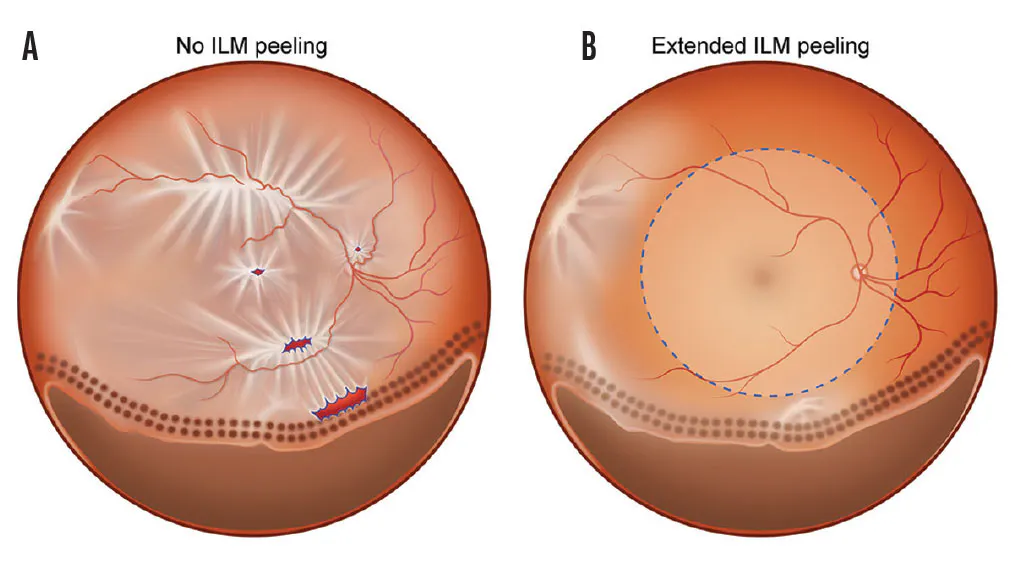
Figure 2. This schematic representation compares no ILM peeling (A) with extended ILM peeling (B). Extended ILM peeling prevents postoperative posterior contraction through broad traction removal.
DISCUSSION
ILM peeling enables complete removal of the overlying preretinal membranes responsible for retinal contraction and prevents reproliferation by eliminating the scaffold for membrane proliferation (Figure 2). These effects promote retinal relaxation, resulting in higher single-surgery success rates, greater reattachment rates under fluid, and fewer reoperations in eyes with grade C PVR. In addition, extended ILM peeling resulted in even superior outcomes—as such, the more ILM that can be peeled, the more likely we were to achieve long-term stable retinal reattachment. Theoretically, broader ILM peeling extending beyond the arcade up to the midperiphery would provide a greater reduction in the tractional forces at both the posterior pole and the midperiphery. However, both the retina and the ILM become thinner beyond the arcade, making an extension of ILM peeling to the far periphery nearly impossible. Therefore, ILM peeling alone is unlikely to eliminate the traction exerted on the peripheral retina.
In our study, although eyes with ILM peeling did not develop recurrent breaks within the arcade, new breaks did occur, predominantly in the periphery. Thus, additional procedures such as retinectomy or placement of an encircling scleral buckle may be required to address peripheral traction and support the anterior retina. However, stretch breaks may occasionally occur at the posterior edge of the retinectomy site or even on scleral buckles, if the membrane contraction is significant. Thus, ILM peeling extended to the retinectomy site may help prevent stretch breaks originating at the retinectomy sites and subsequent redetachment. The lower rate of redetachment with ILM peeling may also contribute to better visual outcomes.
One potential disadvantage of ILM peeling is the risk of iatrogenic retinal breaks due to the grasps for the ILM. However, the beneficial effect of ILM peeling in preventing redetachment likely outweighs such disadvantages, particularly in eyes with grade C PVR, which are at high risk of redetachment. Although ILM peeling can be technically challenging on a detached retina, PFO can be inserted and the ILM peeled under PFO, which provides countertraction. Extended ILM peeling can also be challenging in highly myopic eyes due to retinal thinning; in these cases, arcade-to-arcade peeling may be sufficient to reduce the risk of iatrogenic retinal breaks.
Another potential concern regarding ILM peeling is the theoretical retinal toxicity of the vital dyes. However, in our study, eyes that underwent ILM peeling achieved superior visual outcomes, suggesting any potential adverse effects of dyes are minimal compared with the benefits of traction removal and reduced recurrence.
OPTIMIZE SURGICAL OUTCOMES
We propose ILM peeling as a valuable addition to the surgical strategy for patients with PVR. Increasing the extent of ILM peeling enables a broader removal of traction and suppression of reproliferation, resulting in improved anatomic and visual outcomes. The combination of established procedures, such as an encircling buckle and relaxing retinectomy, and extended ILM peeling may further optimize surgical outcomes for this highly challenging condition.
1. Pastor JC, Rojas J, Pastor-Idoate S, et al. Proliferative vitreoretinopathy: A new concept of disease pathogenesis and practical consequences. Prog Retin Eye Res. 2016;51:125-155.
2. Idrees S, Sridhar J, Kuriyan AE. Proliferative vitreoretinopathy: a review. Int Ophthalmol Clin. 2019;59:221-240.
3. Wakabayashi T, Samuelson AG, Oshima Y, et al. Internal limiting membrane peeling for grade C proliferative vitreoretinopathy: an international multicenter study. Ophthalmol Retina. 2025;S2468-6530(25)00277-5.
4. Francone A, Charles M. Extensive internal limiting membrane peeling for proliferative vitreoretinopathy. Int Ophthalmol. 2023;43:147-153.


_1784132761.jpg?auto=compress,format&w=75)





