


KEY TAKEAWAYS
- The presence of epiretinal proliferation is an important biomarker for determining surgical strategy when treating lamellar macular holes and full-thickness macular holes.
- Researchers can capture en face OCT imaging with customized segmentation settings to clearly visualize a subclinical proliferative change barely seen on traditional en face OCT with the superficial slab or cross-sectional image, termed preretinal abnormal tissue.
- The author proposes incorporating en face OCT imaging to improve the classification of fullthickness macular holes and identify preretinal abnormal tissue preoperatively.
- The author also recommends membrane peeling when preretinal abnormal tissue is detected on en face OCT.
Epiretinal proliferation (EP), first described by Witkin et al in 2006, is a medium-reflective material that fills the space between the inner border of the epiretinal membrane (ERM) and the retinal nerve fiber layer on spectral-domain OCT (Figure 1A).1 EP is frequently observed in eyes with lamellar macular hole (LMH) and full-thickness macular hole (FTMH).2 When EP is identified with preoperative OCT, surgeons often encounter sticky yellowish tissues around the MH during surgery (Figure 1B).
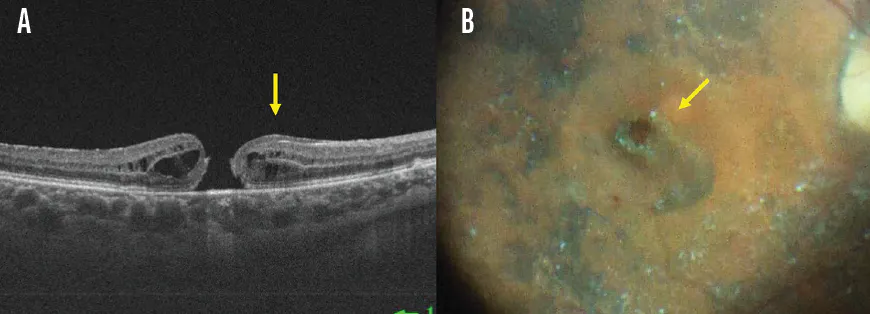
Figure 1. This preoperative cross-sectional OCT image demonstrates EP as a medium reflective material (arrow) located between the inner border of the ERM and the retinal nerve fiber layer (A). Intraoperatively, EP is seen as a sticky yellowish tissue contiguous to the MH during membrane peeling (B, arrow).
Here, I discuss the value of EP detection with en face OCT and propose its inclusion in preoperative imaging for MHs.
WHY EPIRETINAL PROLIFERATION MATTERS
The presence of EP is an important biomarker for determining surgical strategy. For eyes with LMH, an EP embedding technique improves vision and reduces the risk of postoperative FTMH compared with conventional internal limiting membrane (ILM) peeling alone.3 In eyes with FTMH and EP, ILM peeling is recommended because of the improvement in the primary closure rate.4 Additionally, our recent paper demonstrated that EP sparing in eyes with FTMH is beneficial in terms of visual and anatomic outcomes.5
In our daily clinic, clinicians perform cross-sectional OCT to diagnose and classify FTMH. Thus, preoperative cross-sectional OCT is the standard technique for detecting EP. However, in some cases, preoperative cross-sectional OCT images do not reveal EP, but yellowish tissues around the MH can be identified during the surgery (Figure 2). To address this limitation, we need more precise examination techniques to identify EP. Recently, Grondin et al demonstrated that high-resolution en face OCT can visualize a subclinical proliferative change on the retinal surface that later developed into contractile ERM.6 We then used this technique in eyes with FTMH to identify EP.
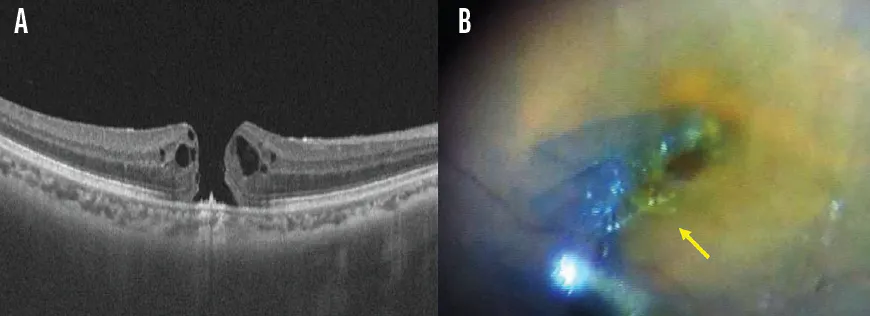
Figure 2. This patient's preoperative cross-sectional OCT image did not indicate the presence of EP (A), although the surgeon encountered the characteristic yellowish tissue consistent with EP during ILM peeling around the MH, as shown in the intraoperative image (B, arrow).
DETECTING PROLIFERATIVE CHANGE
En face OCT is generated by reconstructing hundreds of cross-sectional OCT images from volumetric OCT data. Clinicians often obtain an OCT angiography (OCTA) scan for generating en face OCT because the OCTA scan protocol provides high-density 3D data, enabling high-resolution en face OCT images. En face OCT is created by projecting OCT signals between predefined segmentation boundaries onto one plane. In Figure 3, the original superficial slab of OCT image is defined as a depth range between ILM to inner plexiform layer (IPL) of -9 µm (ie, 9 µm above the IPL). The superficial slab does not illustrate any abnormalities (Figure 3A). Most OCT devices allow customizable segmentation settings to illustrate layer-specific retinal pathology. When we set a custom slab defined as ILM +3 µm to + 9 µm, en face OCT clearly visualizes a subclinical proliferative change barely seen on en face OCT with the superficial slab or cross-sectional OCT image (Figure 3B, arrow). With this technique, we found that one quarter of eyes with FTMH have subtle proliferative change around the hole, termed preretinal abnormal tissue (PAT).7
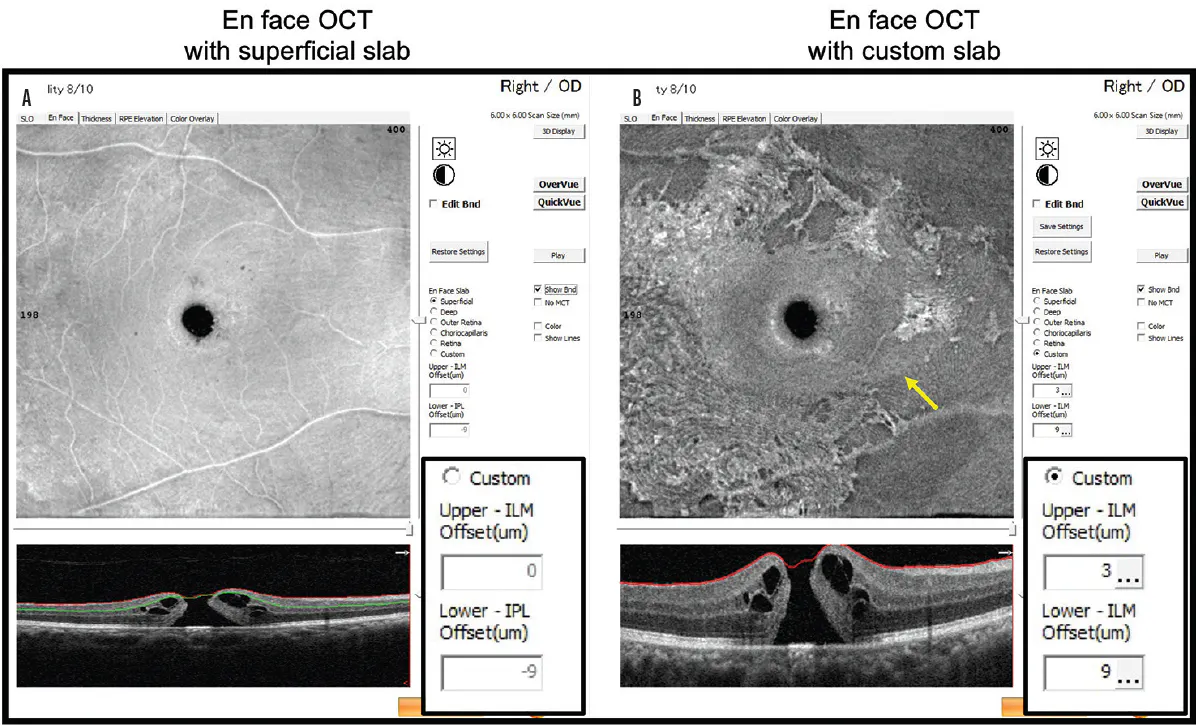
Figure 3. This en face OCT image (XR Avanti, Optovue), generated using the original superficial slab (ILM to IPL, −9 μm), show no apparent abnormality (A). However, the en face OCT image obtained using a custom slab (ILM, +3 μm to +9 μm) clearly shows subtle PAT surrounding the MH (B).
Because brilliant blue G (BBG) selectively stains ILM, the macular area is completely stained if there is no ERM or PAT (Figure 4A). However, surgeons often observe nonstaining areas (Figure 4B), and the nonstaining pattern is similar to the distribution of PAT on en face OCT, as illustrated by the corresponding fundus appearance and en face OCT findings in representative cases. Steel et al demonstrated that there are a variety of nonstaining patterns around the hole using BBG, and eyes with incomplete BBG staining pattern had more multicellular layers and new collagen on the ILM.8 This suggests that BBG staining pattern may help to detect subclinical proliferative change in eyes with FTMH.
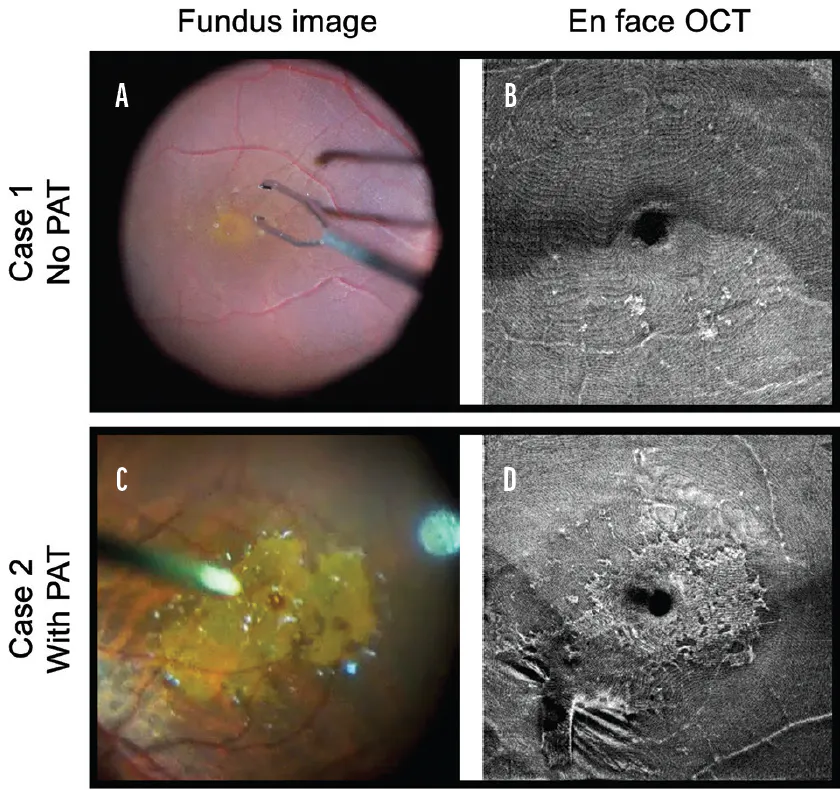
Figure 4. This intraoperative fundus image shows uniform staining around the MH (A). The corresponding en face OCT image obtained with a custom slab (ILM +3 μm to +9 μm) demonstrates the absence of PAT surrounding the hole (B). The intraoperative fundus image of another eye demonstrates an area of nonstaining around the MH (PAT; C). The corresponding en face OCT image reveals PAT distributed around the MH (D).
IDENTIFYING EP WITH EN FACE OCT
My team conducted a retrospective study to assess the detection of EP using BBG staining patterns and en face OCT.9 We defined the presence of EP as yellowish tissues contiguous to the hole observed during membrane peeling. In a total of 110 eyes, preoperative cross-sectional OCT revealed EP in 26 eyes (24%); however, we identified EP intraoperatively, termed surgical EP, in 30 eyes (27%), indicating that preoperative cross-sectional OCT overlooked surgical EP in approximately 10% of eyes.9
In four cases with this discrepancy, we observed peri-MH nonstaining patterns (Figure 4C and D). Using surgical EP as the ground truth, the presence of peri-MH nonstaining showed a sensitivity of 100% and a specificity of 89% for detecting EP. This suggests that if no nonstaining areas are observed after BBG application, the presence of EP is unlikely. When we analyzed eyes with peri-MH nonstaining, those with surgical EP showed a significantly larger average nonstaining area than eyes without surgical EP (2.8 ± 1 disc diameters [DD] vs 1.4 ± 0.9 DD, P < .001).
In 55 eyes with available preoperative en face OCT, 37 eyes had no PAT around the hole, whereas 18 eyes showed PAT. Using surgical EP as the ground truth, the sensitivity of PAT on en face OCT for detecting surgical EP was 100%, with a specificity of 84%. The area of peri-MH PAT was significantly larger in eyes with surgical EP than in eyes without surgical EP (18.8 ± 11.2 mm2 vs 3.4 ± 2.5 mm2, P = .0029). These results suggest that eyes without PAT are less likely to have EP around the hole.
NEXT STEPS IN RESEARCH AND THE OR
Based on our findings, we propose that incorporating en face OCT may improve the classification of FTMH. Because the presence of PAT likely reflects EP or subclinical membrane formation, membrane and ILM peeling would be recommended when PAT is detected on en face OCT.
An important remaining question is whether ILM peeling is truly necessary in eyes with FTMH without PAT. Although ILM peeling improves the primary MH closure rate by approximately 20%, a recent meta-analysis showed that when closure is successfully achieved, eyes without ILM peeling have better visual outcomes than those with ILM peeling.10 We hypothesize that in the absence of PAT, MHs may close successfully without ILM peeling.
We reported preliminary data at the 2025 ASRS meeting showing that in eyes without PAT and with non-large MHs (< 500 µm), the non-ILM peeling group achieved closure rates comparable with those of the ILM peeling group.11 These findings support the potential value of a new en face OCT-based classification, which warrants further prospective validation.
1. Witkin AJ, Ko TH, Fujimoto JG, et al. Redefining lamellar holes and the vitreomacular interface: an ultrahigh-resolution optical coherence tomography study. Ophthalmology. 2006;113:388-397.
2. Itoh Y, Levison AL, Kaiser PK, et al. Prevalence and characteristics of hyporeflective preretinal tissue in vitreomacular interface disorders. Brit J Ophthalmol. 2016;100:399.
3. Shiraga F, Takasu I, Fukuda K, et al. Modified vitreous surgery for symptomatic lamellar macular hole with epiretinal membrane containing macular pigment. Retina. 2013;33:1263-1269.
4. Kim EL, Weiner AJ, Ung C, et al. Characterization of epiretinal proliferation in full-thickness macular holes and effects on surgical outcomes. Ophthalmol Retina. 2019;3:694-702.
5. Fukushima M, Tsuboi K, Akai R, et al. Sparing versus removal of epiretinal proliferation in the surgical repair of full-thickness macular holes. Retina. 2024;44:2066-2075.
6. Grondin C, Au A, Wang D, et al. Identification and characterization of epivascular glia using en face optical coherence tomography. Am J Ophthalmol. 2021;229:108-119.
7. Ishida Y, Tsuboi K, Wakabayashi T, et al. En face OCT detects preretinal abnormal tissues before and after internal limiting membrane peeling in eyes with macular hole. Ophthalmol Retina. 2023;7(2):153-163.
8. Steel DHW, Dinah C, Madi HA, et al. The staining pattern of brilliant blue g during macular hole surgery: a clinicopathologic study. Invest Opthalmol Vis Sci. 2014;55:5924.
9. Fukushima M, Hayashi A, Kusaka S, et al. A discrepancy in epiretinal proliferation detection between preoperative OCT and intraoperative observation in macular hole [online ahead of print January 10, 2026]. Graefes Arch Clin Exp Ophthalmol.
10. Mihalache A, Huang RS, Patil NS, et al. Pars plana vitrectomy with or without internal limiting membrane peel for macular hole. Retina. 2024;44:381-391.
11. Tsuboi K, Ishida Y, Fukushima M, Akai R, Kamei M. The role of preoperative en face OCT to identify non-internal limiting membrane peeling candidates for macular hole surgery. Presented at ASRS; July 31, 2025; Long Beach, California.


_1784132761.jpg?auto=compress,format&w=75)




