


KEY TAKEAWAYS
- Vigabatrin, a drug used as an adjuvant therapy for refractory focal onset epilepsy and for the treatment of infantile spasms, can lead to retinal toxicity in some cases.
- Onset of retinal toxicity has been reported between 6 months to 5 years after initiating treatment, with a 5.3% risk of developing toxicity at 6 months in pediatric patients.
- Multifocal electroretinogram can be helpful in confirming a diagnosis of vigabatrin-related retinal toxicity.
Vigabatrin, an adjuvant therapy for refractory focal onset epilepsy and the treatment of infantile spasms, is a structural analog of gamma-aminobutyric acid (GABA) that irreversibly inhibits GABA transaminase.1,2 It has a high response rate and overall good tolerability.2
In 1997, researchers reported a series of cases of bilateral concentric visual field constriction related to vigabatrin,3 with a frequency of 52% in adults and 34% in children.1 Although approximately 90% of cases are asymptomatic, severity can range from mild to severe, including potential compromise of central vision and reduced quality of life.2
Herein, we report a case of severe, fast-onset vigabatrin retinal toxicity in a pediatric patient.4
CASE REPORT
A 13-year-old Hispanic girl with a long-standing history of refractory epilepsy since her second year of life presented with difficulties going down a staircase due to bilateral inferior scotomas. The patient had been prescribed vigabatrin 3 months earlier, and symptoms began within 3 weeks of use.
She had no prior visual complaints and a past medical history of prior ictal frequency of two seizures per week and approximately one status epilepticus per month. She was being treated with levetiracetam, lamotrigine, and lacosamide, but her seizures persisted, so she was started on vigabatrin initially at a dose of 500 mg twice daily and later 1,000 mg twice daily. The patient also reported obstructive sleep apnea with use of a continuous positive airway pressure machine at night.
The ophthalmic examination showed a VA of 20/20 OU, normal Ishihara plates in each eye, and 0.6 log units of an afferent pupillary defect in her left eye. Motility and anterior segment examinations where normal in each eye. On dilated fundus examination, each optic nerve appeared normal, and a mottled pattern was noted in the midperipheral retina in each eye (Figure 1). Visual field testing demonstrated a concentric loss of sensitivity in the grayscale with a concentric scotoma present in the mean and pattern deviation of each eye (Figure 2).
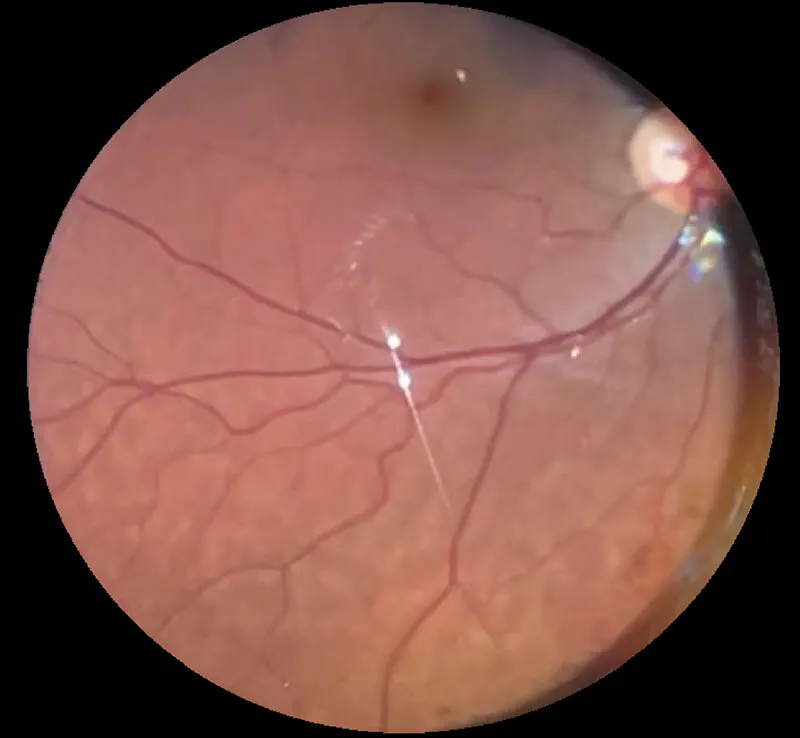
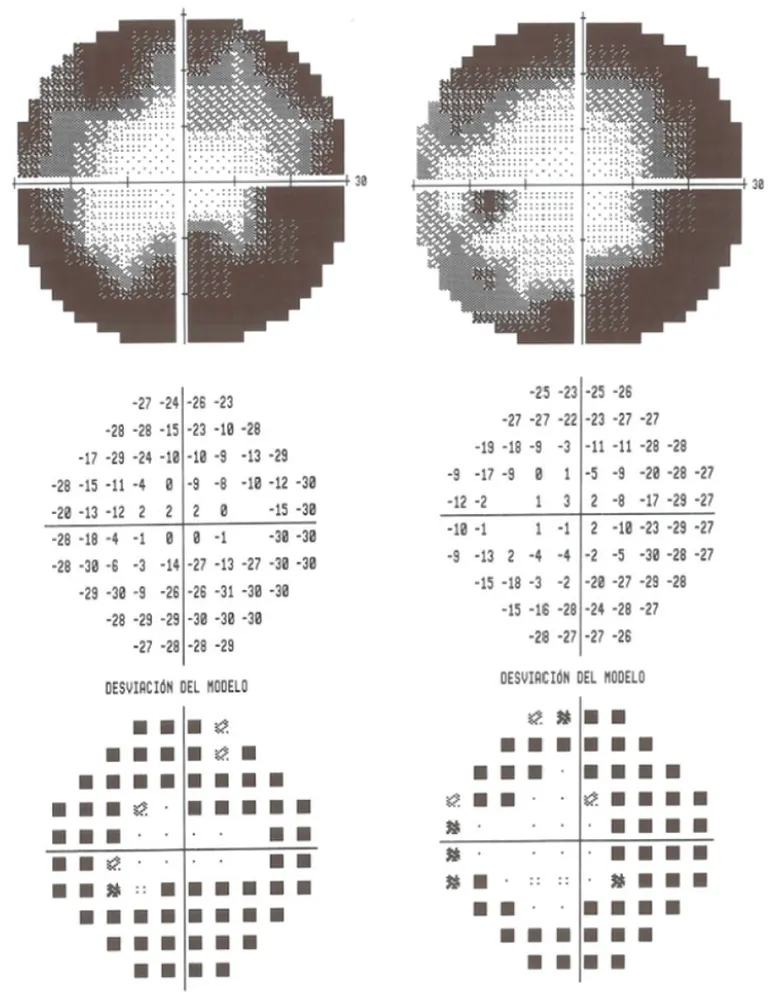
Figure 2. A 30-2 stimulus III SITA standard Humphrey visual field demonstrated a concentric loss of sensitivity in the grayscale with a concentric scotoma present in the mean and pattern deviation of each eye.
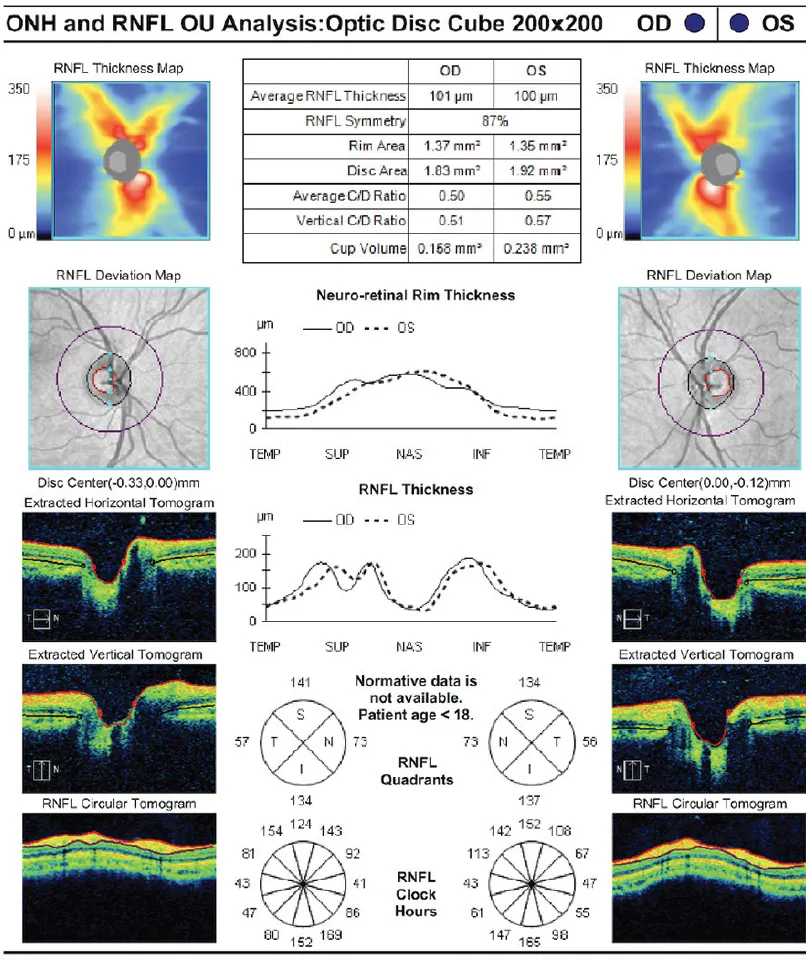
Optic nerve OCT demonstrated normal peripapillary retinal nerve fiber layer (pRNFL) and a mild thinning of the ganglion cell layer-inner plexiform layer (GCL-IPL) complex in each eye (Figure 3). Multifocal electroretinogram (mfERG) was decreased in P1 and N2 waves in the third, fourth, and fifth rings in each eye without electrical changes of the fovea. These results were deemed compatible with cone toxicity.
Vigabatrin was immediately discontinued, and clobazam was prescribed. The patient also underwent a left frontal lobotomy. At the 3-month follow-up visit, her visual acuity remained stable, and no further visual field changes were noted.
VAVFL EXPLAINED
Vigabatrin-associated visual field loss (VAVFL) was first recognized approximately 9 years after the drug’s approval.2 Its toxic mechanism is not completely understood, but data suggest a multifactorial mechanism in which the selective deposition of vigabatrin in the retinal tissue reaches concentrations between five and 18 times of those in the brain.5 This leads to an increase in GABA concentrations up to five times its normal value in the retina, which triggers an intense activation of GABA receptors, inducing excitotoxicity through an osmotic imbalance due to the entry of chlorine, sodium, and water inside the cell.5 Decreased ocular blood flow and an increased production of reactive oxygen species also appears to be associated with VAVFL.5 Other potential factors include the accumulation of ornithine due to a nonselective inhibition of ornithine transferase by vigabatrin and the depletion of taurine, which acts as an antioxidant in retinal tissue.5
The prevalence of vigabatrin retinal toxicity has been reported between 14% and 92%.6,7 A systematic review by Maguire et al found a mean proportion of VAVFL of 52% in adults and 34% in children compared with 7% in non-vigabatrin exposed patients.1 Risk factors for the development of retinal toxicity include mean age, cumulative dose, and duration of treatment.1
Average onset of retinal toxicity has been reported between 6 months to 5 years after initiating treatment, with a 5.3% risk of developing toxicity at 6 months in pediatric patients.1-3,8 To our knowledge, our report describes the earliest case of retinal toxicity only 3 weeks after starting vigabatrin.
Clinically, VAVFL manifests in perimetry as a bilateral concentric constriction of the visual field.1,2 The deficit is variable in severity and has a facultative nasal preponderance that is deemed specific but not always present.2 Many patients fail to perceive the scotomas, compensating with head movements until central vision is compromised; this “asymptomatic” presentation corresponds to 73% to 88% of those affected.1,2,6 About 2% of patients experience severe compromise involving the central 30° of vision.2,6
The diagnosis of retinal toxicity depends on the identification of a bilateral, concentric constriction of the peripheral visual field.2 Fundoscopic findings tend to be nonspecific, but some authors have described optic nerve head pallor, arterial narrowing, surface wrinkling retinopathy, irregular sheen at the macula, and abnormal pigmentation at the macula or peripheral retina.2 Our patient had a midperipheral mottled pattern compatible with previously described findings.
OCT of the optic nerves may show a generalized attenuation of the pRNFL thickness with variable involvement of the upper, nasal, and lower quadrants; the temporal quadrant is usually respected.7,9 OCT may be an alternative clinical tool for patients who cannot undergo perimetry; some authors have calculated a sensitivity between 66% and 100% for OCT findings.7,9 Another pending challenge is establishing a set of standardized pRNFL values for pediatric populations.
Retinal toxicity can be further confirmed by mfERG.10 The focal peripheral points demonstrate a decrease in amplitude, which is directly related to scotomas in the perimetry.10 Moreover, in one study, up to 24% of pediatric control patients may have visual field disturbances even if they were not exposed to vigabatrin, while only those patients exposed to vigabatrin (n = 204) showed mfERG changes.10
MONITOR THESE PATIENTS CLOSELY
Currently, there is no effective treatment for VAVFL, and the nature of its damage appears to be irreversible and nonprogressive once vigabatrin is suspended.2 Some associations yet to be confirmed include the role of interactions with partial GABA agonists, such as valproic acid, in the development of severe presentations. Vigabatrin retinal toxicity should be monitored in all patients using this drug, considering the idiosyncratic nature of the presentation and the potentially serious visual outcomes.
1. Maguire MJ, Hemming K, Wild JM, Hutton JL, Marson AG. Prevalence of visual field loss following exposure to vigabatrin therapy: A systematic review. Epilepsia. 2010;51(12):2423-2431.
2. Wheless JW, Ramsay RE, Collins SD. Vigabatrin. Neurotherapeutics. 2007;4(1):163-172.
3. Eke T, Talbot JF, Lawden MC. Severe persistent visual field constriction associated with vigabatrin. BMJ. 1997;314(7075):180-181.
4. Gagnier JJ, Kienle G, Altman DG, Moher D, Sox H, Riley D; CARE Group. The CARE guidelines: consensus-based clinical case reporting guideline development. J Med Case Rep. 2013;7:223.
5. Heim MK, Gidal BE. Vigabatrin-associated retinal damage - potential biochemical mechanisms. Acta Neurologica Scandinavica. 2012;126(4):219-228.
6. Sergott RC, Bittman RM, Christen EM, Sagar SM. Vigabatrin-induced peripheral visual field defects in patients with refractory partial epilepsy. Epilepsy Research. 2010;92(2-3):170-176.
7. Wild JM, Robson CR, Jones AL, Cunliffe IA, Smith PEM. Detecting vigabatrin toxicity by imaging of the retinal nerve fiber layer. Invest Ophthalmol Vis Sci. 2006;47(3):917-924.
8. Westall CA, Wright T, Cortese F, et al. Vigabatrin retinal toxicity in children with infantile spasms: An observational cohort study. Neurology. 2014;83(24):2262-2268.
9. Kjellström U, Andréasson S, Ponjavic V. Attenuation of the retinal nerve fibre layer and reduced retinal function assessed by optical coherence tomography and full-field electroretinography in patients exposed to vigabatrin medication. Acta Ophthalmologica. 2014;92(2):149-157.
10. Dettoraki M, Moschos MM. The role of multifocal electroretinography in the assessment of drug-induced retinopathy: a review of the literature. Ophthalmic Res. 2016;56(4):169-177.


_1784132761.jpg?auto=compress,format&w=75)





