



Widefield OCT (WF-OCT) and wide-coverage OCT extend our structural and vascular assessment well beyond the central 30° to 50° field of conventional OCT, addressing a critical need when diagnosing and monitoring diseases where peripheral pathology drives clinical decision making.
Enabled by swept-source architectures (~1,050 nm), high A-scan rates, optimized beam optics, eye tracking, motion correction, and montaging algorithms, these systems deliver expanded scan areas with deep penetration and high signal-to-noise ratios. WF-OCT angiography (OCTA) further permits noninvasive visualization of peripheral nonperfusion and microvascular remodeling.
Clinically, WF-OCT supports detection and monitoring of diabetic retinopathy, retinal vein occlusions, uveitis, peripheral vitreoretinal interface disorders, and peripheral degeneration by directly visualizing retinal thickness profiles, tractional changes, breaks, and neovascular complexes across a broader anatomical region.
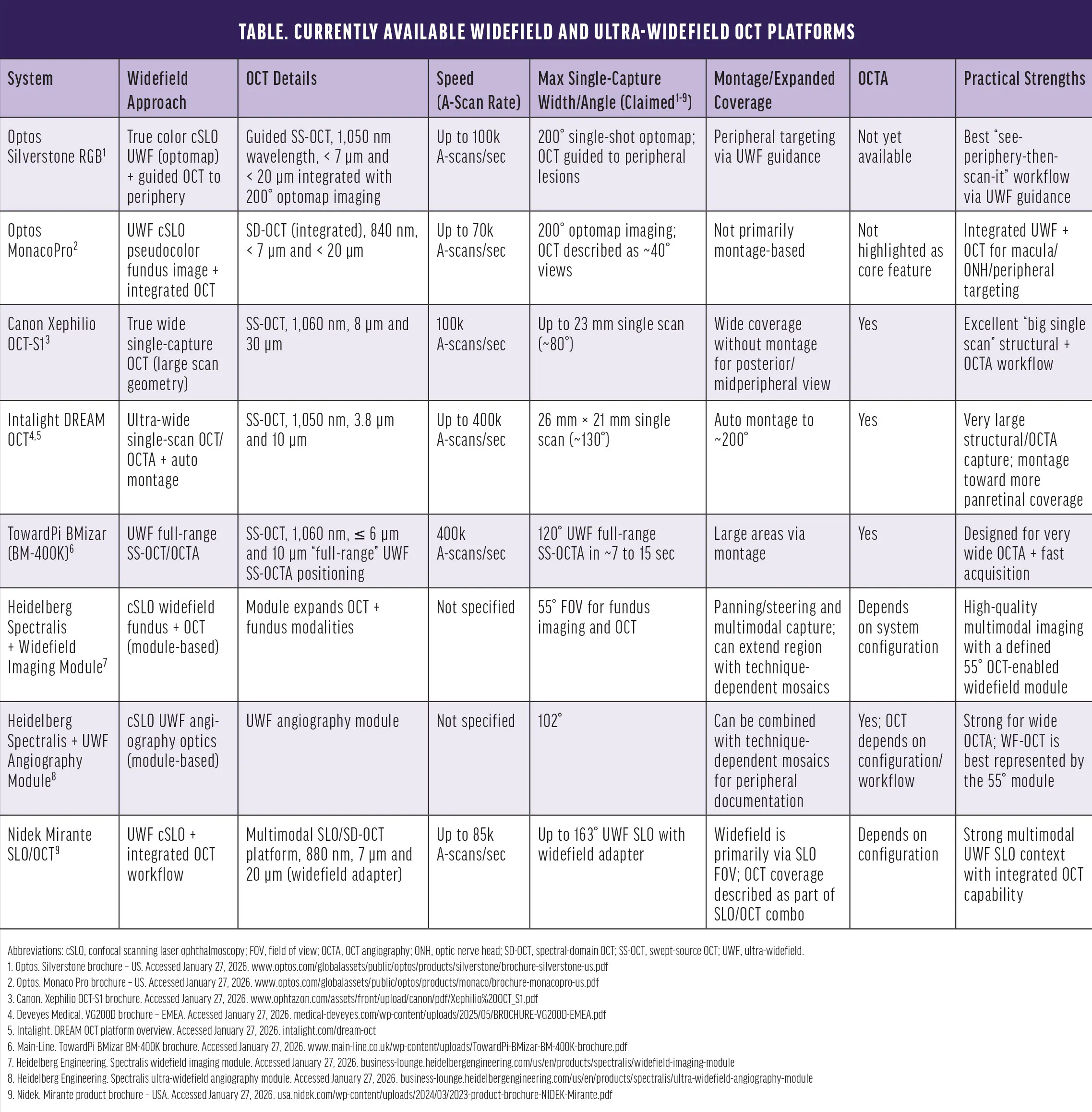
Current WF-OCT systems include the following (Table):
Optos Silverstone RGB. This tool combines approximately 200° ultra-widefield scanning laser ophthalmoscopy with guided swept-source OCT for targeted peripheral B-scans.
Canon Xephilio OCT-S1. This device offers wide single-capture swept-source scans up to approximately 23 mm with high speed and AI-assisted OCTA.
Intalight DREAM OCT. This device was granted a CE mark in Europe with FDA approval pending. Along with the emerging TowardPi platforms, it provides very high-speed swept-source and broad scan fields.
Additional wide-coverage approaches include the Optos MonacoPro with integrated spectral-domain OCT and ultra-WF imaging, the Heidelberg Spectralis + WF imaging module and ultra-WF OCTA module, and multimodal platforms such as the Nidek Mirante scanning laser ophthalmoscope/OCT that combines ultra-WF fundus capture with wide area OCT/OCTA.
IMAGING WHERE YOU NEED IT
These platforms enhance our ability to image the retina, allowing better diagnosis and monitoring of conditions with peripheral changes. As innovation in this area continues, we look forward to even faster devices with higher resolution, increased automation, and more detailed analytics.


_1784132761.jpg?auto=compress,format&w=75)





