

CPT Code: 67113 (Complex Retinal Detachment Repair)
Introduction
A 59-year-old man presented for a second opinion on a recurrent retinal detachment following an attempted repair with combined scleral-buckle and vitrectomy with gas that had been performed elsewhere 1 month prior. His initial exam showed hand motion vision with a chronic-appearing total retinal detachment along with an encircling scleral buckle. The surgical plan was a repeat vitrectomy with possible membrane peeling and silicone oil tamponade.
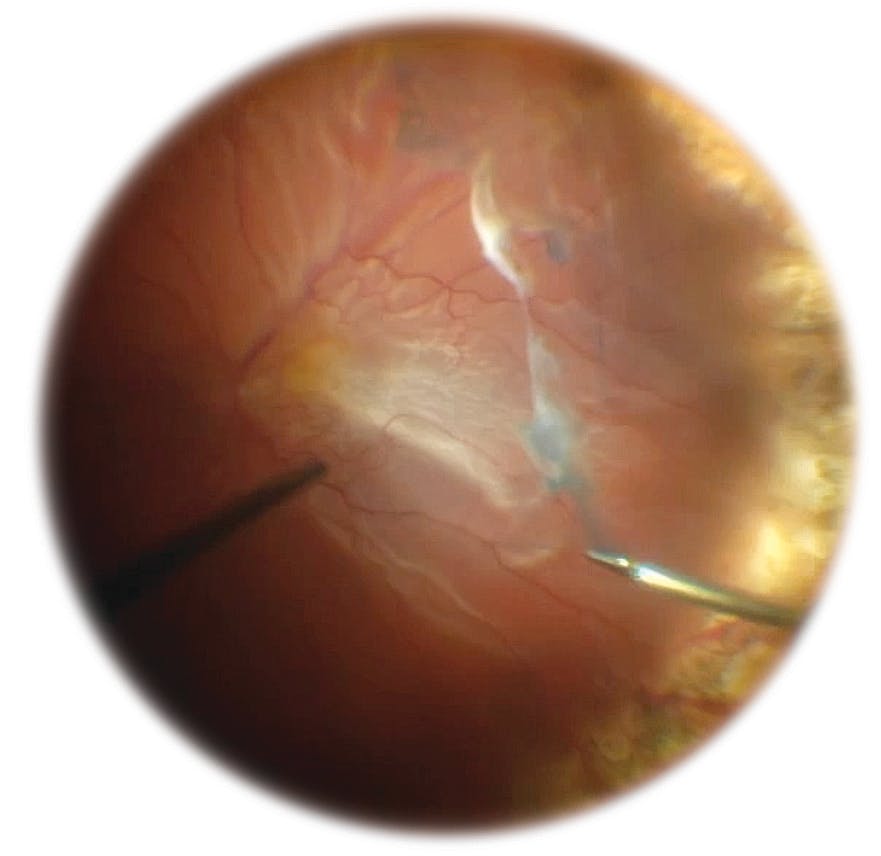
Intraoperatively, TissueBlue™ (Brilliant Blue G Ophthalmic Solution 0.025%; DORC a ZEISS company) revealed the presence of residual posterior vitreous cortex that was in the process of undergoing metaplasia to become early proliferative vitreoretinopathy membranes. It helped me identify and characterize tissue that another commonly used visualization agent was unable to do.
While peeling what initially appeared to be a stained epiretinal membrane off the macular surface, the epiretinal tissue appeared to extend well past the macula and optic nerve as a single fibrous sheet (Figure). It then became apparent that the stained tissue in question was residual posterior vitreous cortex that had not been removed during the previous surgery. Triamcinolone had been injected into the vitreous cavity earlier in the surgery to check for this, but it did not reveal any residual hyaloid.
An Alteration in the Surgical Plan
TissueBlue™ revealed the membrane in question was not localized to the macula and would need to be peeled off the surface of the entire retina up to the edge of the scleral buckle to mitigate the risk of subsequent severe proliferative vitreoretinopathy and recurrent detachment. Therefore, I switched my view from a high magnification contact lens to a widefield viewing system and continued peeling the tissue off the surface of the entire retina, which created significant relaxation of the retina and enabled me to successfully complete the surgery.
In this case, additional staining and peeling was indicated to confirm removal of the internal limiting membrane (ILM) off the macular surface. Indeed, after removing the posterior vitreous cortex, I re-stained the macular surface with TissueBlue™ and found a sheet of ILM, which I then removed.
Given that the source of the recurrent detachment was the presence of the posterior vitreous cortex, I was able to use a gas tamponade, which spared the patient of the need for silicone oil and an additional surgery for its removal.
The patient responded very well to the procedure and improved to 20/70 vision from hand motion. He is now 2 years out from surgery and the retina has remained attached.
Discussion
In cases of retinal detachments that are chronic, with concurrent epiretinal membranes or with proliferative vitreoretinopathy, my preference is to try to peel the ILM concurrently with retinal detachment repair. Consequently, I routinely inject staining agents into the vitreous cavity to aid in visualization of the ILM (chromo-vitrectomy).
TissueBlue™ is the only FDA-approved product for staining and visualization of the ILM, although it has been shown to be useful in visualizing epiretinal membranes as well. Brilliant blue has been demonstrated to have significantly less intrinsic toxicity to retinal tissue compared to other commonly used dyes such as indocyanine green. The potential for toxicity played an especially important role in this case of a retinal detachment, given that any substance injected into the eye with a retinal detachment has the potential to contact the photoreceptor and retinal pigment epithelium layers in the subretinal space. Given the known toxicity that indocyanine green has to the retinal pigment epithelium and photoreceptor layers, it was critical to use the safest known visualization agent possible to maximize the patient’s visual outcome.
