




The 50th Annual Atlantic Coast Retina Club (ACRC) and 26th Macula Conference, held January 8-10, 2026, in Philadelphia, was an engaging 3-day event with mystery cases, timely lectures, and the recognition of Joan W. Miller, MD; Julia A. Haller, MD; William E. Benson, MD; Lawrence A. Yannuzzi, MD; Sunil K. Srivastava, MD; and the late Jerry A. Shields, MD, for their contributions to the field (Figures 1 and 2).
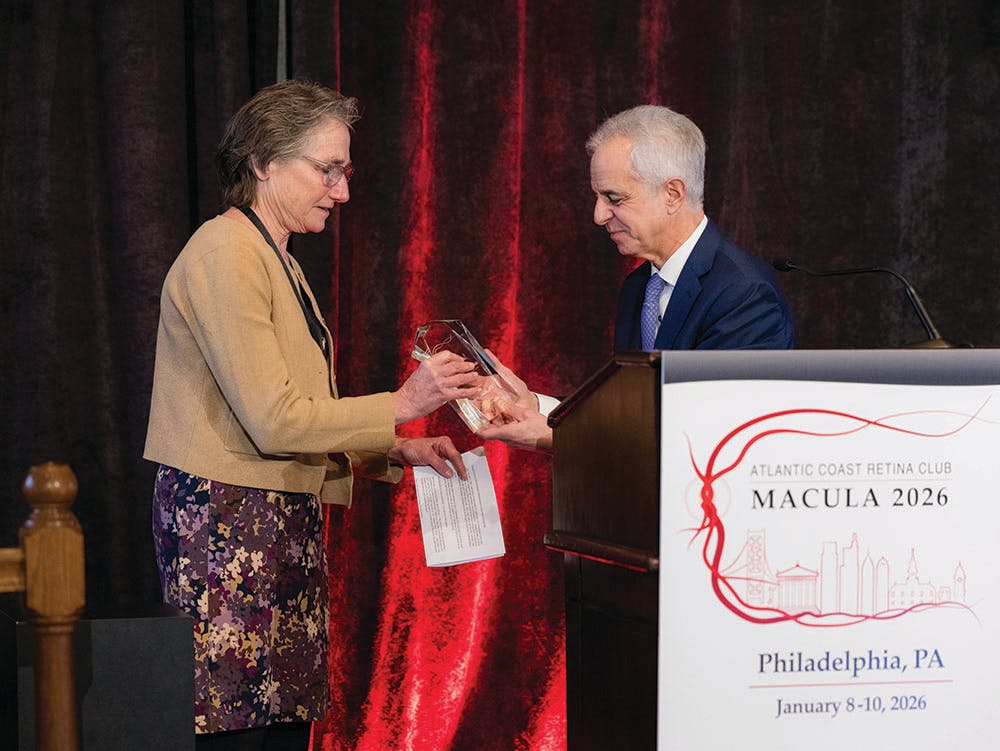
Figure 1. Dr. Carol Shields accepts an award from Dr. Regillo and ACRC on behalf of her late husband, Dr. Jerry Shields, for his contributions to the field of retina and ocular oncology. Image courtesy of Kevin Caldwell Photography.
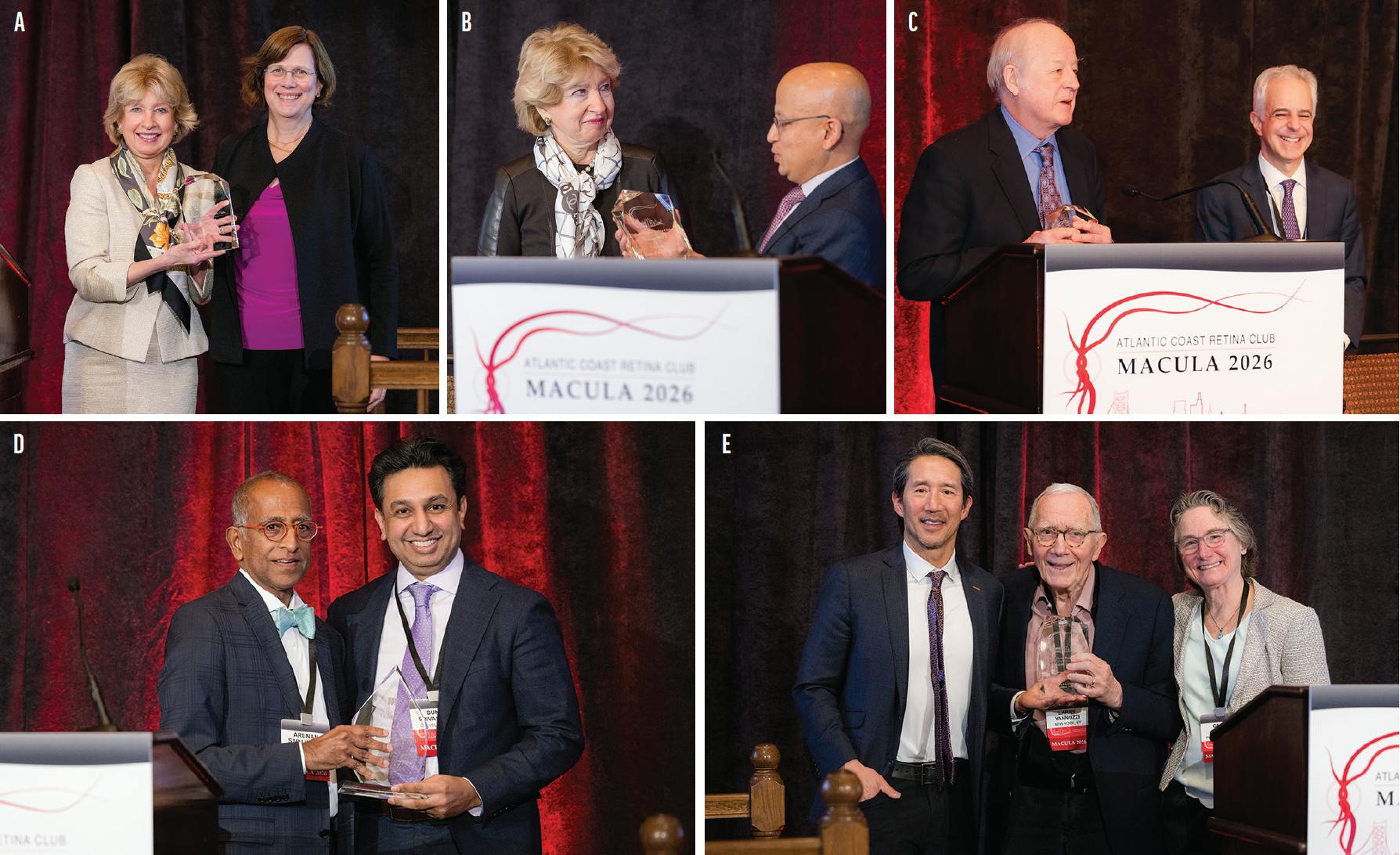
Figure 2. ACRC honored several renowned clinicians in retina, including Drs. Miller (A, presented by Dr. Haller), Haller (B, presented by Dr. Garg), Benson (C, presented by Dr. Regillo), Srivastava (D, presented by Arunan Sivalingam, MD), and Yannuzzi (E, presented by Drs. Ho and Shields). Images courtesy of Kevin Caldwell Photography.
TRAINEE CASE PRESENTATIONS
The first day highlighted myriad interesting cases and a few informative juxtapositions in management. Two cases, presented by Jimmy Chen, MD, and Rehan A. Choudhury, MD, detailed patients with diffuse choroidal hemangiomas associated with encephalofacial angiomatosis, or Sturge Weber syndrome. Each case featured a different therapeutic approach, oral propranolol and plaque brachytherapy. Both patients experienced a reduction in choroidal thickness and improvements in subretinal fluid and vision, although recurrent subretinal fluid was noted after 6 months in patients treated with oral propranolol.
Caroline Cotton, MD, and Saif Hamdan, MD, shared cases of toxoplasmosis retinochoroiditis. One case emphasized that patients with multifocal toxoplasmosis require systemic evaluation for immunosuppressive conditions, such as human immunodeficiency virus. The other highlighted implications for public health, describing a cluster of acquired toxoplasmosis in patients drinking shared well water.
Two cases of transplant-associated thrombotic microangiopathy were shared by Aditya Uppuluri, MD, and Robert J. Medina, BA. The first presented in a neonate who received umbilical cord blood transplantation with subsequent ischemic retinal vascular disease; the second was a patient with trilateral retinoblastoma who developed ischemic retinal vascular disease after a bone marrow transplantation.
On the second day, three presentations by Efrat Naaman, MD; Haroon Rasheed, MD; and Raziyeh Mahmoudzadeh, MD, focused on mitochondrial retinopathy. One case focused on maternally inherited diabetes and deafness with stroke-like episodes, and another on the MT-TL1 mutation with high heteroplasmy and subclinical findings in family members with lower heteroplasmy levels. The third case included a MT-RNR1 homoplasmic mutation presenting in a 3-year-old with optic nerve atrophy but no hearing loss. The cases reminded everyone of the importance of educating patients on family planning.
Naeem Sbaiti, BS, and Promie R. Faruque, MD, presented cases with mutations in the ABCA1 gene, highlighting the variability in these mutations and emphasizing the importance of peripapillary sparing as a clinical sign.
The resident and fellow presentations concluded with a remembrance of Dr. Jerry Shields by Dr. Benson, Carl D. Regillo, MD, and Carol L. Shields, MD. Dr. Jerry Shields was recognized with a standing ovation for his work as a co-founder of the ACRC and founder of the Wills Eye Oncology Service.
FACULTY CASE PRESENTATIONS
The second day also featured cases presented by leading experts in medical retina, vitreoretinal surgery, tumors and oncology, uveitis, and inherited retinal diseases. Notable takeaways include the following:
- Maria H. Berrocal, MD, presented a trauma case in which she left PFO in the eye to reattach the fovea and help the hyaloid detach.
- Samir N. Patel, MD, discussed the first reported case of methylene blue toxicity to the inner retina.
- Gaurav K. Shah, MD, shared cases in which he used fibrin glue (Tisseel, Baxter) and reviewed its various intraocular applications.
- Jasmine H. Francis, MD, FACS, presented two cases of reactive lymphoid hyperplasia with excellent responses after the patient stopped using a glucagon-like peptide-1 (GLP-1) receptor agonist.
- Jose S. Pulido, MD, MS, MPH, MBA, shared the value of eye protection for cases of Stargardt disease.
MACULA 2026
The final day kicked off with imaging advances in dry AMD and a review of upcoming therapies. Justis P. Ehlers, MD, highlighted changes in the ellipsoid zone as a OCT biomarkers, and Caroline Baumal, MD, introduced a new functional OCT technology. There was a lively debate about the utility of photobiomodulation between David S. Boyer, MD, (pro) and Susan B. Bressler, MD (con). Wrapping up the first session, James T. Handa, MD, discussed the importance of a low glycemic index diet in potentially slowing AMD formation and progression.
The second session switched gears to wet AMD with presentations on the Vestrum database by Matthew R. Starr, MD, and surgical management of submacular hemorrhage by J. Fernando Arevalo, MD, PhD. Michael A. Klufas, MD, presented first-time results from the Belvedere study, which showed the potential for the port delivery system (Susvimo, Genentech/Roche) to maintain treatment efficacy with lower treatment burden.
The next session covered a range of diabetic retinopathy topics. Real-world considerations regarding diabetic care were mentioned, including the importance of follow-up (emphasized by Neil M. Bressler, MD) and the need for future studies evaluating combined anti-VEGF and panretinal photocoagulation (shared by Adrienne W. Scott, MD). Rishi P. Singh, MD, provided an in-depth review of diverging data regarding the effect of GLP-1 receptor agonists within the eye. Finally, Katherine E. Talcott, MD, reviewed promising early data from trials of various tyrosine kinase adaptors.
Many talks included quick-hit surgical and medical pearls, including the following:
Surgical Pearls
- The importance of permitting small amounts of subretinal fluid in retinal detachment (by Yasha S. Modi, MD) and the pros and cons of draining subretinal fluid during scleral buckling (by Talia R. Kaden, MD).
- Surgical approaches to Stickler syndrome (by Audina M. Berrocal, MD), including the importance of buckling and anticipating non-homogeneously attached vitreous.
- The value of pediatric scleral buckling (by R. V. Paul Chan, MD, MSc, MBA), including the appropriate age to cut the scleral buckle in pediatric cases.
- Using PFO as a surgical adjunct to remove subretinal oil (by Phoebe L. Mellen, MD).
Medical Pearls
- Remember to evaluate the fellow eye when there is a high index of suspicion for common diagnoses that present atypically (by Jay S. Duker, MD).
- High-dose intravitreal topotecan (180 ug) can be efficacious for vitreous and subretinal seeds in recurrent retinoblastoma (by David H. Abramson, MD).
- Intraarterial chemotherapy can be used for a wide range of conditions, such as orbital histiocytosis, orbital and intraocular medulloepithelioma, and uveal histiocytoma (by Dr. Francis).
- Emerging reports suggest systemic therapy may reduce the rate of central nervous system disease in intraocular lymphoma, although a mortality benefit has not been observed (by Ivana Kim, MD, MBA).
- Results from the ADVISE trial suggest a benefit at 6 and 12 months with the use of adalimumab for the treatment of uveitis compared with conventional immunosuppression (by Douglas A. Jabs, MD, MBA).
- Results from the TEASE trial show that oral gildeuretinol (ALK-001, Alkeus) slows the progression of moderate Stargardt disease (by Philip J. Ferrone, MD).
MEMORABLE AWARD MOMENTS
In addition to Dr. Jerry Sheilds, several other clinicians were honored, including Dr. Miller (introduced by Dr. Haller) for 22 years of leadership as chair of Mass Eye and Ear and a remarkable unifying presence. Dr. Haller was honored by Sunir J. Garg, MD, FACS, FASRS, for a dynamic and ever-evolving career and the recent accomplishment of becoming chair and CEO of Wills Eye Hospital. Dr. Benson was recognized by Dr. Regillo for his consistent educational efforts.
Sunil K. Srivastava, MD, gave the 15th annual J. Arch McNamara Memorial Lecture on his experience with a collaborative team treating Susac syndrome. He showed that nonperfusion with telangiectasias are common in eyes with this rare condition. Dr. Srivastava encouraged vigilance with retinal artery occlusions and recommended a complete and thorough work-up to best guide treatment.
A special lecture by Dr. Yanuzzi provided insights into ocular worms, and he reviewed four rare presentations of the fourteen possible ones featured in an upcoming book. Allen C. Ho, MD, and Dr. Carol Shields then honored Dr. Yanuzzi with an award for his contributions to the field of retina.
See you next year in Boston from January 7-9, 2027, for the 51st ACRC and 27th Macula Conference!


_1773249222.png?auto=compress,format&w=70)


_1784132761.jpg?auto=compress,format&w=75)





