





Key Takeaways
- From 2015 to 2019, women filled 22.1% of faculty positions at retina meetings.
- As of 2025, women comprised 36.6% of meeting faculty, representing meaningful progress toward proportional representation.
- Meetings with at least one woman on the program committee are significantly more likely to include female non-paper presenters, moderators or panelists, and total women faculty.
- Patients from underserved backgrounds are more likely to seek care from providers that share a similar culture, and providers from underserved backgrounds are more likely to serve the communities they represent.
Diverse representation in leadership roles enriches scientific discourse, challenges assumptions, and delivers equitable patient care. The composition of speakers, moderators, and panelists at medical conferences serves as both a mirror and a catalyst for our specialty. These visible leadership roles reflect who holds influence in the field and shape the aspirations of trainees and early-career ophthalmologists. In retina, as in many specialties, achieving representative diversity on the podium and in the field has been a slow journey.1 However, recent data suggest we may be reaching an inflection point.
CLOSING THE GAP WITH INTENTION
Based on the current American Society of Retina Specialists (ASRS) membership data, women represent approximately 20% of regular ASRS members.2 A comprehensive analysis of retina meetings from 2015 to 2019 by Sridhar et al examined 4,521 faculty roles and found that women filled 22.1% of those positions, with a significant increase within those years.3
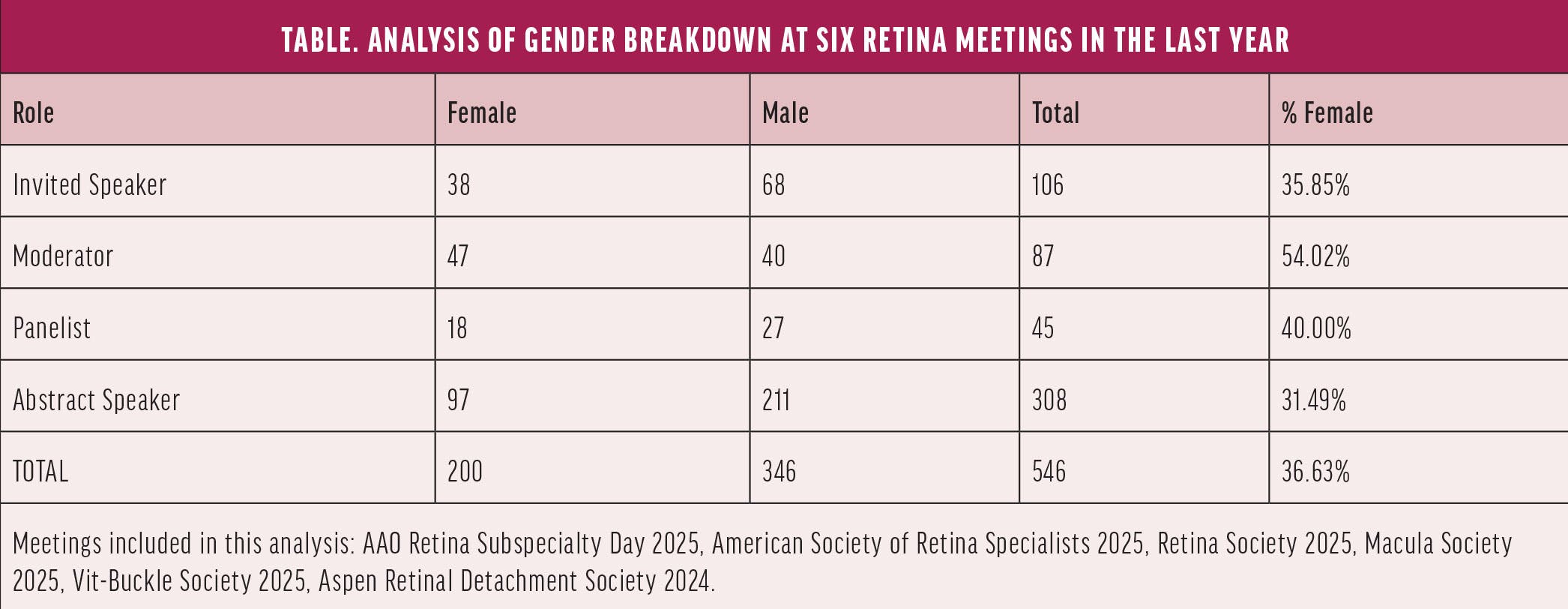
We reviewed recent data from retina meetings in 2025 to provide a present-day snapshot and determine if the number of women on the podium has continued to grow. The meetings included in this analysis were AAO Retina Subspecialty Day, ASRS, Retina Society, Macula Society, Vit-Buckle Society, Aspen Retinal Detachment Society (note that ARDS 2024 data is used instead of 2025, as the 2025 meeting minutes were not yet available). Of the 546 faculty roles at these meetings, women comprised 36.6% of participants, representing meaningful progress toward proportional representation (Table).
The Sridhar et al study documented several important patterns. Women were more likely to serve as invited moderators or panelists (25%) than as paper presenters (21.4%) or non-paper presenters (19.8%).3 While this represented early evidence of intentional diversification efforts in certain roles, the overall numbers remained discouragingly low. Importantly, the study identified a positive trajectory even within that timeframe, with female representation increasing from 19.6% in 2015 to 25.5% in 2019. Abstract presentations showed particular improvement, rising from 19.7% in 2015 to 25.2% in 2019 (P = .045). These trends suggested the field was beginning to address representation disparities, although progress remained slow.3
The leap from 25.5% in 2019 to 36.6% in 2025 highlights an encouraging step forward. This 11% gain in 6 years exceeded the 6% increase observed over the 4 years of the Sridhar et al study, indicating that diversity initiatives may be reaching critical mass and producing amplifying effects.
PUT WOMEN ON THE PLANNING COMMITTEE
Perhaps the most actionable finding from the Sridhar et al analysis was the effect female program committee members had on the meeting itself. Meetings with at least one woman on the program committee were significantly more likely to include female non-paper presenters (P = .02), moderators or panelists (P = .02), and total women faculty (P < .001).2
This finding illuminates a crucial mechanism: Diversifying the decision-makers who select conference faculty directly influences the diversity of those selected. Program committees with female members appear to access broader professional networks, counteract unconscious bias, and create environments where qualified women are more likely to be invited and accepted.
DIVERSITY BEYOND THE PODIUM
Increasing female representation in retina is crucial to recruiting more women to our field. Our findings suggest we have achieved parity in representation at retina meetings; however, the proportion of female faculty at meetings reflects the low overall proportion of female retina specialists. The focus must now shift to recruitment. According to the Association of American Medical Colleges, 52% of medical school graduates were women in 2023.4 Women constitute approximately 40% of ophthalmology residents, yet only 25% of retina fellows are women.
Ensuring women are part of the leadership team at retina conferences and within academic departments gives medical students and residents female role models in retina they can emulate.
MENTORING A MORE DIVERSE FUTURE
While gender diversity has shown measurable progress, tracking minority representation in retina presents a different challenge. Studies have shown that patients from underserved backgrounds are more likely to seek care from providers that share a similar cultural context.5 Further, providers from underserved backgrounds are more likely to serve the communities they represent.6 Training a diverse retina workforce is integral to providing equitable and culturally competent care.
Approximately 20% of medical school attendees identify as underrepresented minorities in medicine (URiM).7 Data from a study assessing trends in racial diversity among US ophthalmology residents showed that fewer than 7% of URiM medical students became ophthalmology residents in the 2019–2020 academic year.7 Of 18 medical and surgical specialties assessed in the study, ophthalmology ranked lowest in the number of residents who identified as URiM.
Programs such as the Minority Ophthalmology Mentoring program (sponsored by the AAO and Association of University Professors of Ophthalmology) and the Rabb-Venable Foundation give URiM students the opportunity to identify mentors who will help them navigate the challenging residency match cycle and provide research and shadowing opportunities.8,9 Recent data from the 2025 San Francisco Match signals that these mentoring efforts are successfully promoting interest among URiM medical students. In last year’s ophthalmology residency match, approximately 15% of matched applicants identified as URiM, a considerable increase from just 7% in 2020.2
With the AAO leading by example, retina societies have started to promote similar mentorship programs. The ASRS launched the Empowerment and Opportunity Mentoring Program in 2022 to offer mentorship opportunities for URiM and LGBTQIA+ trainees. The Retina Society launched its RESOURCE mentoring program in 2022, with the goal of sponsoring research among URiM residents and providing mentorship in their future careers as retina specialists.
Survey data from the ASRS DEI ad-hoc committee estimates that approximately 3.2% of current retina specialists identify as URiM physicians.10 A recent analysis of the 2025 retina fellowship match data by Garg et al suggests that 6.8% of the latest retina applicant class identified as URiM.11 These numbers highlight a positive trend and suggest mentoring efforts at the medical school and residency level may affect the future composition of our field.
Whether increased URiM representation within retina will eventually be reflected in its leadership remains to be seen. Our ability to assess the number of URiM speakers on the podium is hampered by our access to race, ethnicity, and gender data—and without good data, we are unable to track outcomes. The URiM checkbox was eliminated from the ophthalmology residency application in 2025 due to concerns with the legality of this question in conservative states. Losing this data point undermines our ability to track our progress toward a more diverse future and limits our capacity to assess and support the programs that bolster that goal. We echo the ASRS’ request for members to update the “Background” section of their profile so that we can continue to evaluate our efforts toward proportional leadership representation.
WHY THIS MATTERS
The case for diverse conference representation extends far beyond checkbox diversity initiatives. When women and URiM physicians see themselves reflected in conference faculty, it signals belonging and potential. Research across medical specialties has demonstrated that visible representation influences career trajectories. Trainees are more likely to pursue academic careers and leadership roles when they see diverse role models in prominent positions.
The absence of diversity at high-profile meetings perpetuates implicit bias and maintains barriers to advancement. When program committees repeatedly draw from the same networks, they inadvertently exclude talented physicians whose contributions could advance the field. Beyond individual effect, diverse panels produce better discussions.
More women have taken leadership roles at retina meetings and shifts within the retina fellowship applicant pool promise a more diverse future. As we approach an inflection point toward greater inclusion, we cannot become complacent. Our specialty treats a diverse patient population; our scientific discourse should reflect that breadth of experience and insight. Breaking these patterns requires intentional effort and sustained commitment.
1. Reeves M-GR, Pasricha MV, Ludwig CA, et al. Trends in leadership and award recognition among women in the American Society of Retina Specialists. J Vitreoretin Dis. 2021;6:374-380.
2. San Francisco Match Results 2025. General Report. Personal Correspondence. November 2025.
3. Sridhar J, Kuriyan AE, Yonekawa Y, et al. Representation of women in vitreoretinal meeting faculty roles from 2015 through 2019. Am J Ophthalmol. 2021;221:131-136.
4. The state of women in academic medicine: progressing toward equity, 2023-2024. Association of American Medical Colleges. 2024.
5. Saha S, Taggart SH, Komaromy M, Bindman AB. Do patients choose physicians of their own race? Health Aff (Millwood). 2000;19:76-83.
6. Marrast LM, Zallman L, Woolhandler S, et al. Minority physicians’ role in the care of underserved patients: diversifying the physician workforce may be key in addressing health disparities. JAMA Intern Med. 2014;174:289-291.
7. Atkuru A, Lieng MK, Emami-Naeini P. Trends in racial diversity among united states ophthalmology residents. Ophthalmology. 2022;129:957-959.
8. Olivier MMG, Forster S, Carter KD, et al. Lighting a pathway: the minority ophthalmology mentoring program. Ophthalmology. 2020;127:848-851.
9. Knight OJ, Padovani-Claudio DA, Croteau-Chonka CC, et al. Rabb–Venable Excellence in Ophthalmology Research Program: contributions to ophthalmology workforce diversity. J Acad Ophthalmol (2017). 2021;13(2):e298-e303.
10. American Society of Retina Specialists. Demographic Information. November 2025. Accessed January 14, 2025. www.asrs.org/sections/dei-ad-hoc-committee/demographic-information
11. Garg AK, Khan MJ, Rustam Z, et al. Demographic trends in the retina fellowship match [poster abstract]. Association of University Professors of Ophthalmology Annual Meeting; February 4-7; San Diego.


_1773249222.png?auto=compress,format&w=70)


_1784132761.jpg?auto=compress,format&w=75)





